

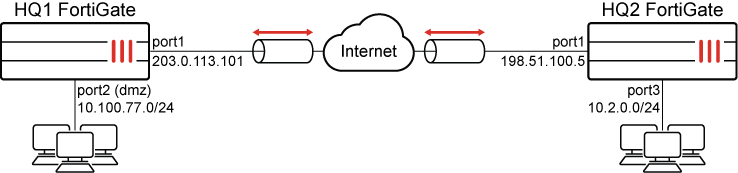
This example shows how to configure a basic site-to-site IPsec tunnel between two FortiGates. This IKEv2 tunnel will use a pre-shared key to authenticate. Only traffic from the local subnets are permitted through the tunnel.

|
Individual options may vary. However, in order for the tunnel to come up, options configured on one FortiGate should be identical to the other. For more information on IPsec settings, see Phase 1 configuration and Phase 2 configuration. |
To configure an IPsec VPN using the VPN Wizard in the GUI:
-
Configure the HQ1 FortiGate.
-
Go to VPN > VPN Wizard and configure the following settings for VPN Setup:
-
Enter a VPN name in the Tunnel name field. In this example, HQ2B2.
-
From the Select a template options, select Site to Site.
-
Click Begin.
-
-
Configure the Remote Site:
-
For Remote site device type, select FortiGate.
-
For Remote site device, select Accessible and static.
-
For the IP address, enter 198.51.100.5.
-
For Remote site subnets that can access VPN, enter 10.2.0.0/24.
-
Click Next.
-
-
Configure the VPN tunnel:
-
For Authentication Method, select Pre-shared Key.
-
In the Pre-shared Key field, enter your key.
-
For IKE, select Version 2.
-
For Transport, select Auto. Leave the Use Fortinet encapsulation option toggled off.
-
For NAT traversal, select Enable.
-
For Keepalive frequency, enter 10.
-
-
Configure the Local Site:
-
For Outgoing interface that binds to tunnel, select the WAN interface. In this example, port1. Disable the Create and add interface to zone toggle, if you do not want a zone created.
-
For Local Interface, select an interface from the Select Entries slide-out panel. In this example, port2.
-
The Local subnets that can access VPN field should automatically fill with the IP address related to the selected local interface (10.100.77.0/24).
-
Leave the Allow remote site’s internet traffic through this device toggle disabled.
-
Click Next.
-
-
Review the configuration and click Submit.
-
-
Configure the HQ2 FortiGate
-
Go to VPN > VPN Wizard and configure the following settings for VPN Setup:
-
Enter a VPN name in the Tunnel name field. In this example, B2toHQ.
-
From the Select a template options, select Site to Site.
-
Click Begin.
-
-
Configure the Remote Site:
-
For Remote site device type, select FortiGate.
-
For Remote site device, select Accessible and static.
-
For the IP address, enter 203.0.113.101.
-
For Remote site subnets that can access VPN, enter 10.100.77.0/24.
-
Click Next.
-
-
Configure the VPN tunnel:
-
For Authentication Method, select Pre-shared Key.
-
In the Pre-shared Key field, enter your key.
-
For IKE, select Version 2.
-
For Transport, select Auto. Leave the Use Fortinet encapsulation option toggled off.
-
For NAT traversal, select Enable.
-
For Keepalive frequency, enter 10.
-
-
Configure the Local Site:
-
For Outgoing interface that binds to tunnel, select the WAN interface. In this example, port1. Leave the Create and add interface to zone toggle enabled.
-
For Local Interface, select an interface from the Select Entries slide-out panel. In this example, port3.
-
The Local subnets that can access VPN field should automatically fill with the IP address related to the selected local interface (10.2.0.0/24).
-
Leave the Allow remote site’s internet traffic through this device toggle disabled.
-
Click Next.
-
-
Verify the VPN tunnel configurations created in the VPN Wizard
Verify the VPN tunnel configurations for HQ1 and HQ2 created in the VPN Wizard using the CLI.
Verify the HQ1 configuration
config firewall address
    edit "HQ2B2_local_subnet_0"
        set allow-routing enable
        set subnet 10.100.77.0 255.255.255.0
    next
    edit "HQ2B2_remote_subnet_0"
        set allow-routing enable
        set subnet 10.2.0.0 255.255.255.0
    next
end
config firewall addrgrp
edit "HQ2B2_local"
set allow-routing enable
set member "HQ2B2_local_subnet_0"
set comment "VPN: HQ2B2 -- Created by VPN wizard"
next
edit "HQ2B2_remote"
set allow-routing enable
set member "HQ2B2_remote_subnet_0"
set comment "VPN: HQ2B2 -- Created by VPN wizard"
next
endconfig vpn ipsec phase1-interface
edit "HQ2B2"
set interface "port1"
set ike-version 2
set peertype any
set net-device disable
set proposal aes128-sha256 aes256-sha256 aes128gcm-prfsha256 aes256gcm-prfsha384 chacha20poly1305-prfsha256
set comments "VPN: HQ2B2 -- Created by VPN wizard"
set wizard-type static-fortigate
set remote-gw 198.51.100.5
set psksecret ENC <encrypted key>
next
endconfig vpn ipsec phase2-interface
edit "HQ2B2"
set phase1name "HQ2B2"
set proposal aes128-sha1 aes256-sha1 aes128-sha256 aes256-sha256 aes128gcm aes256gcm chacha20poly1305
set comments "VPN: HQ2B2 -- Created by VPN wizard"
set src-addr-type name
set dst-addr-type name
set src-name "HQ2B2_local"
set dst-name "HQ2B2_remote"
next
endconfig router static
edit 14
set device "HQ2B2"
set comment "VPN: HQ2B2 -- Created by VPN wizard"
set dstaddr "HQ2B2_remote"
next
edit 16
set distance 254
set comment "VPN: HQ2B2 -- Created by VPN wizard"
set blackhole enable
set dstaddr "HQ2B2_remote"
set vrf 0
next
endconfig firewall policy
edit 29
set name "vpn_HQ2B2_local"
set srcintf "port2"
set dstintf "HQ2B2"
set action accept
set srcaddr "HQ2B2_local"
set dstaddr "HQ2B2_remote"
set schedule "always"
set service "ALL"
set comments "VPN: HQ2B2 -- Created by VPN wizard"
next
edit 32
set name "vpn_HQ2B2_remote"
set srcintf "HQ2B2"
set dstintf "port2"
set action accept
set srcaddr "HQ2B2_remote"
set dstaddr "HQ2B2_local"
set schedule "always"
set service "ALL"
set comments "VPN: HQ2B2 -- Created by VPN wizard"
next
end
Verify the HQ2 configuration
config firewall address
    edit "B2toHQ_local_subnet_0"
        set allow-routing enable
        set subnet 10.2.0.0 255.255.255.0
    next
    edit "B2toHQ_remote_subnet_0"
        set allow-routing enable
        set subnet 10.100.77.0 255.255.255.0
    next
end
config firewall addrgrp
edit "B2toHQ_local"
set allow-routing enable
set member "B2toHQ_local_subnet_0"
set comment "VPN: B2toHQ -- Created by VPN wizard"
next
edit "B2toHQ_remote"
set allow-routing enable
set member "B2toHQ_remote_subnet_0"
set comment "VPN: B2toHQ -- Created by VPN wizard"
next
endconfig vpn ipsec phase1-interface
edit "B2toHQ"
set interface "port1"
set ike-version 2
set peertype any
set net-device disable
set proposal aes128-sha256 aes256-sha256 aes128gcm-prfsha256 aes256gcm-prfsha384 chacha20poly1305-prfsha256
set comments "VPN: B2toHQ -- Created by VPN wizard"
set wizard-type static-fortigate
set remote-gw 203.0.113.101
set psksecret ENC <encrypted key>
next
endconfig vpn ipsec phase2-interface
edit "B2toHQ"
set phase1name "B2toHQ"
set proposal aes128-sha1 aes256-sha1 aes128-sha256 aes256-sha256 aes128gcm aes256gcm chacha20poly1305
set comments "VPN: B2toHQ -- Created by VPN wizard"
set src-addr-type name
set dst-addr-type name
set src-name "B2toHQ_local"
set dst-name "B2toHQ_remote"
next
endconfig firewall policy
edit 5
set name "vpn_B2toHQ_local"
set uuid dbc31212-9326-51ef-fea3-ea8cb4e2a064
set srcintf "port3"
set dstintf "B2toHQ"
set action accept
set srcaddr "B2toHQ_local"
set dstaddr "B2toHQ_remote"
set schedule "always"
set service "ALL"
set comments "VPN: B2toHQ -- Created by VPN wizard"
next
edit 6
set name "vpn_B2toHQ_remote"
set uuid dbc58e3e-9326-51ef-1896-d5d2f3c1932d
set srcintf "B2toHQ"
set dstintf "port3"
set action accept
set srcaddr "B2toHQ_remote"
set dstaddr "B2toHQ_local"
set schedule "always"
set service "ALL"
set comments "VPN: B2toHQ -- Created by VPN wizard"
next
endconfig router static
edit 7
set device "B2toHQ"
set comment "VPN: B2toHQ -- Created by VPN wizard"
set dstaddr "B2toHQ_remote"
next
edit 9
set distance 254
set comment "VPN: B2toHQ -- Created by VPN wizard"
set blackhole enable
set dstaddr "B2toHQ_remote"
set vrf 0
next
end
Testing the tunnel
To verify a tunnel is established, go to Dashboard > Network and open the IPsec widget. You can also use the following CLI command to verify the tunnel is established:
# diagnose vpn ike gateway list name <tunnel>
Verify the HQ1 tunnel
-
Go to Dashboard > Network and open the IPsec widget.
-
Look for the newly created tunnel, in this example, HQ2B2, and hover the cursor over the tunnel name and observe additional details.
-
From the CLI, run the
diagnose vpn ike gateway list name HQ2B2command and observe the output: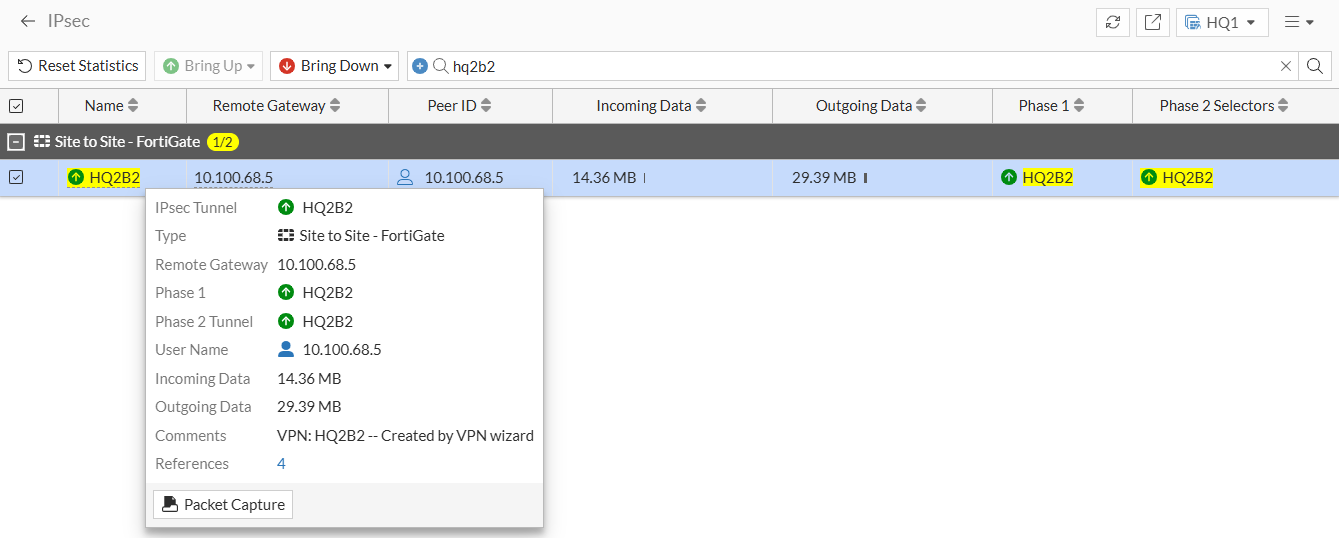
vd: root/0
name: HQ2B2
version: 2
interface: port1 3
addr: 203.0.113.101:500 -> 198.51.100.5:500
tun_id: 198.51.100.5/::198.51.100.5
remote_location: 0.0.0.0
network-id: 0
transport: UDP
created: 852804s ago
peer-id: 198.51.100.5
peer-id-auth: no
pending-queue: 0
PPK: no
IKE SA: created 1/11  established 1/11  time 0/820/9010 ms
IPsec SA: created 1/21  established 1/21  time 0/433/9010 ms
id/spi: 8895 45e69522bd784183/69be2940ae314677
direction: responder
status: established 77898-77898s ago = 0ms
proposal: aes128-sha256
child: yes
SK_ei: 07446ef38bd406fa-18e45bec886a2bd3
SK_er: b940f4338b27f369-7beaa308b7241a1b
SK_ai: 61eeb720d062c70b-e606340beab6f9d5-3a4da2966373ab15-e5766540cf6c7dd1
SK_ar: bbdd888b98dbda7b-669da7a726ce2148-3f08940f802f580c-52b6ef93f48672aa
message-id sent/recv: 0/1783
QKD: no
lifetime/rekey: 86400/8231
DPD sent/recv: 00000000/00000000
peer-id: 198.51.100.5
HQ1 acted as the responder, and established the tunnel with remote peer 198.51.100.5 over UDP/500.
Verify the HQ2 tunnel
-
Go to Dashboard > Network and open the IPsec widget.
-
Look for the newly created tunnel, in this example, B2toHQ, and hover the cursor over the tunnel name and observe additional details.
-
From the CLI, run the
diagnose vpn ike gateway list name B2toHQcommand and observe the output:vd: root/0 name: B2toHQ version: 2 interface: port1 3 addr: 198.51.100.5:500 -> 203.0.113.101:500 tun_id: 203.0.113.101/::203.0.113.101 remote_location: 0.0.0.0 network-id: 0 transport: UDP created: 853181s ago peer-id: 203.0.113.101 peer-id-auth: no pending-queue: 0 PPK: no IKE SA: created 1/11 established 1/11 time 0/5/10 ms IPsec SA: created 1/21 established 1/21 time 0/0/10 ms
id/spi: 5788 45e69522bd784183/69be2940ae314677
direction: initiator
status: established 78281-78281s ago = 10ms
proposal: aes128-sha256
child: yes
SK_ei: 07446ef38bd406fa-18e45bec886a2bd3
SK_er: b940f4338b27f369-7beaa308b7241a1b
SK_ai: 61eeb720d062c70b-e606340beab6f9d5-3a4da2966373ab15-e5766540cf6c7dd1
SK_ar: bbdd888b98dbda7b-669da7a726ce2148-3f08940f802f580c-52b6ef93f48672aa
message-id sent/recv: 1792/0
QKD: no
lifetime/rekey: 86400/7818
DPD sent/recv: 00001ed7/00001ed7
peer-id: 203.0.113.101
HQ2 acted as the initiator, and established the tunnel with remote peer 203.0.113.101 over UDP/500.
Verifying traffic flow
Send traffic from PC1 10.100.77.101 to the 10.2.0.0/24 network and verify traffic goes through.
Verify traffic on PC1 (10.100.77.101)
root@dmz-public-server:~# ping 10.2.0.7
PING 10.2.0.7 (10.2.0.7) 56(84) bytes of data.
64 bytes from 10.2.0.7: icmp_seq=1 ttl=62 time=9.84 ms
64 bytes from 10.2.0.7: icmp_seq=2 ttl=62 time=0.808 ms
Verify traffic on HQ1
In the CLI, run diagnose sniffer packet any 'host 10.2.0.7' 4 0 l and observe the output:
HQ1 # diag sniffer packet any 'host 10.2.0.7' 4 0 l
Using Original Sniffing Mode
interfaces=[any]
filters=[host 10.2.0.7]
2024-11-05 12:06:05.509027 port2 in 10.100.77.101 -> 10.2.0.7: icmp: echo request
2024-11-05 12:06:05.509074 HQ2B2 out 10.100.77.101 -> 10.2.0.7: icmp: echo request
2024-11-05 12:06:05.518607 HQ2B2 in 10.2.0.7 -> 10.100.77.101: icmp: echo reply
2024-11-05 12:06:05.518632 port2 out 10.2.0.7 -> 10.100.77.101: icmp: echo reply
The ICMP request is received on port2 and routed to the HQ2B2 tunnel. The ICMP reply is received on the HQ2B2 tunnel and routed back out port2.
Verify traffic on HQ2
In the CLI, run diagnose sniffer packet any 'host 10.100.77.101' 4 0 l and observe the output:
HQ2 # diag sniffer packet any 'host 10.100.77.101' 4 0 l
Using Original Sniffing Mode
interfaces=[any]
filters=[host 10.100.77.101]
2024-11-05 12:06:05.509711 B2toHQ in 10.100.77.101 -> 10.2.0.7: icmp: echo request
2024-11-05 12:06:05.509791 port3 out 10.100.77.101 -> 10.2.0.7: icmp: echo request
2024-11-05 12:06:05.518809 port3 in 10.2.0.7 -> 10.100.77.101: icmp: echo reply
2024-11-05 12:06:05.518899 B2toHQ out 10.2.0.7 -> 10.100.77.101: icmp: echo reply
The ICMP request is received on the B2toHQ tunnel and routed to port3. The ICMP reply is received on port3 and routed back out the B2toHQ tunnel.