

Example SD-WAN overlay placeholders using ADVPN 2.0
In a typical hub and spoke SD-WAN configuration, the hub uses the same underlay transports as the spokes. However, in unique circumstances, spokes may use different transports than the hub. For example, spokes may have direct MPLS connections that are not connected to the hub. Hubs are not necessarily connected to all the same underlay transports as spokes. In these instances, ADVPN 2.0 can use overlay placeholders to trigger shortcuts between spokes over transports to which hubs are not connected. Once the regular shortcut and placeholder shortcuts are established, SD-WAN will steer traffic based on the service rule, such as which link has the best quality.
In this SD-WAN example, the Hub, Spoke-1, and Spoke-2 all have broadband WAN connections. However, Spoke-1 and Spoke-2 have an additional MPLS connection between them. With ADVPN 2.0 enabled, Spoke-1 and Spoke-2 have regular parent tunnels (H1_T11) to the Hub. Spoke-1 and Spoke-2 also have placeholder parent tunnels configured (Placeholder_MPLS_1), where auto-discovery-dialup-placeholder is enabled and remote-gateway isn't statically specified. As a placeholder tunnel, no connection is established between the spoke and the hub. Instead, the tunnel interface is utilized in the SD-WAN configurations as if it were a regular overlay because shortcuts can be established between spokes in a placeholder overlay.
Traffic is sent from PC-1 to PC-2. This traffic matches an SD-WAN rule that include two interfaces: a VPN tunnel to the Hub, and a placeholder tunnel. As only the first tunnel is alive, the first bit of traffic goes through this tunnel to the Hub and triggers SHORTCUT_QUERY/SHORTCUT_REPLY exchange with the Hub. When Spoke-1 receives SHORTCUT_REPLY message, which includes WAN and SD-WAN information about Spoke-2's eligible shortcut interfaces, Spoke-1 calculates and creates the shortcut between regular parent tunnels and triggers a shortcut between the placeholder parent tunnels too.
As the SHORTCUT_REPLY from the Hub contains additional information for a second WAN interface on Spoke-2, a SHORTCUT_QUERY is triggered on Spoke-1 to see if another shortcut can be established. This SHORTCUT_QUERY utilizes the H1_T11 tunnel to facilitate the SHORTCUT_QUERY/SHORTCUT_REPLY exchange with the Hub.
Health-checks, which are automatically running on the regular shortcut and the placeholder shortcut, help decide which interface to use for forwarding the remaining traffic.
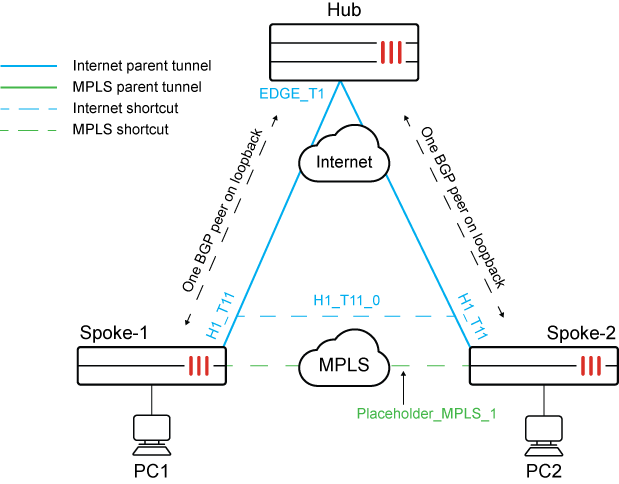
Settings on the spoke relevant to the example:
config vpn ipsec phase1-interface
    edit <placeholder_phase1_interface_name>
        set type dynamic
        ...
        set net-device enable
        ...
        set auto-discovery-dialup-placeholder enable
    next
end
To enable overlay placeholder tunnels on Spoke-1 and Spoke-2:
-
Configure key components on Spoke-1:
-
Configure a parent tunnel and a placeholder tunnel:
Tunnel H1_T11 is the parent tunnel, and tunnel Placeholder_MPLS_1 is the placeholder tunnel:
config vpn ipsec phase1-interface edit "H1_T11" set interface "port1" set ike-version 2 set keylife 28800 set peertype any set net-device enable set exchange-ip-addr4 172.31.0.65 set proposal aes256gcm-prfsha384 set add-route disable set dpd on-idle set idle-timeout enable set idle-timeoutinterval 5 set auto-discovery-receiver enable set encapsulation vpn-id-ipip set network-overlay enable set network-id 11 set transport udp set remote-gw 172.31.1.1 set psksecret ENC fRkYaHGx3MoAASxMsHoJSObbOfphOmBntEpKhZAY8/9OjjqJxbmTehe4Z7LOGTvjFRXTULiPBkfPupnr0JtBo0KJb0IoUfJ8zWU3mJttCyfHNaDBXG/t5d0D93iu3ZlRoSs1EBRD7KX5fO1QnSHm0maXTJZzrKLWVSaRztdOF246z/RbEXFzlm4+64ccLHG/3X/Ha1lmMjY3dkVA set dpd-retryinterval 5 next edit "Placeholder_MPLS_1" set type dynamic set interface "port3" set ike-version 2 set keylife 28800 set peertype any set net-device enable set exchange-ip-addr4 172.31.0.65 set proposal aes128-sha256 aes256-sha256 aes128gcm-prfsha256 aes256gcm-prfsha384 chacha20poly1305-prfsha256 set add-route disable set dpd on-idle set idle-timeout enable set idle-timeoutinterval 5 set auto-discovery-receiver enable set auto-discovery-dialup-placeholder enable set encapsulation vpn-id-ipip set network-overlay enable set network-id 250 set transport udp set psksecret ENC e3XlBFTNA+fk4Kn7NMLfzJLgU0Pk6ssX9oJ7VSA2Q371x+oqIRSomFhRyZiErb1j07FmGT/lPUFHAB2BJG7vhNIh0SSjEqThai8rIKWqHsIpjHwUAM0/maBzH1iTXZAyjEX0vFiu65QSLAoQzfgXkfX16P82Q1gjIim/GX4phzA+cIYJnfegbqXylFg4fxkqCrYFGFlmMjY3dkVA set dpd-retryinterval 60 next end -
Configure SD-WAN:
Enable ADVPN 2.0 and health-checks for the overlay. Configure the SD-WAN members and their transport groups.
config system sdwan
    set status enable
    config zone
        edit "overlay"
            set advpn-select enable
            set advpn-health-check "HUB"
        next
    end
    config members
        edit 4
            set interface "H1_T11"
            set zone "overlay"
            set source 172.31.0.65
            set priority 10
            set transport-group 1
        next
        edit 13
            set interface "Placeholder_MPLS_1"
            set zone "overlay"
            set source 172.31.0.65
            set priority 10
            set transport-group 2
        next
    end
    config health-check
        edit "HUB"
            set server "172.31.100.100"
            set members 4 13
            config sla
                edit 1
                    set link-cost-factor latency
                    set latency-threshold 100
                next
            end
        next
    end
    config service
        edit 1
            set name "1"
            set mode sla
            set dst "spoke-2_LAN-1"
            set src "spoke-1_LAN-1"
            config sla
                edit "HUB"
                    set id 1
                next
            end
            set priority-members 4 13
        next
    end
end
-
-
Configure key components on Spoke-2:
-
Configure a parent tunnel and a placeholder tunnel:
Tunnel H1_T11 is the parent tunnel, and tunnel Placeholder_MPLS_1 is the placeholder tunnel:
config vpn ipsec phase1-interface edit "H1_T11" set interface "port1" set ike-version 2 set keylife 28800 set peertype any set net-device enable set exchange-ip-addr4 172.31.0.66 set proposal aes256gcm-prfsha384 set add-route disable set dpd on-idle set idle-timeout enable set idle-timeoutinterval 5 set auto-discovery-receiver enable set encapsulation vpn-id-ipip set network-overlay enable set network-id 11 set transport udp set remote-gw 172.31.1.1 set psksecret ENC 7tP6FktH3z3nIpiGoANS/PbxfMOeLf0KCp65MbG2/yBmeAZz0XXcF9XMbnfBtaWhZhoTnGx086ST1aRmLDxCfVu/BM6S+j1XOUSxSZb6xgwRoaQsFTFaXq/8PYjUzJK7SdPZiJDsCrGaslMR/mTLzFTasA4y9YGteJM+tELW5K0C6Ntrwlq8UnAtrdFMGN/3BrLNyllmMjY3dkVA set dpd-retryinterval 5 next edit "Placeholder_MPLS_1" set type dynamic set interface "port3" set ike-version 2 set keylife 28800 set peertype any set net-device enable set exchange-ip-addr4 172.31.0.66 set proposal aes128-sha256 aes256-sha256 aes128gcm-prfsha256 aes256gcm-prfsha384 chacha20poly1305-prfsha256 set add-route disable set dpd on-idle set idle-timeout enable set idle-timeoutinterval 5 set auto-discovery-receiver enable set auto-discovery-dialup-placeholder enable set encapsulation vpn-id-ipip set network-overlay enable set network-id 250 set transport udp set psksecret ENC Un++iggqXo1wU8fAArjS9JY5rsAcd8+Xw3WR7MtRVLU0BpXT56bAwrP6wQ4gpMt32ABTQ/mAddlq1Mq5LxCV0X+lYaxj2vVIulTb1n71Wn1WeTbDXjiTzDbrMnp4fM9+1uBKwy+RJ+u782IpI9WRhCWE/H4LNgZhYzUmyluTCouNoBpJyzdJrekAXOtSvxLJfju/7FlmMjY3dkVA set dpd-retryinterval 60 next end -
Configure SD-WAN:
Enable ADVPN 2.0 and health-checks for the overlay. Configure the SD-WAN members and their transport groups. The internet overlay (H1_T11) is added to transport group 1, and the MPLS overlay (Placeholder_MPLS_1) is added to transport group 2.
config system sdwan
    set status enable
    config zone
        edit "overlay"
            set advpn-select enable
            set advpn-health-check "HUB"
        next
    end
    config members
        edit 4
            set interface "H1_T11"
            set zone "overlay"
            set source 172.31.0.66
            set priority 10
            set transport-group 1
        next
        edit 13
            set interface "Placeholder_MPLS_1"
            set zone "overlay"
            set source 172.31.0.66
            set priority 10
            set transport-group 2
        next
    end
    config health-check
        edit "HUB"
            set server "172.31.100.100"
            set members 4 13
            config sla
                edit 1
                    set link-cost-factor latency
                    set latency-threshold 100
                next
            end
        next
    end
end
-
To check the health status and traffic:
-
Check the health status on Spoke-1 and Spoke-2, and check the SD-WAN status of Spoke-1:
-
Check the health of Spoke-1:
The placeholder tunnel (Placeholder_MPLS_1) is dead.
# diagnose sys sdwan  health-check
Health Check(HUB):
Seq(4 H1_T11): state(alive), packet-loss(0.000%), latency(0.235), jitter(0.011), mos(4.404), bandwidth-up(999998), bandwidth-dw(999998), bandwidth-bi(1999996), sla_map=0x1
Seq(13 Placeholder_MPLS_1): state(dead), packet-loss(100.000%), sla_map=0x0
-
Check the health of Spoke-2:
The placeholder tunnel (Placeholder_MPLS_1) is dead.
# diagnose sys sdwan  health-check
Health Check(HUB):
Seq(4 H1_T11): state(alive), packet-loss(0.000%), latency(0.250), jitter(0.041), mos(4.404), bandwidth-up(999998), bandwidth-dw(999998), bandwidth-bi(1999996), sla_map=0x1
Seq(13 Placeholder_MPLS_1): state(dead), packet-loss(100.000%), sla_map=0x0
-
Check the SD-WAN status of Spoke-1:
# diagnose sys sdwan service4
Service(1): Address Mode(IPV4) flags=0x4200 use-shortcut-sla use-shortcut
 Tie break: cfg
 Shortcut priority: 3
  Gen(21), TOS(0x0/0x0), Protocol(0): src(1->65535):dst(1->65535), Mode(sla), sla-compare-order
  Members(2):
    1: Seq_num(4 H1_T11 overlay), alive, sla(0x1), gid(0), cfg_order(0), local cost(0), selected
    2: Seq_num(13 Placeholder_MPLS_1 overlay), dead, sla(0x0), gid(0), cfg_order(1), local cost(0)
  Src address(1):
        10.0.3.0-10.0.3.255
  Dst address(1):
        10.0.4.0-10.0.4.255
-
-
Send traffic from PC-1 to PC-2:
When Spoke-1 receives
SHORTCUT_REPLYmessage, which includes SD-WAN information about Spoke-2, Spoke-1 calculates and creates the shortcut between regular parent tunnels, and it triggers a shortcut between the placeholder tunnels too.-
Check the health of Spoke-1:
The health-check is automatically running on the regular shortcut (H1_T11_0) and on the placeholder shortcut (Placeholder_MPLS_1_0).
# diagnose sys sdwan  health-check
Health Check(HUB):
Seq(4 H1_T11): state(alive), packet-loss(0.000%), latency(0.239), jitter(0.017), mos(4.404), bandwidth-up(999998), bandwidth-dw(999998), bandwidth-bi(1999996), sla_map=0x1
Seq(4 H1_T11_0): state(alive), packet-loss(0.000%), latency(0.260), jitter(0.010), mos(4.404), bandwidth-up(999999), bandwidth-dw(999999), bandwidth-bi(1999998), sla_map=0x1
Seq(13 Placeholder_MPLS_1): state(dead), packet-loss(100.000%), sla_map=0x0
Seq(13 Placeholder_MPLS_1_0): state(alive), packet-loss(0.000%), latency(0.139), jitter(0.006), mos(4.404), bandwidth-up(1000000), bandwidth-dw(1000000), bandwidth-bi(2000000), sla_map=0x1
-
Check the health of Spoke-2:
The health-check is automatically running on the regular shortcut (H1_T11_0) and on the placeholder shortcut (Placeholder_MPLS_1_0).
# diagnose sys sdwan  health-check
Health Check(HUB):
Seq(4 H1_T11): state(alive), packet-loss(0.000%), latency(0.214), jitter(0.012), mos(4.404), bandwidth-up(999998), bandwidth-dw(999997), bandwidth-bi(1999995), sla_map=0x1
Seq(4 H1_T11_0): state(alive), packet-loss(0.000%), latency(0.296), jitter(0.030), mos(4.404), bandwidth-up(999999), bandwidth-dw(999998), bandwidth-bi(1999997), sla_map=0x1
Seq(13 Placeholder_MPLS_1): state(dead), packet-loss(100.000%), sla_map=0x0
Seq(13 Placeholder_MPLS_1_0): state(alive), packet-loss(0.000%), latency(0.159), jitter(0.023), mos(4.404), bandwidth-up(1000000), bandwidth-dw(1000000), bandwidth-bi(2000000), sla_map=0x1
-
Check the SD-WAN status of Spoke-1:
The regular shortcut (H1_T11_0 overlay) is preferred, because it is the better performing link, as determined by SD-WAN intelligence.
# diagnose sys sdwan service4

Service(1): Address Mode(IPV4) flags=0x4200 use-shortcut-sla use-shortcut
 Tie break: cfg
 Shortcut priority: 3
  Gen(33), TOS(0x0/0x0), Protocol(0): src(1->65535):dst(1->65535), Mode(sla), sla-compare-order
  Member sub interface(4):
    3: seq_num(4), interface(H1_T11):
       1: H1_T11_0(1152)
    4: seq_num(13), interface(dummy_MPLS_1):
       1: dummy_MPLS_1_0(1153)
  Members(4):
    1: Seq_num(4 H1_T11_0 overlay), alive, sla(0x1), gid(0), cfg_order(0), local cost(0), selected
    2: Seq_num(13 Placeholder_MPLS_1_0 overlay), alive, sla(0x1), gid(0), cfg_order(1), local cost(0), selected
    3: Seq_num(4 H1_T11 overlay), alive, sla(0x1), gid(0), cfg_order(0), local cost(0), selected
    4: Seq_num(13 Placeholder_MPLS_1 overlay), dead, sla(0x0), gid(0), cfg_order(1), local cost(0)
  Src address(1):
        10.0.3.0-10.0.3.255
  Dst address(1):
        10.0.4.0-10.0.4.255
-
-
Diagnose the sniffer packet:
The first few packets travel over the regular parent tunnel (H1_T11), and then the packets switch to the regular shortcut tunnel (H1_T11_0).
# diagnose sniffer packet any 'host 10.0.4.2' 4
interfaces=[any]
filters=[host 10.0.4.2]
4.967575 port4 in 10.0.3.2 -> 10.0.4.2: icmp: echo request
4.967976 H1_T11 out 10.0.3.2 -> 10.0.4.2: icmp: echo request
4.969587 H1_T11 in 10.0.4.2 -> 10.0.3.2: icmp: echo reply
4.969629 port4 out 10.0.4.2 -> 10.0.3.2: icmp: echo reply
5.968744 port4 in 10.0.3.2 -> 10.0.4.2: icmp: echo request
5.968838 H1_T11 out 10.0.3.2 -> 10.0.4.2: icmp: echo request
5.969785 H1_T11 in 10.0.4.2 -> 10.0.3.2: icmp: echo reply
5.969842 port4 out 10.0.4.2 -> 10.0.3.2: icmp: echo reply
6.969970 port4 in 10.0.3.2 -> 10.0.4.2: icmp: echo request
6.970187 H1_T11 out 10.0.3.2 -> 10.0.4.2: icmp: echo request
9.969251 port4 in 10.0.3.2 -> 10.0.4.2: icmp: echo request
9.969366 H1_T11_0 out 10.0.3.2 -> 10.0.4.2: icmp: echo request
9.970229 H1_T11_0 in 10.0.4.2 -> 10.0.3.2: icmp: echo reply
9.970278 port4 out 10.0.4.2 -> 10.0.3.2: icmp: echo reply
10.969982 port4 in 10.0.3.2 -> 10.0.4.2: icmp: echo request
10.970199 H1_T11_0 out 10.0.3.2 -> 10.0.4.2: icmp: echo request
-
When the regular shortcut tunnel (H1_T11_0) is out of SLA, traffic switches to the placeholder shortcut tunnel (Placeholder_MPLS_1).
-
Diagnose the SD-WAN service:
The placeholder shortcut tunnel (Placeholder_MPLS_1) is preferred, and the regular shortcut tunnel (H1_T11_0 overlay) is out of SLA.
# diagnose sys sdwan service4 Service(1): Address Mode(IPV4) flags=0x4200 use-shortcut-sla use-shortcut Tie break: cfg Shortcut priority: 3 Gen(87), TOS(0x0/0x0), Protocol(0): src(1->65535):dst(1->65535), Mode(sla), sla-compare-order Member sub interface(4): 2: seq_num(4), interface(H1_T11): 1: H1_T11_0(1167) 4: seq_num(13), interface(Placeholder_MPLS_1): 1: Placeholder_MPLS_1_0(1168) Members(4): 1: Seq_num(13 Placeholder_MPLS_1_0 overlay), alive, sla(0x1), gid(0), cfg_order(1), local cost(0), selected 2: Seq_num(4 H1_T11 overlay), alive, sla(0x1), gid(0), cfg_order(0), local cost(0), selected 3: Seq_num(4 H1_T11_0 overlay), alive, sla(0x0), gid(0), cfg_order(0), local cost(0), selected 4: Seq_num(13 Placeholder_MPLS_1 overlay), dead, sla(0x0), gid(0), cfg_order(1), local cost(0) Src address(1): 10.0.3.0-10.0.3.255 Dst address(1): 10.0.4.0-10.0.4.255 -
Sniff the packet to see the traffic switch to the placeholder shortcut tunnel (Placeholder_MPLS_1_0):
# diagnose sniffer packet any 'host 10.0.4.2' 4
interfaces=[any]
filters=[host 10.0.4.2]

17.356165 port4 in 10.0.3.2 -> 10.0.4.2: icmp: echo request
17.356261 Placeholder_MPLS_1_0 out 10.0.3.2 -> 10.0.4.2: icmp: echo request
17.356857 Placeholder_MPLS_1_0 in 10.0.4.2 -> 10.0.3.2: icmp: echo reply
17.356913 port4 out 10.0.4.2 -> 10.0.3.2: icmp: echo reply
18.361038 port4 in 10.0.3.2 -> 10.0.4.2: icmp: echo request
18.361247 Placeholder_MPLS_1_0 out 10.0.3.2 -> 10.0.4.2: icmp: echo request
-