
Fortinet white logo
Fortinet white logo

Administration Guide

Spoke learns egress shaping value from other spoke over ADVPN shortcut New

Spoke learns egress shaping value from other spoke over ADVPN shortcut New

With peer egress shaping for IPsec tunnels enabled, IKE bandwidth negotiation is used for traffic shaping. This configuration is useful for speed tests of large-scale SD-WAN deployments with thousands of sites using diverse connections (4G/5G, satellite, broadband).

ADVPN spoke-to-spoke shaping evaluates both the local and remote peers' egress shaping values and applies the lower of the two to optimize traffic flow. Additionally, this update enables the synchronization of the peer-egress-shaping-value during ADVPN shortcut reply messages sent to the shortcut initiator. Subsequently, during the regular IPsec negotiation, the initiator shares its shaping value with the responder, allowing shaping to be applied accordingly.

config vpn ipsec phase1-interface
    edit <tunnel_name>
        set ike-version 2
        set peer-egress-shaping {enable | disable}
        set peer-egress-shaping-value <integer>  
    next
end

Command

Description

peer-egress-shaping {enable | disable}

Enable/disable peer egress shaping.

peer-egress-shaping-value <integer>

Configure outbound bandwidth to use for peer egress shaping, in kbps (0 - 80000000, default = 0).

Example

This example shows the configuration of a hub with two spokes.
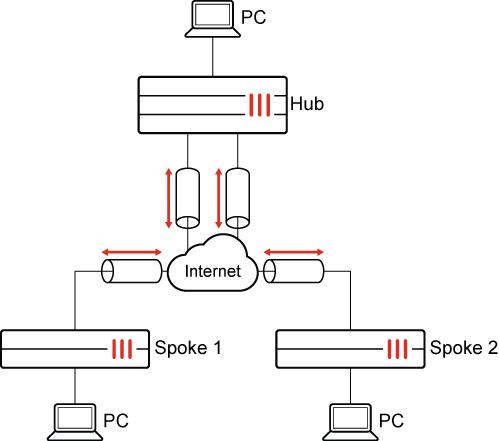
A peer-egress-shaping-value is configured on both Spoke 1 and Spoke 2, and the peer spoke learns the value through ADVPN's shortcut-reply. Subsequently, each spoke applies the egress bandwidth limit to their overlay tunnel.

The IP addresses are as follows:

FortiGate

Interface

IP adress

Spoke1

Port1

172.16.200.1

Spoke1 PC

Port2

10.1.100.1

Spoke2

Port1

172.16.200.3

Spoke2 PC

Port2

192.168.4.3

Hub

Port1

172.16.200.4

Hub PC

Port2

192.168.5.4

The configuration steps are:

  1. Configure the Hub:

    1. Configure the IPsec VPN

    2. Configure the static route

    3. Configure the firewall policies

  2. Configure Spoke1:

    1. Configure the IPsec VPN

    2. Configure the static route

    3. Configure the firewall policies

    4. Configure the shaping class

    5. Configure the shaping profile

    6. Apply shaping profile to Spoke1’s tunnel interface

  3. Configure Spoke2:

    1. Configure the IPsec VPN

    2. Configure the static route

    3. Configure the firewall policies

    4. Configure the shaping class

    5. Configure the shaping profile

    6. Apply shaping profile to Spoke2’s tunnel interface

To configure the hub:
  1. Configure the IPsec VPN:

    config vpn ipsec phase1-interface
        edit "tospokes"
            set type dynamic
            set interface "port1"
            set ike-version 2
            set peertype any
            set net-device disable
            set mode-cfg enable
            set proposal aes128-sha256 aes256-sha256 aes128gcm-prfsha256 aes256gcm-prfsha384 chacha20poly1305-prfsha256
            set add-route disable
            set dpd on-idle
            set npu-offload disable
            set auto-discovery-sender enable
            set transport auto
            set ipv4-start-ip 100.100.100.10
            set ipv4-end-ip 100.100.100.20
            set ipv4-netmask 255.255.255.0
            set psksecret ******
            set dpd-retryinterval 60
        next
    end
    config vpn ipsec phase2-interface
        edit "tospokes"
            set phase1name "tospokes"
            set proposal aes128-sha1 aes256-sha1 aes128-sha256 aes256-sha256 aes128gcm aes256gcm chacha20poly1305
        next
    end
    
  2. Configure the static route:

    config router static
        edit 1
            set device "tospokes"
        next
    end
    
  3. Configure the firewall policies:

    config firewall policy
        edit 1
            set srcintf "port2"
            set dstintf "tospokes"
            set action accept
            set srcaddr "all"
            set dstaddr "all"
            set schedule "always"
            set service "ALL"
        next
        edit 2
            set srcintf "tospokes"
            set dstintf "port2"
            set action accept
            set srcaddr "all"
            set dstaddr "all"
            set schedule "always"
            set service "ALL"
        next
        edit 3
            set srcintf "tospokes"
            set dstintf "tospokes"
            set action accept
            set srcaddr "all"
            set dstaddr "all"
            set schedule "always"
            set service "ALL"
        next
    end
    
To configure spoke1:
  1. Configure the IPsec VPN:

    config vpn ipsec phase1-interface
        edit "tohub-d"
            set interface "port1"
            set ike-version 2
            set peertype any
            set net-device disable
            set peer-egress-shaping enable                
            set peer-egress-shaping-value 500             
            set mode-cfg enable
            set proposal aes128-sha256 aes256-sha256 aes128gcm-prfsha256 aes256gcm-prfsha384 chacha20poly1305-prfsha256
            set add-route disable
            set auto-discovery-shortcuts enable
            set auto-discovery-receiver enable
            set transport auto
            set remote-gw 172.16.200.4
            set psksecret ******
        next
    end
    config vpn ipsec phase2-interface
        edit "tohub-d"
            set phase1name "tohub-d"
            set proposal aes128-sha1 aes256-sha1 aes128-sha256 aes256-sha256 aes128gcm aes256gcm chacha20poly1305
            set auto-negotiate enable
        next
    end
    
  2. Configure the static route:

    config router static
        edit 1
            set device "tohub-d"
        next
    end
    
  3. Configure the firewall policies:

    config firewall policy
        edit 1
            set srcintf "port2"
            set dstintf "tohub-d"
            set action accept
            set srcaddr "all"
            set dstaddr "all"
            set schedule "always"
            set service "ALL"
        next
        edit 2
            set srcintf "tohub-d"
            set dstintf "port2"
            set action accept
            set srcaddr "all"
            set dstaddr "all"
            set schedule "always"
            set service "ALL"
        next
    end
    
  4. Configure the shaping class:

    config firewall traffic-class
        edit 2
            set class-name "class_id_2"
        next
    end
    
  5. Configure the shaping profile:

    config firewall shaping-profile
        edit "spoke_spoke"
            set type policing
            set default-class-id 2
            config shaping-entries
                edit 1
                    set class-id 2
                    set guaranteed-bandwidth-percentage 100
                    set maximum-bandwidth-percentage 100
                next
            end
        next
    end
    
  6. Apply shaping profile to Spoke1’s tunnel interface:

    config system interface
        edit "tospokes"
            set egress-shaping-profile "hub_spoke"
        next
    end
    
    Note

    When configuring egress shaping on a tunnel interface, do not manually set the outbandwidth value. This value is dynamically obtained from the PEER_EGRESS_SHAPING_VALUE for each tunnel and should be left at its default value of 0.

To configure spoke2:
  1. Configure the IPsec VPN:

    config vpn ipsec phase1-interface
        edit "tohub-d"
            set interface "port1"
            set ike-version 2
            set peertype any
            set net-device disable
            set peer-egress-shaping enable           
            set peer-egress-shaping-value 500        
            set mode-cfg enable
            set proposal aes128-sha256 aes256-sha256 aes128gcm-prfsha256 aes256gcm-prfsha384 chacha20poly1305-prfsha256
            set add-route disable
            set auto-discovery-receiver enable
            set auto-discovery-shortcuts dependent
            set transport auto
            set remote-gw 172.16.200.4
            set psksecret ******
        next
    end
    config vpn ipsec phase2-interface
        edit "tohub-d"
            set phase1name "tohub-d"
            set proposal aes128-sha1 aes256-sha1 aes128-sha256 aes256-sha256 aes128gcm aes256gcm chacha20poly1305
            set auto-negotiate enable
        next
    end
    
  2. Configure the static route:

    config router static
        edit 1
            set device "tohub-d"
        next
    end
    
  3. Configure the firewall policies:

    config firewall policy
        edit 1
            set srcintf "port2"
            set dstintf "tohub-d"
            set action accept
            set srcaddr "all"
            set dstaddr "all"
            set schedule "always"
            set service "ALL"
        next
        edit 2
            set srcintf "tohub-d"
            set dstintf "port2"
            set action accept
            set srcaddr "all"
            set dstaddr "all"
            set schedule "always"
            set service "ALL"
        next
    end
    
  4. Configure the shaping class:

    config firewall traffic-class
        edit 2
            set class-name "class_id_2"
        next
    end
    
  5. Configure the shaping profile:

    config firewall shaping-profile
        edit "spoke_spoke"
            set type policing
            set default-class-id 2
            config shaping-entries
                edit 1
                    set class-id 2
                    set guaranteed-bandwidth-percentage 100
                    set maximum-bandwidth-percentage 100
                next
            end
        next
    end
    
  6. Apply shaping profile to Spoke2’s tunnel interface:

    config system interface
        edit "tospokes"
            set egress-shaping-profile "hub_spoke"
        next
    end
    
To verify the configuration:
  1. Verify that traffic can be send from Spoke1 to Spoke2:

    # ping 192.168.4.3
    Pinging 192.168.4.3 with 32 bytes of data:
    Reply from 192.168.4.3: bytes=32 time=2ms TTL=62
    Reply from 192.168.4.3: bytes=32 time=2ms TTL=62
    Reply from 192.168.4.3: bytes=32 time=1ms TTL=62
    Reply from 192.168.4.3: bytes=32 time<1ms TTL=62
    
    Ping statistics for 192.168.4.3:
        Packets: Sent = 4, Received = 4, Lost = 0 (0% loss),
    Approximate round trip times in milli-seconds:
        Minimum = 0ms, Maximum = 2ms, Average = 1ms
    
  2. Check Spoke1 tunnel shaping:

    # diagnose vpn tunnel list | grep -A 5 "egress traffic control"
    egress traffic control:
            bandwidth=500(kbps) lock_hit=1 default_class=2 n_active_class=1
            class-id=2      allocated-bandwidth=500(kbps)   guaranteed-bandwidth=500(kbps)
                            max-bandwidth=500(kbps)         current-bandwidth=1(kbps)
                            priority=high   forwarded_bytes=84
                            dropped_packets=0       dropped_bytes=0 
    
  3. Check Spoke2 tunnel shaping:

    # diagnose vpn tunnel list | grep -A 5 "egress traffic control"
    egress traffic control:
            bandwidth=500(kbps) lock_hit=0 default_class=2 n_active_class=1
            class-id=2      allocated-bandwidth=500(kbps)   guaranteed-bandwidth=500(kbps)
                            max-bandwidth=500(kbps)         current-bandwidth=1(kbps)
                            priority=high   forwarded_bytes=824
                            dropped_packets=0       dropped_bytes=0 
    
  4. Confirm IKE negotiation on Spoke1:

    # diagnose debug application ike -1
    ike V=root:0:tohub-d:7: received informational request 
    ike V=root:0:tohub-d:7: processing notify type SHORTCUT_REPLY 
    ike V=root:0:tohub-d: recv shortcut-reply 3150081142027665143 6cb78f05ef0079bc/11b6b9160e729839 172.16.200.3 to 10.1.100.11 0 psk 64 ppk 0 ver 2 mode 0 ext-mapping 172.16.200.3:0, network-id 0/0 shaping=500 
    ike V=root:0:tohub-d: iif 48 192.168.4.33->10.1.100.11 0 route lookup oif 8 port2 gwy 0.0.0.0 
    ike V=root:0:tohub-d: shortcut-reply received from 172.16.200.3:500, local-nat=no, peer-nat=no 
    ike V=root:0:tohub-d:tohub-d: created connection: 0x55c5c21d3860 7 172.16.200.1->172.16.200.3:500. ike V=root:0:tohub-d: adding new dynamic tunnel for 172.16.200.3:500 
    ike V=root:0:tohub-d_0: tunnel created tun_id 172.16.200.3/::172.16.200.3 remote_location 0.0.0.0 
    ike V=root:0:tohub-d_0: added new dynamic tunnel for 172.16.200.3:500 
    ike V=root:0:tohub-d_0: shortcut selector added new 1 a203
    ...
    ike V=root:0:tohub-d_0:10: initiator received AUTH msg 
    ike V=root:0:tohub-d_0:10: peer identifier IPV4_ADDR 172.16.200.3 
    ike V=root:0:tohub-d_0:10: auth verify done 
    ike V=root:0:tohub-d_0:10: initiator AUTH continuation 
    ike V=root:0:tohub-d_0:10: authentication succeeded 
    ike V=root:0:tohub-d_0:10: processing notify type MESSAGE_ID_SYNC_SUPPORTED 
    ike V=root:0:tohub-d_0:10: processing notify type INTERFACE_ADDR4 
    ike V=root:0:tohub-d_0:10: INTERFACE-ADDR4 100.100.100.11 
    ike V=root:0:tohub-d_0:10: processing notify type PEER_EGRESS_SHAPING_VALUE 
    ike V=root:0:tohub-d_0:10: received peer egress shaping value=500 
    ike V=root:0:tohub-d_0:10: established IKE SA 6cb78f05ef0079bc/11b6b9160e729839 
    ike V=root:0:tohub-d_0:10: auto-discovery receiver 
    ike V=root:0:tohub-d_0:10: auto-discovery 2 
    ike V=root:0:tohub-d_0:10: check peer route: if_addr4_rcvd=1, if_addr6_rcvd=0, mode_cfg=0 
    ike V=root:0:tohub-d_0:10: update peer route 0.0.0.0 -> 100.100.100.11 
    ike V=root:0:tohub-d_0: add peer static route 100.100.100.11 via 172.16.200.3 dev tohub-d_0 
    ike V=root:0:tohub-d: schedule auto-negotiate
    ...   
    
  5. Confirm IKE negotiation on Spoke2:

    # diagnose debug application ike -1 
    ike V=root:0:tohub-d:7: processing notify type SHORTCUT_QUERY 
    ike V=root:0:tohub-d: recv shortcut-query 3150081142027665143 6cb78f05ef0079bc/0000000000000000 172.16.200.1 10.1.100.11:2048->192.168.4.33:0 0 psk 64 ppk 0 ttl 31 nat 0 ver 2 mode 0 network-id 0 ike V=root:0:tohub-d: iif 46 10.1.100.11->192.168.4.33 0 route lookup oif 8 port2 gwy 0.0.0.0 ike V=root:0:tohub-d: shortcut-query received from 172.16.200.1:500, local-nat=no, peer-nat=no 
    ike 0:6cb78f05ef0079bc/11b6b9160e729839:8: out FF 
    ike V=root:0:ff00000000000000/2100000000000000:f32a0000:8: sent 
    IKE msg (keepalive): 172.16.200.3:500->172.16.200.1:500, len=1, vrf=0, id=ff00000000000000/2100000000000000:f32a0000, oif=7 
    ike V=root:0:tohub-d: send vwl advpn-info request (0x763f04e2) for intf tohub-d ike V=root:0:tohub-d: send vwl request error: No such file or directory 
    ike V=root:0:tohub-d: send shortcut-reply 3150081142027665143 6cb78f05ef0079bc/11b6b9160e729839 172.16.200.3 to 10.1.100.11 0 psk 64 ppk 0 ver 2 mode 0 network-id 0/0 shaping=500
    …
    ike V=root:0:tohub-d:8: responder received AUTH msg 
    ike V=root:0:tohub-d:8: processing notify type INITIAL_CONTACT 
    ike V=root:0:tohub-d:8: processing notify type INTERFACE_ADDR4 
    ike V=root:0:tohub-d:8: INTERFACE-ADDR4 100.100.100.10 
    ike V=root:0:tohub-d:8: processing notify type MESSAGE_ID_SYNC_SUPPORTED 
    ike V=root:0:tohub-d:8: processing notify type PEER_EGRESS_SHAPING_VALUE 
    ike V=root:0:tohub-d:8: received peer egress shaping value=500 
    ike V=root:0:tohub-d:8: peer identifier IPV4_ADDR 172.16.200.1 
    ike V=root:0:tohub-d:8: auth verify done 
    ike V=root:0:tohub-d:8: responder AUTH continuation 
    ike V=root:0:tohub-d:8: authentication succeeded 
    ike V=root:0:tohub-d:8: responder creating new child
    …
    

Spoke learns egress shaping value from other spoke over ADVPN shortcut New

Spoke learns egress shaping value from other spoke over ADVPN shortcut New

With peer egress shaping for IPsec tunnels enabled, IKE bandwidth negotiation is used for traffic shaping. This configuration is useful for speed tests of large-scale SD-WAN deployments with thousands of sites using diverse connections (4G/5G, satellite, broadband).

ADVPN spoke-to-spoke shaping evaluates both the local and remote peers' egress shaping values and applies the lower of the two to optimize traffic flow. Additionally, this update enables the synchronization of the peer-egress-shaping-value during ADVPN shortcut reply messages sent to the shortcut initiator. Subsequently, during the regular IPsec negotiation, the initiator shares its shaping value with the responder, allowing shaping to be applied accordingly.

config vpn ipsec phase1-interface
    edit <tunnel_name>
        set ike-version 2
        set peer-egress-shaping {enable | disable}
        set peer-egress-shaping-value <integer>  
    next
end

Command

Description

peer-egress-shaping {enable | disable}

Enable/disable peer egress shaping.

peer-egress-shaping-value <integer>

Configure outbound bandwidth to use for peer egress shaping, in kbps (0 - 80000000, default = 0).

Example

This example shows the configuration of a hub with two spokes.

A peer-egress-shaping-value is configured on both Spoke 1 and Spoke 2, and the peer spoke learns the value through ADVPN's shortcut-reply. Subsequently, each spoke applies the egress bandwidth limit to their overlay tunnel.

The IP addresses are as follows:

FortiGate

Interface

IP adress

Spoke1

Port1

172.16.200.1

Spoke1 PC

Port2

10.1.100.1

Spoke2

Port1

172.16.200.3

Spoke2 PC

Port2

192.168.4.3

Hub

Port1

172.16.200.4

Hub PC

Port2

192.168.5.4

The configuration steps are:

  1. Configure the Hub:

    1. Configure the IPsec VPN

    2. Configure the static route

    3. Configure the firewall policies

  2. Configure Spoke1:

    1. Configure the IPsec VPN

    2. Configure the static route

    3. Configure the firewall policies

    4. Configure the shaping class

    5. Configure the shaping profile

    6. Apply shaping profile to Spoke1’s tunnel interface

  3. Configure Spoke2:

    1. Configure the IPsec VPN

    2. Configure the static route

    3. Configure the firewall policies

    4. Configure the shaping class

    5. Configure the shaping profile

    6. Apply shaping profile to Spoke2’s tunnel interface

To configure the hub:
  1. Configure the IPsec VPN:

    config vpn ipsec phase1-interface
        edit "tospokes"
            set type dynamic
            set interface "port1"
            set ike-version 2
            set peertype any
            set net-device disable
            set mode-cfg enable
            set proposal aes128-sha256 aes256-sha256 aes128gcm-prfsha256 aes256gcm-prfsha384 chacha20poly1305-prfsha256
            set add-route disable
            set dpd on-idle
            set npu-offload disable
            set auto-discovery-sender enable
            set transport auto
            set ipv4-start-ip 100.100.100.10
            set ipv4-end-ip 100.100.100.20
            set ipv4-netmask 255.255.255.0
            set psksecret ******
            set dpd-retryinterval 60
        next
    end
    config vpn ipsec phase2-interface
        edit "tospokes"
            set phase1name "tospokes"
            set proposal aes128-sha1 aes256-sha1 aes128-sha256 aes256-sha256 aes128gcm aes256gcm chacha20poly1305
        next
    end
    
  2. Configure the static route:

    config router static
        edit 1
            set device "tospokes"
        next
    end
    
  3. Configure the firewall policies:

    config firewall policy
        edit 1
            set srcintf "port2"
            set dstintf "tospokes"
            set action accept
            set srcaddr "all"
            set dstaddr "all"
            set schedule "always"
            set service "ALL"
        next
        edit 2
            set srcintf "tospokes"
            set dstintf "port2"
            set action accept
            set srcaddr "all"
            set dstaddr "all"
            set schedule "always"
            set service "ALL"
        next
        edit 3
            set srcintf "tospokes"
            set dstintf "tospokes"
            set action accept
            set srcaddr "all"
            set dstaddr "all"
            set schedule "always"
            set service "ALL"
        next
    end
    
To configure spoke1:
  1. Configure the IPsec VPN:

    config vpn ipsec phase1-interface
        edit "tohub-d"
            set interface "port1"
            set ike-version 2
            set peertype any
            set net-device disable
            set peer-egress-shaping enable                
            set peer-egress-shaping-value 500             
            set mode-cfg enable
            set proposal aes128-sha256 aes256-sha256 aes128gcm-prfsha256 aes256gcm-prfsha384 chacha20poly1305-prfsha256
            set add-route disable
            set auto-discovery-shortcuts enable
            set auto-discovery-receiver enable
            set transport auto
            set remote-gw 172.16.200.4
            set psksecret ******
        next
    end
    config vpn ipsec phase2-interface
        edit "tohub-d"
            set phase1name "tohub-d"
            set proposal aes128-sha1 aes256-sha1 aes128-sha256 aes256-sha256 aes128gcm aes256gcm chacha20poly1305
            set auto-negotiate enable
        next
    end
    
  2. Configure the static route:

    config router static
        edit 1
            set device "tohub-d"
        next
    end
    
  3. Configure the firewall policies:

    config firewall policy
        edit 1
            set srcintf "port2"
            set dstintf "tohub-d"
            set action accept
            set srcaddr "all"
            set dstaddr "all"
            set schedule "always"
            set service "ALL"
        next
        edit 2
            set srcintf "tohub-d"
            set dstintf "port2"
            set action accept
            set srcaddr "all"
            set dstaddr "all"
            set schedule "always"
            set service "ALL"
        next
    end
    
  4. Configure the shaping class:

    config firewall traffic-class
        edit 2
            set class-name "class_id_2"
        next
    end
    
  5. Configure the shaping profile:

    config firewall shaping-profile
        edit "spoke_spoke"
            set type policing
            set default-class-id 2
            config shaping-entries
                edit 1
                    set class-id 2
                    set guaranteed-bandwidth-percentage 100
                    set maximum-bandwidth-percentage 100
                next
            end
        next
    end
    
  6. Apply shaping profile to Spoke1’s tunnel interface:

    config system interface
        edit "tospokes"
            set egress-shaping-profile "hub_spoke"
        next
    end
    
    Note

    When configuring egress shaping on a tunnel interface, do not manually set the outbandwidth value. This value is dynamically obtained from the PEER_EGRESS_SHAPING_VALUE for each tunnel and should be left at its default value of 0.

To configure spoke2:
  1. Configure the IPsec VPN:

    config vpn ipsec phase1-interface
        edit "tohub-d"
            set interface "port1"
            set ike-version 2
            set peertype any
            set net-device disable
            set peer-egress-shaping enable           
            set peer-egress-shaping-value 500        
            set mode-cfg enable
            set proposal aes128-sha256 aes256-sha256 aes128gcm-prfsha256 aes256gcm-prfsha384 chacha20poly1305-prfsha256
            set add-route disable
            set auto-discovery-receiver enable
            set auto-discovery-shortcuts dependent
            set transport auto
            set remote-gw 172.16.200.4
            set psksecret ******
        next
    end
    config vpn ipsec phase2-interface
        edit "tohub-d"
            set phase1name "tohub-d"
            set proposal aes128-sha1 aes256-sha1 aes128-sha256 aes256-sha256 aes128gcm aes256gcm chacha20poly1305
            set auto-negotiate enable
        next
    end
    
  2. Configure the static route:

    config router static
        edit 1
            set device "tohub-d"
        next
    end
    
  3. Configure the firewall policies:

    config firewall policy
        edit 1
            set srcintf "port2"
            set dstintf "tohub-d"
            set action accept
            set srcaddr "all"
            set dstaddr "all"
            set schedule "always"
            set service "ALL"
        next
        edit 2
            set srcintf "tohub-d"
            set dstintf "port2"
            set action accept
            set srcaddr "all"
            set dstaddr "all"
            set schedule "always"
            set service "ALL"
        next
    end
    
  4. Configure the shaping class:

    config firewall traffic-class
        edit 2
            set class-name "class_id_2"
        next
    end
    
  5. Configure the shaping profile:

    config firewall shaping-profile
        edit "spoke_spoke"
            set type policing
            set default-class-id 2
            config shaping-entries
                edit 1
                    set class-id 2
                    set guaranteed-bandwidth-percentage 100
                    set maximum-bandwidth-percentage 100
                next
            end
        next
    end
    
  6. Apply shaping profile to Spoke2’s tunnel interface:

    config system interface
        edit "tospokes"
            set egress-shaping-profile "hub_spoke"
        next
    end
    
To verify the configuration:
  1. Verify that traffic can be send from Spoke1 to Spoke2:

    # ping 192.168.4.3
    Pinging 192.168.4.3 with 32 bytes of data:
    Reply from 192.168.4.3: bytes=32 time=2ms TTL=62
    Reply from 192.168.4.3: bytes=32 time=2ms TTL=62
    Reply from 192.168.4.3: bytes=32 time=1ms TTL=62
    Reply from 192.168.4.3: bytes=32 time<1ms TTL=62
    
    Ping statistics for 192.168.4.3:
        Packets: Sent = 4, Received = 4, Lost = 0 (0% loss),
    Approximate round trip times in milli-seconds:
        Minimum = 0ms, Maximum = 2ms, Average = 1ms
    
  2. Check Spoke1 tunnel shaping:

    # diagnose vpn tunnel list | grep -A 5 "egress traffic control"
    egress traffic control:
            bandwidth=500(kbps) lock_hit=1 default_class=2 n_active_class=1
            class-id=2      allocated-bandwidth=500(kbps)   guaranteed-bandwidth=500(kbps)
                            max-bandwidth=500(kbps)         current-bandwidth=1(kbps)
                            priority=high   forwarded_bytes=84
                            dropped_packets=0       dropped_bytes=0 
    
  3. Check Spoke2 tunnel shaping:

    # diagnose vpn tunnel list | grep -A 5 "egress traffic control"
    egress traffic control:
            bandwidth=500(kbps) lock_hit=0 default_class=2 n_active_class=1
            class-id=2      allocated-bandwidth=500(kbps)   guaranteed-bandwidth=500(kbps)
                            max-bandwidth=500(kbps)         current-bandwidth=1(kbps)
                            priority=high   forwarded_bytes=824
                            dropped_packets=0       dropped_bytes=0 
    
  4. Confirm IKE negotiation on Spoke1:

    # diagnose debug application ike -1
    ike V=root:0:tohub-d:7: received informational request 
    ike V=root:0:tohub-d:7: processing notify type SHORTCUT_REPLY 
    ike V=root:0:tohub-d: recv shortcut-reply 3150081142027665143 6cb78f05ef0079bc/11b6b9160e729839 172.16.200.3 to 10.1.100.11 0 psk 64 ppk 0 ver 2 mode 0 ext-mapping 172.16.200.3:0, network-id 0/0 shaping=500 
    ike V=root:0:tohub-d: iif 48 192.168.4.33->10.1.100.11 0 route lookup oif 8 port2 gwy 0.0.0.0 
    ike V=root:0:tohub-d: shortcut-reply received from 172.16.200.3:500, local-nat=no, peer-nat=no 
    ike V=root:0:tohub-d:tohub-d: created connection: 0x55c5c21d3860 7 172.16.200.1->172.16.200.3:500. ike V=root:0:tohub-d: adding new dynamic tunnel for 172.16.200.3:500 
    ike V=root:0:tohub-d_0: tunnel created tun_id 172.16.200.3/::172.16.200.3 remote_location 0.0.0.0 
    ike V=root:0:tohub-d_0: added new dynamic tunnel for 172.16.200.3:500 
    ike V=root:0:tohub-d_0: shortcut selector added new 1 a203
    ...
    ike V=root:0:tohub-d_0:10: initiator received AUTH msg 
    ike V=root:0:tohub-d_0:10: peer identifier IPV4_ADDR 172.16.200.3 
    ike V=root:0:tohub-d_0:10: auth verify done 
    ike V=root:0:tohub-d_0:10: initiator AUTH continuation 
    ike V=root:0:tohub-d_0:10: authentication succeeded 
    ike V=root:0:tohub-d_0:10: processing notify type MESSAGE_ID_SYNC_SUPPORTED 
    ike V=root:0:tohub-d_0:10: processing notify type INTERFACE_ADDR4 
    ike V=root:0:tohub-d_0:10: INTERFACE-ADDR4 100.100.100.11 
    ike V=root:0:tohub-d_0:10: processing notify type PEER_EGRESS_SHAPING_VALUE 
    ike V=root:0:tohub-d_0:10: received peer egress shaping value=500 
    ike V=root:0:tohub-d_0:10: established IKE SA 6cb78f05ef0079bc/11b6b9160e729839 
    ike V=root:0:tohub-d_0:10: auto-discovery receiver 
    ike V=root:0:tohub-d_0:10: auto-discovery 2 
    ike V=root:0:tohub-d_0:10: check peer route: if_addr4_rcvd=1, if_addr6_rcvd=0, mode_cfg=0 
    ike V=root:0:tohub-d_0:10: update peer route 0.0.0.0 -> 100.100.100.11 
    ike V=root:0:tohub-d_0: add peer static route 100.100.100.11 via 172.16.200.3 dev tohub-d_0 
    ike V=root:0:tohub-d: schedule auto-negotiate
    ...   
    
  5. Confirm IKE negotiation on Spoke2:

    # diagnose debug application ike -1 
    ike V=root:0:tohub-d:7: processing notify type SHORTCUT_QUERY 
    ike V=root:0:tohub-d: recv shortcut-query 3150081142027665143 6cb78f05ef0079bc/0000000000000000 172.16.200.1 10.1.100.11:2048->192.168.4.33:0 0 psk 64 ppk 0 ttl 31 nat 0 ver 2 mode 0 network-id 0 ike V=root:0:tohub-d: iif 46 10.1.100.11->192.168.4.33 0 route lookup oif 8 port2 gwy 0.0.0.0 ike V=root:0:tohub-d: shortcut-query received from 172.16.200.1:500, local-nat=no, peer-nat=no 
    ike 0:6cb78f05ef0079bc/11b6b9160e729839:8: out FF 
    ike V=root:0:ff00000000000000/2100000000000000:f32a0000:8: sent 
    IKE msg (keepalive): 172.16.200.3:500->172.16.200.1:500, len=1, vrf=0, id=ff00000000000000/2100000000000000:f32a0000, oif=7 
    ike V=root:0:tohub-d: send vwl advpn-info request (0x763f04e2) for intf tohub-d ike V=root:0:tohub-d: send vwl request error: No such file or directory 
    ike V=root:0:tohub-d: send shortcut-reply 3150081142027665143 6cb78f05ef0079bc/11b6b9160e729839 172.16.200.3 to 10.1.100.11 0 psk 64 ppk 0 ver 2 mode 0 network-id 0/0 shaping=500
    …
    ike V=root:0:tohub-d:8: responder received AUTH msg 
    ike V=root:0:tohub-d:8: processing notify type INITIAL_CONTACT 
    ike V=root:0:tohub-d:8: processing notify type INTERFACE_ADDR4 
    ike V=root:0:tohub-d:8: INTERFACE-ADDR4 100.100.100.10 
    ike V=root:0:tohub-d:8: processing notify type MESSAGE_ID_SYNC_SUPPORTED 
    ike V=root:0:tohub-d:8: processing notify type PEER_EGRESS_SHAPING_VALUE 
    ike V=root:0:tohub-d:8: received peer egress shaping value=500 
    ike V=root:0:tohub-d:8: peer identifier IPV4_ADDR 172.16.200.1 
    ike V=root:0:tohub-d:8: auth verify done 
    ike V=root:0:tohub-d:8: responder AUTH continuation 
    ike V=root:0:tohub-d:8: authentication succeeded 
    ike V=root:0:tohub-d:8: responder creating new child
    …