
Fortinet white logo
Fortinet white logo

Administration Guide

Configuring HTTP2 profiles

Configuring HTTP2 profiles

You can now create application profiles that support HTTP2. To do so, you must first create an HTTP2 Profile, then use that profile when creating a new application profile.

Alternatively, predefined profiles are available to be referenced in HTTP/HTTPS application profiles. All values in the predefined profile is view-only and cannot be modified.

Profile Description
LB_HTTP2_PROFILE_DEFAULT

Priority Mode — Best Effort

Upgrade Mode — Upgradeable

Max Concurrent Stream — 5

Max Receive Window — 65535

Max Frame Size — 16384

Header Table Size — 4096

Max Header List Size — 65536

SSL Constraint — Enable

Backend HTTP2 — Disable

LB_HTTP2_PROFILE_END2END_H2

Priority Mode — Best Effort

Upgrade Mode — Upgradeable

Max Concurrent Stream — 5

Max Receive Window — 65535

Max Frame Size — 16384

Header Table Size — 4096

Max Header List Size — 65536

SSL Constraint — Enable

Backend HTTP2 — Enable

Backend Max Receive Window — 65535

Backend Concurrent Stream — 5

Backend Proto Mode HTTPS — ALPN

Backend Proto Mode HTTP — Force H1

Backend Multiplex Mode — Multi Connection

To configure HTTP2 profiles:
  1. Go to Server Load Balance > Application Resources.
  2. Click the HTTP2 Profile tab.
  3. Click Create New to display the configuration editor.
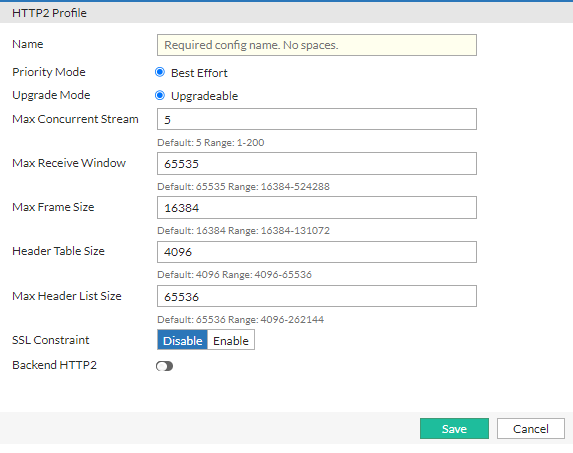
  4. Configure the following settings:
    Type Profile Configuration Guidelines

    Name

    Specify a unique name for the HTTP2 profile.

    Priority Mode

    Set to Best Effort. Not configurable.

    Upgrade ModeSet to Upgradeable. Not configurable.
    Max Concurrent StreamSpecify the maximum number of concurrent streams available at one time. The default number is 5, and the valid range is 1-200.
    Max Receive WindowSpecify the maximum number of bytes that can be received without sending an acknowledgment response. The default value is 65535 bytes, and the valid range is 16384-524288.
    Max Frame Size

    Specify the max size of the data frames, in bytes that the HTTP2 protocol sends to the client. Setting a large frame size improves network utilization, but it can also affect concurrency. The default value is 16384 bytes, and the valid range is 16384-131072.

    Note: When Backend HTTP2 is enabled, the Max Frame Size is not supported, as this cannot be set independently for the frontend and backend. Instead, the HTTP2 Profile Max Frame Size will override the Tune Buffer Size in the Application Profile.

    Header Table SizeSpecify the size of the header table, in KB. A larger table size allows for better HTTP header compression, but it requires more memory. The default value is 4096, and the valid range is 4096-65536.
    Header List LimitationSpecify the size of the name value length , in bytes, that the HTTP2 protocol sends in a single header frame. The default value is 65536, and the valid range is 4096-262144.
    SSL Constraint

    Enable or disable SSL constraint. If enabled, the following conditions must be met:

    • The TLS implementation supports Server Name Indication.
    • The TLS implementation disables compression.
    • The TLS implementation disables renegotiation.
    • Renegotiation takes place before the connection preface is sent.
    • HTTP/2 uses cipher suites with ephemeral key exchange.
    • Ephemeral key exchange has a size of at least 2048 bits (for DHE) or a security level of at least 128 bits (for ECDHE).
    • Clients accept DHE no smaller than 4096 bits.
    • Stream or block ciphers are not used with HTTP.

    Backend HTTP2

    Enable/disable support for the backend HTTP/2 functionality.

    When enabled, the related virtual server will switch to httproxy3 for support.

    This is disabled by default.

    Note: The backend HTTP/2 implementation is built on HTTP/3, which introduces specific limitations. For details, see Configuring HTTP3 profiles.

    Backend Max Receive Window

    The Backend Max Receive Window option is available if Backend HTTP2 is enabled.

    Specify the init-windows-size configuration for the backend HTTP/2 connection. The default value is 65535, and the valid range is 16384-524288.

    Backend Concurrent Stream

    The Backend Concurrent Stream option is available if Backend HTTP2 is enabled.

    Specify the maximum limit for concurrent streams that the backend server can handle to ensure optimal performance and prevent overloading. The default value is 5, and the valid range is 1-200.

    Backend Proto Mode HTTPS

    The Backend Proto Mode HTTPS option is available if Backend HTTP2 is enabled.

    Select the HTTPS server backend HTTP/2 protocol mode.

    • ALPN — Use Application-Layer Protocol Negotiation (ALPN).

    • Force H1 — Enforce HTTP/1.

    • Force H2 — Enforce HTTP/2.

    The default is ALPN.

    Backend Proto Mode HTTP

    The Backend Proto Mode HTTP option is available if Backend HTTP2 is enabled.

    Select the HTTP server backend HTTP/2 protocol mode.

    • Force H1 — Enforce HTTP/1.

    • Force H2 — Enforce HTTP/2.

    The default is Force H1.

    Backend Multiplex Mode

    The Backend Multiplex Mode option is available if Backend HTTP2 is enabled.

    Select the backend multiplexing mode.

    • Multi Connection — Multiple streams from the frontend are mapped to multiple backend connections.

    • Single Connection — All requests from multiple frontend connections are sent through a single backend connection.

    The default is Multi Connection.

  5. Click Save.

Once the HTTP2 Profile configuration is saved, it can be referenced in an HTTP/HTTPS Application Profile configuration.

Configuring HTTP2 profiles

Configuring HTTP2 profiles

You can now create application profiles that support HTTP2. To do so, you must first create an HTTP2 Profile, then use that profile when creating a new application profile.

Alternatively, predefined profiles are available to be referenced in HTTP/HTTPS application profiles. All values in the predefined profile is view-only and cannot be modified.

Profile Description
LB_HTTP2_PROFILE_DEFAULT

Priority Mode — Best Effort

Upgrade Mode — Upgradeable

Max Concurrent Stream — 5

Max Receive Window — 65535

Max Frame Size — 16384

Header Table Size — 4096

Max Header List Size — 65536

SSL Constraint — Enable

Backend HTTP2 — Disable

LB_HTTP2_PROFILE_END2END_H2

Priority Mode — Best Effort

Upgrade Mode — Upgradeable

Max Concurrent Stream — 5

Max Receive Window — 65535

Max Frame Size — 16384

Header Table Size — 4096

Max Header List Size — 65536

SSL Constraint — Enable

Backend HTTP2 — Enable

Backend Max Receive Window — 65535

Backend Concurrent Stream — 5

Backend Proto Mode HTTPS — ALPN

Backend Proto Mode HTTP — Force H1

Backend Multiplex Mode — Multi Connection

To configure HTTP2 profiles:
  1. Go to Server Load Balance > Application Resources.
  2. Click the HTTP2 Profile tab.
  3. Click Create New to display the configuration editor.
  4. Configure the following settings:
    Type Profile Configuration Guidelines

    Name

    Specify a unique name for the HTTP2 profile.

    Priority Mode

    Set to Best Effort. Not configurable.

    Upgrade ModeSet to Upgradeable. Not configurable.
    Max Concurrent StreamSpecify the maximum number of concurrent streams available at one time. The default number is 5, and the valid range is 1-200.
    Max Receive WindowSpecify the maximum number of bytes that can be received without sending an acknowledgment response. The default value is 65535 bytes, and the valid range is 16384-524288.
    Max Frame Size

    Specify the max size of the data frames, in bytes that the HTTP2 protocol sends to the client. Setting a large frame size improves network utilization, but it can also affect concurrency. The default value is 16384 bytes, and the valid range is 16384-131072.

    Note: When Backend HTTP2 is enabled, the Max Frame Size is not supported, as this cannot be set independently for the frontend and backend. Instead, the HTTP2 Profile Max Frame Size will override the Tune Buffer Size in the Application Profile.

    Header Table SizeSpecify the size of the header table, in KB. A larger table size allows for better HTTP header compression, but it requires more memory. The default value is 4096, and the valid range is 4096-65536.
    Header List LimitationSpecify the size of the name value length , in bytes, that the HTTP2 protocol sends in a single header frame. The default value is 65536, and the valid range is 4096-262144.
    SSL Constraint

    Enable or disable SSL constraint. If enabled, the following conditions must be met:

    • The TLS implementation supports Server Name Indication.
    • The TLS implementation disables compression.
    • The TLS implementation disables renegotiation.
    • Renegotiation takes place before the connection preface is sent.
    • HTTP/2 uses cipher suites with ephemeral key exchange.
    • Ephemeral key exchange has a size of at least 2048 bits (for DHE) or a security level of at least 128 bits (for ECDHE).
    • Clients accept DHE no smaller than 4096 bits.
    • Stream or block ciphers are not used with HTTP.

    Backend HTTP2

    Enable/disable support for the backend HTTP/2 functionality.

    When enabled, the related virtual server will switch to httproxy3 for support.

    This is disabled by default.

    Note: The backend HTTP/2 implementation is built on HTTP/3, which introduces specific limitations. For details, see Configuring HTTP3 profiles.

    Backend Max Receive Window

    The Backend Max Receive Window option is available if Backend HTTP2 is enabled.

    Specify the init-windows-size configuration for the backend HTTP/2 connection. The default value is 65535, and the valid range is 16384-524288.

    Backend Concurrent Stream

    The Backend Concurrent Stream option is available if Backend HTTP2 is enabled.

    Specify the maximum limit for concurrent streams that the backend server can handle to ensure optimal performance and prevent overloading. The default value is 5, and the valid range is 1-200.

    Backend Proto Mode HTTPS

    The Backend Proto Mode HTTPS option is available if Backend HTTP2 is enabled.

    Select the HTTPS server backend HTTP/2 protocol mode.

    • ALPN — Use Application-Layer Protocol Negotiation (ALPN).

    • Force H1 — Enforce HTTP/1.

    • Force H2 — Enforce HTTP/2.

    The default is ALPN.

    Backend Proto Mode HTTP

    The Backend Proto Mode HTTP option is available if Backend HTTP2 is enabled.

    Select the HTTP server backend HTTP/2 protocol mode.

    • Force H1 — Enforce HTTP/1.

    • Force H2 — Enforce HTTP/2.

    The default is Force H1.

    Backend Multiplex Mode

    The Backend Multiplex Mode option is available if Backend HTTP2 is enabled.

    Select the backend multiplexing mode.

    • Multi Connection — Multiple streams from the frontend are mapped to multiple backend connections.

    • Single Connection — All requests from multiple frontend connections are sent through a single backend connection.

    The default is Multi Connection.

  5. Click Save.

Once the HTTP2 Profile configuration is saved, it can be referenced in an HTTP/HTTPS Application Profile configuration.