
Fortinet white logo
Fortinet white logo

Administration Guide

Use secondary tunnel for FEC redundant parity packets NEW

Use secondary tunnel for FEC redundant parity packets NEW

In the original implementation of adaptive FEC, FEC parity packets are sent inside the same overlay tunnel. However, the parity packets are susceptible to being dropped at the same rate as other VPN packets.

This enhancement to adaptive FEC introduces the capability to send FEC parity packets in a secondary overlay tunnel that is associated with the same destination. The following setting can be configured on the primary tunnel that requires parity packets to be sent on a redundant tunnel:

config vpn ipsec phase1-interface
    edit <tunnel>
        set fec-separate-redundant-tunnel enable
    next
end

The redundant tunnel must have the same destination location-id as the original tunnel.

Example

In the following example, a VPN Hub (FGTD) is configured as a dialup VPN gateway. A spoke has two underlays going to different ISPs, where the primary (port1) has 10G bandwidth and the secondary (port9) has 1G bandwidth. Two tunnels are established from the Spoke to the Hub over the two underlays. The intention is to send data over the primary tunnel while using the secondary tunnel for redundancy and parity packets for the primary tunnel.

The FEC mappings are configured to send two parity packets per 8 base packets upon packet-loss threshold above 2%. Additionally, it will send three parity packets per nine base packets when bandwidth exceeds 950Mbps.

This example utilizes one Hub/destination, so the default location-id will be shared between the tunnels without any conflicts. When multiple Hubs are in use, and you need to apply the parity packet duplication on the same Hub and destination, use a different location-id for each hub.

config system settings
    set location-id <unique id for each hub>
end
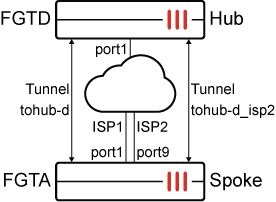
To configure the hub, FGTD:
config vpn ipsec phase1-interface
    edit "tospokes"
        set type dynamic
        set interface "port1"
        set ike-version 2
        set peertype any
        set net-device disable
        set mode-cfg enable
        set proposal aes128-sha256 aes256-sha256 aes128gcm-prfsha256 aes256gcm-prfsha384 chacha20poly1305-prfsha256
        set add-route disable
        set dpd on-idle
        set dhgrp 20 21
        set auto-discovery-sender enable
        set fec-ingress enable
        set transport auto
        set ipv4-start-ip 100.100.100.10
        set ipv4-end-ip 100.100.100.20
        set ipv4-netmask 255.255.255.0
        set psksecret ****************
        set dpd-retryinterval 60
    next
end
config vpn ipsec phase2-interface
    edit "tospokes"
        set phase1name "tospokes"
        set proposal aes128-sha256 aes256-sha256 aes128gcm aes256gcm chacha20poly1305
        set dhgrp 20 21
    next
end
To configure the spoke, FGTA:
  1. Configure FEC mapping to bind network SLA metrics and FEC base and redundant packets:

    config vpn ipsec fec
        edit "m1"
            config mappings
                edit 1
                    set base 8
                    set redundant 2
                    set packet-loss-threshold 2
                next
                edit 2
                    set base 9
                    set redundant 3
                    set bandwidth-up-threshold 950000
                next
            end
        next
    end
  2. Configure the IPsec tunnels:

    On the primary tunnel, enable FEC enabled and apply FEC mapping. The redundant tunnel does not need FEC enabled, or the fec-separate-redundant-tunnel setting.

    config vpn ipsec phase1-interface
        edit "tohub-d"
            set interface "port1"
            set ike-version 2
            set peertype any
            set net-device disable
            set mode-cfg enable
            set proposal aes128-sha256 aes256-sha256 aes128gcm-prfsha256 aes256gcm-prfsha384 chacha20poly1305-prfsha256
            set add-route disable
            set dhgrp 20 21
            set auto-discovery-receiver enable
            set auto-discovery-shortcuts dependent
            set fec-egress enable
            set fec-separate-redundant-tunnel enable
            set fec-codec rs
            set fec-health-check "1"
            set fec-mapping-profile "m1"
            set transport auto
            set remote-gw 172.16.200.4
            set psksecret ****************
        next
        edit "tohub-d_isp2"
            set interface "port9"
            set ike-version 2
            set peertype any
            set net-device disable
            set mode-cfg enable
            set proposal aes128-sha256 aes256-sha256 aes128gcm-prfsha256 aes256gcm-prfsha384 chacha20poly1305-prfsha256
            set add-route disable
            set dhgrp 20 21
            set auto-discovery-receiver enable
            set auto-discovery-shortcuts dependent
            set transport auto
            set remote-gw 172.16.200.4
            set psksecret ****************
        next
    end
    config vpn ipsec phase2-interface
        edit "tohub-d"
            set phase1name "tohub-d"
            set proposal aes128-sha256 aes256-sha256 aes128gcm aes256gcm chacha20poly1305
            set dhgrp 20 21
            set auto-negotiate enable
        next
        edit "tohub-d_isp2"
            set phase1name "tohub-d_isp2"
            set proposal aes128-sha256 aes256-sha256 aes128gcm aes256gcm chacha20poly1305
            set dhgrp 20 21
            set auto-negotiate enable
        next
    end
  3. Configure SD-WAN:

    Assign the overlay interface as an SD-WAN member and attach it to a zone. Configure health-check on the overlay member in order to detect packet-loss and bandwidth utilization.

    config system sdwan
        set status enable
        config zone
            edit "virtual-wan-link"
            next
        end
        config members
            edit 1
                set interface "port1"
                set gateway 172.16.200.3
            next
            edit 4
                set interface "tohub-d"
            next
            edit 5
                set interface "port9"
                set gateway 11.101.1.2
            next
        end
        config health-check
                edit "1"
                set server "192.168.5.44"
                set members 4
                config sla
                    edit 1
                    next
                end
            next
        end
        config service
            edit 2
                set name "1_clone"
                set dst "all"
                set src "10.1.100.0"
                set priority-members 4 1
            next
        end
    end
To verify the results:
  1. Confirm that both tunnels are established on their respective interfaces on FGTA:

    # diagnose vpn ike gateway list 
    
    vd: root/0
    name: tohub-d_isp2
    version: 2
    interface: port9 15
    addr: 11.101.1.1:5929 -> 172.16.200.4:4500
    ext addr: 11.101.1.1 5929
    tun_id: 10.0.0.2/::10.0.0.2
    remote_location: 0.0.0.0
    network-id: 0
    transport: TCP
    virtual-interface-addr: remote: 100.100.100.4
    created: 407s ago
    peer-id: 172.16.200.4
    peer-id-auth: no
    assigned IPv4 address: 100.100.100.11/255.255.255.0
    nat: me
    auto-discovery: 2 receiver
    pending-queue: 0
    PPK: no
    IKE SA: created 1/1  established 1/1  time 36000/36000/36000 ms
    IPsec SA: created 1/1  established 1/1  time 36000/36000/36000 ms
    
      id/spi: 10217 77f9b317d1c985cd/cd40650eb175ec62
      direction: initiator
      status: established 407-371s ago = 36000ms
      proposal: aes128-sha256
      child: no
      SK_ei: 3fc9a5151af50e58-fec5cfed3c436fb1
      SK_er: de07bdc42f053f82-cdc945fc5a7ad5f4
      SK_ai: 0262f60ee41bafa2-2f7b9fc40f38e2b6-415b31885b81b778-b28c62a9915d2e5d
      SK_ar: 693d5e98d6695490-bc9c26b8a15e5322-0285e96df10e48cc-3535038e2c9a442d
      PPK: no
      message-id sent/recv: 2/0
      QKD: no
      PQC-KEM (IKE): no
      PQC-KEM (all IPsec): no
      lifetime/rekey: 86400/85728
      DPD sent/recv: 00000000/00000000
      peer-id: 172.16.200.4
    
    vd: root/0
    name: tohub-d
    version: 2
    interface: port1 7
    addr: 172.16.200.1:500 -> 172.16.200.4:500
    ext addr: 172.16.200.1 500
    tun_id: 172.16.200.4/::172.16.200.4
    remote_location: 0.0.0.0
    network-id: 0
    transport: UDP
    virtual-interface-addr: remote: 100.100.100.4
    created: 377s ago
    peer-id: 172.16.200.4
    peer-id-auth: no
    assigned IPv4 address: 100.100.100.10/255.255.255.0
    auto-discovery: 2 receiver
    pending-queue: 0
    PPK: no
    IKE SA: created 1/1  established 1/1  time 0/0/0 ms
    IPsec SA: created 1/1  established 1/1  time 0/0/0 ms
    
      id/spi: 10218 43bc6decd5bc56af/d5a405f1ff957a2f
      direction: initiator
      status: established 377-377s ago = 0ms
      proposal: aes128-sha256
      child: no
      SK_ei: 677aadd417ae719f-6cc99b2215be8711
      SK_er: f2b69ab1aecc08d6-04236a6849b56cae
      SK_ai: e9294b9b9087f973-9aebb458b27f5b13-39aab03bfee864bf-e616994e29cae238
      SK_ar: 7ef28f030c54ef5a-84c9765946e408da-d026e7294a209973-3d607b182eb86ec4
      PPK: no
      message-id sent/recv: 2/0
      QKD: no
      PQC-KEM (IKE): no
      PQC-KEM (all IPsec): no
      lifetime/rekey: 86400/85722
      DPD sent/recv: 00000000/00000000
      peer-id: 172.16.200.4
  2. Confirm that FEC is enabled in the egress direction for the tohub-d tunnel:

    # diagnose vpn tunnel list 
    list all ipsec tunnel in vd 0
    ------------------------------------------------------
    name=tohub-d_isp2 ver=2 serial=5 11.101.1.1:5929->172.16.200.4:4500 nexthop=11.101.1.2 tun_id=10.0.0.2 tun_id6=::10.0.0.2 status=up dst_mtu=1500 weight=1 country=ZZ
    bound_if=15 real_if=15 lgwy=static/1 tun=intf mode=auto/1 encap=none options[0x228]=npu frag-rfc  run_state=0 role=primary accept_traffic=1 overlay_id=0
    
    proxyid_num=1 child_num=0 refcnt=5 ilast=31 olast=31 ad=r/2
    stat: rxp=347 txp=22 rxb=458878 txb=1410
    dpd: mode=on-demand on=1 status=ok idle=20000ms retry=3 count=0 seqno=1802
    natt: mode=none draft=0 interval=0 remote_port=0
    proxyid=tohub-d_isp2 proto=0 sa=1 ref=3 serial=1 auto-negotiate adr
      src: 0:0.0.0.0-255.255.255.255:0
      dst: 0:0.0.0.0-255.255.255.255:0
      SA:  ref=3 options=1a227 type=00 soft=0 mtu=1438 expire=42519/0B replaywin=2048
           seqno=17 esn=0 replaywin_lastseq=0000015c qat=0 rekey=0 hash_search_len=1
      life: type=01 bytes=0/0 timeout=42902/43200
      dec: spi=18e0b19e esp=aes key=16 c005a5c587fcd4ad85686868323f7a21
           ah=sha256 key=32 3da0b40b525f363355acb3dd445f0131c924b14bb3f704dfd8d7b205412e01d9
      enc: spi=c0e46a65 esp=aes key=16 a161fb71279cd02bed75614c16ce48d0
           ah=sha256 key=32 34977a64e77716c20d4fdfb4619f0745f8d850e448e0330a64baed64dbc24f91
      dec:pkts/bytes=347/458878, enc:pkts/bytes=22/2952
      npu_flag=00 npu_rgwy=0.0.0.0:0 npu_lgwy=0.0.0.0:0npu_selid=6
      dec_npuid=0 enc_npuid=0 dec_engid=-1 enc_engid=-1 dec_saidx=-1 enc_saidx=-1
    ------------------------------------------------------
    name=tohub-d ver=2 serial=4 172.16.200.1:0->172.16.200.4:0 nexthop=172.16.200.4 tun_id=172.16.200.4 tun_id6=::172.16.200.4 status=up dst_mtu=1500 weight=1 country=ZZ
    bound_if=7 real_if=7 lgwy=static/1 tun=intf mode=auto/1 encap=none options[0x228]=npu frag-rfc  run_state=0 role=primary accept_traffic=1 overlay_id=0
    
    proxyid_num=1 child_num=0 refcnt=4 ilast=1 olast=1 ad=r/2
    stat: rxp=375 txp=937 rxb=40092 txb=61856
    dpd: mode=on-demand on=1 status=ok idle=20000ms retry=3 count=0 seqno=16
    natt: mode=none draft=0 interval=0 remote_port=0
    fec: egress=1 ingress=0 
    proxyid=tohub-d proto=0 sa=1 ref=31 serial=1 auto-negotiate adr
      src: 0:0.0.0.0-255.255.255.255:0
      dst: 0:0.0.0.0-255.255.255.255:0
      SA:  ref=6 options=1a227 type=00 soft=0 mtu=1342 expire=42509/0B replaywin=2048
           seqno=17aa esn=0 replaywin_lastseq=0000004d qat=0 rekey=0 hash_search_len=1
      life: type=01 bytes=0/0 timeout=42898/43200
      dec: spi=18e0b19f esp=aes key=16 3e578ce917adbf940e9ad602baa71a92
           ah=sha256 key=32 4a23b8861918b8ad336cae572dd17f808e64ee22367a219d00249d06405736cf
      enc: spi=c0e46a64 esp=aes key=16 b5e7464c94b4847c30c804f7effa8a0d
           ah=sha256 key=32 bbde5831078147c8b3fd88d0d5112b6110cce75bdb5b23392cc3c2f90c9e4336
      dec:pkts/bytes=6/240, enc:pkts/bytes=937/125532
      npu_flag=03 npu_rgwy=172.16.200.4:0 npu_lgwy=172.16.200.1:0npu_selid=5
      dec_npuid=1 enc_npuid=1 dec_engid=-1 enc_engid=-1 dec_saidx=7399 enc_saidx=4
  3. Confirm that the profile selected is sending three parity packets per nine base packets:

    # diagnose vpn tunnel fec tohub-d
    egress:  enabled=1
            base=9 redundant=3 codec=0 timeout=10(ms)
            encode=132 encode_timeout=129 encode_fail=0
            tx_data=166 tx_parity=396
            total_tx_data=166 total_tx_parity=396
    ingress: enabled=0
            timeout=0(ms) fasm_cnt=0 fasm_full=0
            ipsec_fec_chk_fail=0 complete=0
            recover=0 recover_timeout=0 recover_fail=0
            rx_data=0 rx_parity=0
            rx=0 rx_fail=0

Use secondary tunnel for FEC redundant parity packets NEW

Use secondary tunnel for FEC redundant parity packets NEW

In the original implementation of adaptive FEC, FEC parity packets are sent inside the same overlay tunnel. However, the parity packets are susceptible to being dropped at the same rate as other VPN packets.

This enhancement to adaptive FEC introduces the capability to send FEC parity packets in a secondary overlay tunnel that is associated with the same destination. The following setting can be configured on the primary tunnel that requires parity packets to be sent on a redundant tunnel:

config vpn ipsec phase1-interface
    edit <tunnel>
        set fec-separate-redundant-tunnel enable
    next
end

The redundant tunnel must have the same destination location-id as the original tunnel.

Example

In the following example, a VPN Hub (FGTD) is configured as a dialup VPN gateway. A spoke has two underlays going to different ISPs, where the primary (port1) has 10G bandwidth and the secondary (port9) has 1G bandwidth. Two tunnels are established from the Spoke to the Hub over the two underlays. The intention is to send data over the primary tunnel while using the secondary tunnel for redundancy and parity packets for the primary tunnel.

The FEC mappings are configured to send two parity packets per 8 base packets upon packet-loss threshold above 2%. Additionally, it will send three parity packets per nine base packets when bandwidth exceeds 950Mbps.

This example utilizes one Hub/destination, so the default location-id will be shared between the tunnels without any conflicts. When multiple Hubs are in use, and you need to apply the parity packet duplication on the same Hub and destination, use a different location-id for each hub.

config system settings
    set location-id <unique id for each hub>
end

To configure the hub, FGTD:
config vpn ipsec phase1-interface
    edit "tospokes"
        set type dynamic
        set interface "port1"
        set ike-version 2
        set peertype any
        set net-device disable
        set mode-cfg enable
        set proposal aes128-sha256 aes256-sha256 aes128gcm-prfsha256 aes256gcm-prfsha384 chacha20poly1305-prfsha256
        set add-route disable
        set dpd on-idle
        set dhgrp 20 21
        set auto-discovery-sender enable
        set fec-ingress enable
        set transport auto
        set ipv4-start-ip 100.100.100.10
        set ipv4-end-ip 100.100.100.20
        set ipv4-netmask 255.255.255.0
        set psksecret ****************
        set dpd-retryinterval 60
    next
end
config vpn ipsec phase2-interface
    edit "tospokes"
        set phase1name "tospokes"
        set proposal aes128-sha256 aes256-sha256 aes128gcm aes256gcm chacha20poly1305
        set dhgrp 20 21
    next
end
To configure the spoke, FGTA:
  1. Configure FEC mapping to bind network SLA metrics and FEC base and redundant packets:

    config vpn ipsec fec
        edit "m1"
            config mappings
                edit 1
                    set base 8
                    set redundant 2
                    set packet-loss-threshold 2
                next
                edit 2
                    set base 9
                    set redundant 3
                    set bandwidth-up-threshold 950000
                next
            end
        next
    end
  2. Configure the IPsec tunnels:

    On the primary tunnel, enable FEC enabled and apply FEC mapping. The redundant tunnel does not need FEC enabled, or the fec-separate-redundant-tunnel setting.

    config vpn ipsec phase1-interface
        edit "tohub-d"
            set interface "port1"
            set ike-version 2
            set peertype any
            set net-device disable
            set mode-cfg enable
            set proposal aes128-sha256 aes256-sha256 aes128gcm-prfsha256 aes256gcm-prfsha384 chacha20poly1305-prfsha256
            set add-route disable
            set dhgrp 20 21
            set auto-discovery-receiver enable
            set auto-discovery-shortcuts dependent
            set fec-egress enable
            set fec-separate-redundant-tunnel enable
            set fec-codec rs
            set fec-health-check "1"
            set fec-mapping-profile "m1"
            set transport auto
            set remote-gw 172.16.200.4
            set psksecret ****************
        next
        edit "tohub-d_isp2"
            set interface "port9"
            set ike-version 2
            set peertype any
            set net-device disable
            set mode-cfg enable
            set proposal aes128-sha256 aes256-sha256 aes128gcm-prfsha256 aes256gcm-prfsha384 chacha20poly1305-prfsha256
            set add-route disable
            set dhgrp 20 21
            set auto-discovery-receiver enable
            set auto-discovery-shortcuts dependent
            set transport auto
            set remote-gw 172.16.200.4
            set psksecret ****************
        next
    end
    config vpn ipsec phase2-interface
        edit "tohub-d"
            set phase1name "tohub-d"
            set proposal aes128-sha256 aes256-sha256 aes128gcm aes256gcm chacha20poly1305
            set dhgrp 20 21
            set auto-negotiate enable
        next
        edit "tohub-d_isp2"
            set phase1name "tohub-d_isp2"
            set proposal aes128-sha256 aes256-sha256 aes128gcm aes256gcm chacha20poly1305
            set dhgrp 20 21
            set auto-negotiate enable
        next
    end
  3. Configure SD-WAN:

    Assign the overlay interface as an SD-WAN member and attach it to a zone. Configure health-check on the overlay member in order to detect packet-loss and bandwidth utilization.

    config system sdwan
        set status enable
        config zone
            edit "virtual-wan-link"
            next
        end
        config members
            edit 1
                set interface "port1"
                set gateway 172.16.200.3
            next
            edit 4
                set interface "tohub-d"
            next
            edit 5
                set interface "port9"
                set gateway 11.101.1.2
            next
        end
        config health-check
                edit "1"
                set server "192.168.5.44"
                set members 4
                config sla
                    edit 1
                    next
                end
            next
        end
        config service
            edit 2
                set name "1_clone"
                set dst "all"
                set src "10.1.100.0"
                set priority-members 4 1
            next
        end
    end
To verify the results:
  1. Confirm that both tunnels are established on their respective interfaces on FGTA:

    # diagnose vpn ike gateway list 
    
    vd: root/0
    name: tohub-d_isp2
    version: 2
    interface: port9 15
    addr: 11.101.1.1:5929 -> 172.16.200.4:4500
    ext addr: 11.101.1.1 5929
    tun_id: 10.0.0.2/::10.0.0.2
    remote_location: 0.0.0.0
    network-id: 0
    transport: TCP
    virtual-interface-addr: remote: 100.100.100.4
    created: 407s ago
    peer-id: 172.16.200.4
    peer-id-auth: no
    assigned IPv4 address: 100.100.100.11/255.255.255.0
    nat: me
    auto-discovery: 2 receiver
    pending-queue: 0
    PPK: no
    IKE SA: created 1/1  established 1/1  time 36000/36000/36000 ms
    IPsec SA: created 1/1  established 1/1  time 36000/36000/36000 ms
    
      id/spi: 10217 77f9b317d1c985cd/cd40650eb175ec62
      direction: initiator
      status: established 407-371s ago = 36000ms
      proposal: aes128-sha256
      child: no
      SK_ei: 3fc9a5151af50e58-fec5cfed3c436fb1
      SK_er: de07bdc42f053f82-cdc945fc5a7ad5f4
      SK_ai: 0262f60ee41bafa2-2f7b9fc40f38e2b6-415b31885b81b778-b28c62a9915d2e5d
      SK_ar: 693d5e98d6695490-bc9c26b8a15e5322-0285e96df10e48cc-3535038e2c9a442d
      PPK: no
      message-id sent/recv: 2/0
      QKD: no
      PQC-KEM (IKE): no
      PQC-KEM (all IPsec): no
      lifetime/rekey: 86400/85728
      DPD sent/recv: 00000000/00000000
      peer-id: 172.16.200.4
    
    vd: root/0
    name: tohub-d
    version: 2
    interface: port1 7
    addr: 172.16.200.1:500 -> 172.16.200.4:500
    ext addr: 172.16.200.1 500
    tun_id: 172.16.200.4/::172.16.200.4
    remote_location: 0.0.0.0
    network-id: 0
    transport: UDP
    virtual-interface-addr: remote: 100.100.100.4
    created: 377s ago
    peer-id: 172.16.200.4
    peer-id-auth: no
    assigned IPv4 address: 100.100.100.10/255.255.255.0
    auto-discovery: 2 receiver
    pending-queue: 0
    PPK: no
    IKE SA: created 1/1  established 1/1  time 0/0/0 ms
    IPsec SA: created 1/1  established 1/1  time 0/0/0 ms
    
      id/spi: 10218 43bc6decd5bc56af/d5a405f1ff957a2f
      direction: initiator
      status: established 377-377s ago = 0ms
      proposal: aes128-sha256
      child: no
      SK_ei: 677aadd417ae719f-6cc99b2215be8711
      SK_er: f2b69ab1aecc08d6-04236a6849b56cae
      SK_ai: e9294b9b9087f973-9aebb458b27f5b13-39aab03bfee864bf-e616994e29cae238
      SK_ar: 7ef28f030c54ef5a-84c9765946e408da-d026e7294a209973-3d607b182eb86ec4
      PPK: no
      message-id sent/recv: 2/0
      QKD: no
      PQC-KEM (IKE): no
      PQC-KEM (all IPsec): no
      lifetime/rekey: 86400/85722
      DPD sent/recv: 00000000/00000000
      peer-id: 172.16.200.4
  2. Confirm that FEC is enabled in the egress direction for the tohub-d tunnel:

    # diagnose vpn tunnel list 
    list all ipsec tunnel in vd 0
    ------------------------------------------------------
    name=tohub-d_isp2 ver=2 serial=5 11.101.1.1:5929->172.16.200.4:4500 nexthop=11.101.1.2 tun_id=10.0.0.2 tun_id6=::10.0.0.2 status=up dst_mtu=1500 weight=1 country=ZZ
    bound_if=15 real_if=15 lgwy=static/1 tun=intf mode=auto/1 encap=none options[0x228]=npu frag-rfc  run_state=0 role=primary accept_traffic=1 overlay_id=0
    
    proxyid_num=1 child_num=0 refcnt=5 ilast=31 olast=31 ad=r/2
    stat: rxp=347 txp=22 rxb=458878 txb=1410
    dpd: mode=on-demand on=1 status=ok idle=20000ms retry=3 count=0 seqno=1802
    natt: mode=none draft=0 interval=0 remote_port=0
    proxyid=tohub-d_isp2 proto=0 sa=1 ref=3 serial=1 auto-negotiate adr
      src: 0:0.0.0.0-255.255.255.255:0
      dst: 0:0.0.0.0-255.255.255.255:0
      SA:  ref=3 options=1a227 type=00 soft=0 mtu=1438 expire=42519/0B replaywin=2048
           seqno=17 esn=0 replaywin_lastseq=0000015c qat=0 rekey=0 hash_search_len=1
      life: type=01 bytes=0/0 timeout=42902/43200
      dec: spi=18e0b19e esp=aes key=16 c005a5c587fcd4ad85686868323f7a21
           ah=sha256 key=32 3da0b40b525f363355acb3dd445f0131c924b14bb3f704dfd8d7b205412e01d9
      enc: spi=c0e46a65 esp=aes key=16 a161fb71279cd02bed75614c16ce48d0
           ah=sha256 key=32 34977a64e77716c20d4fdfb4619f0745f8d850e448e0330a64baed64dbc24f91
      dec:pkts/bytes=347/458878, enc:pkts/bytes=22/2952
      npu_flag=00 npu_rgwy=0.0.0.0:0 npu_lgwy=0.0.0.0:0npu_selid=6
      dec_npuid=0 enc_npuid=0 dec_engid=-1 enc_engid=-1 dec_saidx=-1 enc_saidx=-1
    ------------------------------------------------------
    name=tohub-d ver=2 serial=4 172.16.200.1:0->172.16.200.4:0 nexthop=172.16.200.4 tun_id=172.16.200.4 tun_id6=::172.16.200.4 status=up dst_mtu=1500 weight=1 country=ZZ
    bound_if=7 real_if=7 lgwy=static/1 tun=intf mode=auto/1 encap=none options[0x228]=npu frag-rfc  run_state=0 role=primary accept_traffic=1 overlay_id=0
    
    proxyid_num=1 child_num=0 refcnt=4 ilast=1 olast=1 ad=r/2
    stat: rxp=375 txp=937 rxb=40092 txb=61856
    dpd: mode=on-demand on=1 status=ok idle=20000ms retry=3 count=0 seqno=16
    natt: mode=none draft=0 interval=0 remote_port=0
    fec: egress=1 ingress=0 
    proxyid=tohub-d proto=0 sa=1 ref=31 serial=1 auto-negotiate adr
      src: 0:0.0.0.0-255.255.255.255:0
      dst: 0:0.0.0.0-255.255.255.255:0
      SA:  ref=6 options=1a227 type=00 soft=0 mtu=1342 expire=42509/0B replaywin=2048
           seqno=17aa esn=0 replaywin_lastseq=0000004d qat=0 rekey=0 hash_search_len=1
      life: type=01 bytes=0/0 timeout=42898/43200
      dec: spi=18e0b19f esp=aes key=16 3e578ce917adbf940e9ad602baa71a92
           ah=sha256 key=32 4a23b8861918b8ad336cae572dd17f808e64ee22367a219d00249d06405736cf
      enc: spi=c0e46a64 esp=aes key=16 b5e7464c94b4847c30c804f7effa8a0d
           ah=sha256 key=32 bbde5831078147c8b3fd88d0d5112b6110cce75bdb5b23392cc3c2f90c9e4336
      dec:pkts/bytes=6/240, enc:pkts/bytes=937/125532
      npu_flag=03 npu_rgwy=172.16.200.4:0 npu_lgwy=172.16.200.1:0npu_selid=5
      dec_npuid=1 enc_npuid=1 dec_engid=-1 enc_engid=-1 dec_saidx=7399 enc_saidx=4
  3. Confirm that the profile selected is sending three parity packets per nine base packets:

    # diagnose vpn tunnel fec tohub-d
    egress:  enabled=1
            base=9 redundant=3 codec=0 timeout=10(ms)
            encode=132 encode_timeout=129 encode_fail=0
            tx_data=166 tx_parity=396
            total_tx_data=166 total_tx_parity=396
    ingress: enabled=0
            timeout=0(ms) fasm_cnt=0 fasm_full=0
            ipsec_fec_chk_fail=0 complete=0
            recover=0 recover_timeout=0 recover_fail=0
            rx_data=0 rx_parity=0
            rx=0 rx_fail=0