

Support is included for internal and external border gateway protocols (IBGP and EBGP) in virtual routing and forwarding (VRF).
FortiGate can establish neighbor connections with other FortiGates or routers, and the learned routes are put into different VRF tables according to the neighbor's settings.
This example uses the following topology:
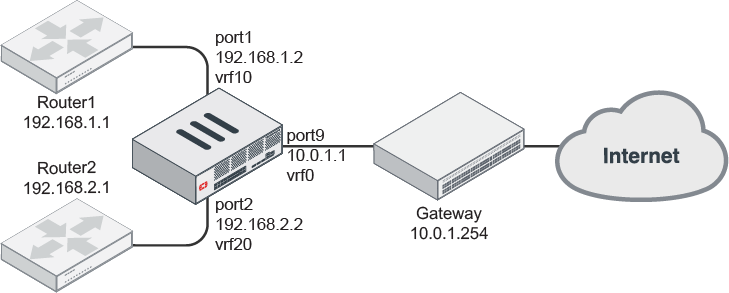
- BGP routes learned from the Router1 neighbor are put into vrf10.
- BGP routes learned from the Router2 neighbor are put into vrf20.
To configure this example:
config system interface
    edit port1
        set vrf 10
    next
    edit port2
        set vrf 20
    next
end
config router bgp
config neighbor
edit "192.168.1.1"
set update-source port1
next
edit "192.168.2.1"
set interface port2
next
end
end
Results
Using the above topology:
- Both Router1 and Router2 establish OSPF and BGP neighbor with the FortiGate.
- Router1 advertises 10.10.1.0/24 into OSPF and 10.10.2.0/24 into BGP.
- Router2 advertises 20.20.1.0/24 into OSPF and 20.20.2.0/24 into BGP.
When port1 and port2 have not set VRF, all of the routing is in VRF=0:
# get router info routing-table all
Codes: K - kernel, C - connected, S - static, R - RIP, B - BGP
       O - OSPF, IA - OSPF inter area
       N1 - OSPF NSSA external type 1, N2 - OSPF NSSA external type 2
       E1 - OSPF external type 1, E2 - OSPF external type 2
       i - IS-IS, L1 - IS-IS level-1, L2 - IS-IS level-2, ia - IS-IS inter area
       * - candidate default

Routing table for VRF=0
S*      0.0.0.0/0 [5/0] via 10.0.1.254, port9
C       10.0.1.0/24 is directly connected, port9
O       10.10.1.0/24 [110/10] via 192.168.1.1, port1, 00:18:31
B       10.10.2.0/24 [20/200] via 192.168.1.1, port1, 00:01:31
O       20.20.1.0/22 [110/10] via 192.168.2.1, port2, 00:19:05
B       20.20.2.0/24 [20/200] via 192.168.2.1, port2, 00:01:31
C       192.168.1.0/24 is directly connected, port1
C       192.168.2.0/24 is directly connected, port2
After VRF is set for BGP, BGP routes are added to the VRF tables along with OSPF and connected routes:
# get router info routing-table all
Codes: K - kernel, C - connected, S - static, R - RIP, B - BGP
       O - OSPF, IA - OSPF inter area
       N1 - OSPF NSSA external type 1, N2 - OSPF NSSA external type 2
       E1 - OSPF external type 1, E2 - OSPF external type 2
       i - IS-IS, L1 - IS-IS level-1, L2 - IS-IS level-2, ia - IS-IS inter area
       * - candidate default

Routing table for VRF=0
S*      0.0.0.0/0 [5/0] via 10.0.1.254, port9
C       10.0.1.0/24 is directly connected, port9

Routing table for VRF=10
O       10.10.1.0/24 [110/10] via 192.168.1.1, port1, 00:18:31
B       10.10.2.0/24 [20/200] via 192.168.1.1, port1, 00:01:31
C       192.168.1.0/24 is directly connected, port1

Routing table for VRF=20
O       20.20.1.0/22 [110/10] via 192.168.2.1, port2, 00:19:05
B       20.20.2.0/24 [20/200] via 192.168.2.1, port2, 00:01:31
C       192.168.2.0/24 is directly connected, port2
BGP neighbor groups
This feature is also supported in the BGP neighbor groups. For example:
config router bgp
    config neighbor-group
        edit "FGT"
            set update-source "port1"
        next
    end
    config neighbor-range
        edit 1
            set prefix 172.16.201.0 255.255.255.0
            set neighbor-group "FGT"
        next
    end
end
Note that the set interface command is not supported.