Fortinet white logo
Fortinet white logo

User Guide

ServiceNow Integration

ServiceNow Integration

Configuring ServiceNow for FortiSIEM Integration

  1. Log in to ServiceNow.
  2. For Service Provider Configurations, create Companies by creating Company Name.
  3. For the integrations to work, FortiSIEM needs to modify certain ServiceNow database tables.
    • if you are using custom integration, then make sure that the FortiSIEM user account has the read/write permissions on the specific ServiceNow tables and columns.

Incident Outbound Integration (Default)

In this integration, you can create tickets in ServiceNow when an Incident triggers in FortiSIEM. In the Default integration, FortiSIEM Incidents are written to the ServiceNow incident table. FortiSIEM incident attributes are mapped to ServiceNow incident table columns as follows.

FortiSIEM Incident Attribute

ServiceNow Incident Table Column

Incident Status

work_notes

Incident Name

short_description

Incident Comments (generated string containing few Incident attributes – see Step 1.4.k.)

comments

Organization Name

company

Incident Severity

impact

Incident Severity

urgency

Step 1: Create an Integration

  1. Log into your Supervisor node with administrator credentials.
  2. Navigate to ADMIN > Settings > General > External Integration.
  3. Click New.
  4. From the Integration Policy window, take the following steps.
    1. From the Type drop-down list, select Incident.
    2. From the Direction drop-down list, select Outbound.
    3. From the Vendor drop-down list, select ServiceNow. When you select a vendor, an instance is created, with a unique name for the policy. For example, if you had two ServiceNow installations, each would have different instance names.
    4. Set the Instance - This is the name of the integration. If you want matching inbound and outbound Incident integration for a specific vendor, then the instance name for the inbound and outbound integration must be the same. For example, ServiceNow Outbound and ServiceNow Inbound should have the same instance name, for example, ServiceNow1.
    5. For Plugin Name, a default Plugin Name is populated. Leave it as is. This is the Java code that implements the integration, including connecting to the external help desk systems and synching the CMDB elements.
    6. In the Host/URL field, enter the login URL, for example, https://vendor123.service-now.com.
    7. In the User Name field, enter the ServiceNow username login credential.
    8. In the Password field, enter the ServiceNow password login credential.
    9. Leave the ServiceNow Table Name attribute alone.
    10. In the Description field, enter a description as to what the integration does. This is for display purposes only.
    11. For Incident Comment, you can keep the default format shown in Step 1.k.i, or create your own, shown in Step 1.k.ii.
      1. Default format : [FortiSIEM]Incident Id:<val>;First seen time:<val>;Target IP:<val>;Incident Details:<val>;Mitre TechniqueId:<val>;Mitre Tactics:<val>; Description:<Rule Name>
      2. To create your own, click the Edit icon, and form a string by combining your own text and incident attributes by choosing from the Insert Content drop-down list. When done, click Save.
    12. For Organization Mapping, click the Edit icon to create mappings between the Organizations in your FortiSIEM deployment and Company names in ServiceNow (created in Configuring ServiceNow for FortiSIEM Integration, Step 2).
    13. For Run For, click the Edit icon, and choose the organizations for whom tickets will be created.
    14. In the Max Incidents field, enter the maximum number of incidents you want to record.
    15. Click Save.

Step 2: Link Integration to an Automation Policy

You need to link the integration to an automation policy, so that the integration runs when the automation policy triggers.

Take the following steps.

  1. Go to ADMIN > Settings > General > Automation Policy.
  2. Click New to create a new policy or Edit to edit an existing policy.
  3. In the Automation Settings dialog box, select Action > Invoke an Integration Policy, then select the edit icon.
  4. Choose a specific integration from the drop-down list.
  5. Click Save.

Incident Outbound Integration (Custom)

In this integration, you can create tickets in ServiceNow when an Incident triggers in FortiSIEM. You can choose your own ServiceNow table to map FortiSIEM Incidents to. Take the following steps to create a custom outbound integration.

Step 1: Create an Integration

  1. Log into your Supervisor node with administrator credentials.
  2. Navigate to ADMIN > Settings > General > External Integration.
  3. Click New.
  4. From the Integration Policy window, take the following steps.
    1. From the Type drop-down list, select Incident.
    2. From the Direction drop-down list, select Outbound.
    3. From the Vendor drop-down list, select ServiceNow. When you select a vendor, an instance is created, with a unique name for the policy. For example, if you had two ServiceNow installations, each would have different instance names.
    4. For Plugin Name, a default Plugin Name is populated. Leave it as is. This is the Java code that implements the integration, including connecting to the external help desk systems and synching the CMDB elements. For other vendors, you must create your own plugin and enter the plugin name here.
    5. In the Host/URL field, enter the login URL, for example, https://vendor123.service-now.com.
    6. In the User Name field, enter the ServiceNow username login credential.
    7. In the Password field, enter the ServiceNow password login credential.
    8. In the ServiceNow Table Name field, enter the custom ServiceNow table
    9. In the Description field, enter a description as to what the integration does. This is for display purposes only.
    10. For Incident Comment, you can keep the default format shown in Step 1.j.i, or create your own, shown in Step 1.j.ii.
      1. Default format : [FortiSIEM]Incident Id:<val>;First seen time:<val>;Target IP:<val>;Incident Details:<val>;Mitre TechniqueId:<val>;Mitre Tactics:<val>; Description:<Rule Name>
      2. To create your own, click the Edit icon, and form a string by combining your own text and incident attributes by choosing from the Insert Content drop-down list. When done, click Save.
    11. For Organization Mapping, click the Edit icon to create mappings between the Organizations in your FortiSIEM deployment and Company names in ServiceNow (created in Configuring ServiceNow for FortiSIEM Integration, Step 2).
    12. For Run For, click the Edit icon, and choose the organizations for whom tickets will be created.
    13. For Content Mapping, click the Edit icon to define mappings between FortiSIEM Incident fields and ServiceNow custom table columns.
      1. Select the Field Mappings dialog box and click +.
        Note: To delete a Field Mapping, select the entry and click -. To edit a Field Mapping, click the Edit icon.
      2. From the FortiSIEM Incident Field drop-down list, select a FortiSIEM Incident field.
      3. From the ServiceNow Field drop-down list, select a mapped ServiceNow field. Note that the menu is populated from the table in step 4.i.
      4. Select the Value Mappings dialog box and click + to enter Value Mappings if you want the values for a specific field to be transformed. A standard example is Severity, where FortiSIEM Incident Severity 1-> 4 may be mapped to Low, 5-8 as Medium and 9-10 as High.
      5. From Field, select the ServiceNow Field whose values need to be transformed.
      6. In the From field, select the value that FortiSIEM generates.
      7. In the To field, select the value that you want ServiceNow to store.
      8. When done, click Save.
    14. In the Max Incidents field, enter the maximum number of incidents you want to record.
    15. Click Save.

Step 2: Link Integration to an Automation Policy

You need to link the integration to an automation policy, so that the integration runs when the automation policy triggers.

Note: In the default Outbound integration, Incident updates are recorded in the comments field. However, in the custom integration, Incident updates are not reflected in ServiceNow.

Take the following steps.

  1. Go to ADMIN > Settings > General > Automation Policy.
  2. Click New to create a new policy or Edit to edit an existing policy.
  3. In the Automation Policy dialog box, select Action > Invoke an Integration Policy, then select the edit icon.
  4. Choose a specific integration from the drop-down list.
  5. Click Save.

Incident Inbound Integration (Default)

Using this integration, a FortiSIEM Incident can be programmatically cleared when a user closes the corresponding ticket in ServiceNow. In the default integration, the following fields from ServiceNow incident table are mapped to FortiSIEM incident fields.

ServiceNow Incident Table Column

FortiSIEM Incident Field

incident_state

Incident Status

Closed_code

Incident Resolution

Closed_by

External User

number

External Ticket Id

incident_state

External Ticket Status

Step 1: Create an Incident Inbound Integration

  1. Log into your Supervisor node with administrator credentials.
  2. Navigate to ADMIN > Settings > General > External Integration.
  3. Click New.
  4. From the Integration Policy window, take the following steps.
    1. From the Type drop-down list, select Incident.
    2. From the Direction drop-down list, select Inbound.
    3. From the Vendor drop-down list, select ServiceNow. When you select a vendor, an instance is created, with a unique name for the policy. For example, if you had two ServiceNow installations, each would have different instance names.
    4. Set the Instance - This is the name of the integration. If you want matching inbound and outbound Incident integration for a specific vendor, then the instance name for the inbound and outbound integration must be the same. For example, ServiceNow Outbound and ServiceNow Inbound should have the same instance name, for example, ServiceNow1.
    5. For Plugin Name, a default Plugin Name is populated. Leave it as is. This is the Java code that implements the integration, including connecting to the external help desk systems and synching the CMDB elements.
    6. In the Host/URL field, enter the login URL, for example, https://vendor123.service-now.com.
    7. In the User Name field, enter the ServiceNow username login credential.
    8. In the Password field, enter the ServiceNow password login credential.
    9. Leave the ServiceNow Table Name attribute alone.
    10. In the Description field, enter a description as to what the integration does. This is for display purposes only.
    11. For Content Mapping, do not make any edits. Keep the system defined one.
    12. In the Time Window field, enter/select the number of hours for which incident states will be synched from ServiceNow. For example, if time window is set to 10 hours, then the states of incidents that occurred in the last 10 hours will be synched.
    13. When done, click Save.

Step 2: Create an Incident Inbound Integration Schedule

This determines the schedule on which the inbound integration policy defined in Step 1: Create an Incident Inbound Integration will be run.

  1. Log into your Supervisor node with administrator credentials.
  2. Navigate to ADMIN > Settings > General > External Integration.
  3. Click Schedule.
  4. Click + to open the Integration Policy Schedules window.
    1. From the Integration Policy column, select your integration policy and move it to the Selected column.
    2. Under Time Range, configure your schedule by taking the following steps.
      1. In the Start Time field, enter the start time of your schedule.
      2. From the Local/UTC Timeand Region drop-down lists, configure the start time of the schedule.
    3. Under Recurrence Pattern, configure the frequency.
      1. Select Once, Minutely, Hourly, Daily, Weekly, or Monthly for the schedule's recurrence pattern. Depending on what is selected, configure the related date/time schedule attributes.
      2. In the Start From field, enter the date which the schedule starts.
    4. When done, click Save.

Incident Inbound Integration (Custom)

In this integration, you can clear tickets in FortiSIEM when a user closes the corresponding ServiceNow ticket. You can choose your own ServiceNow table to update the following FortiSIEM Incident fields:

  • External Ticket Id
  • Incident Status
  • Incident Resolution
  • External User
  • External Ticket State

Step 1: Create an Incident Inbound Integration

  1. Log into your Supervisor node with administrator credentials.
  2. Navigate to ADMIN > Settings > General > External Integration.
  3. Click New.
  4. From the Integration Policy window, take the following steps.
    1. From the Type drop-down list, select Incident.
    2. From the Direction drop-down list, select Inbound.
    3. From the Vendor drop-down list, select ServiceNow. When you select a vendor, an instance is created, with a unique name for the policy. For example, if you had two ServiceNow installations, each would have different instance names.
    4. For Plugin Name, a default Plugin Name is populated. Leave it as is. This is the Java code that implements the integration, including connecting to the external help desk systems and synching the CMDB elements.
    5. In the Host/URL field, enter the login URL, for example, https://vendor123.service-now.com.
    6. In the User Name field, enter the ServiceNow username login credential.
    7. In the Password field, enter the ServiceNow password login credential.
    8. For the ServiceNow Table Name, choose your custom ServiceNow table.
    9. In the Description field, enter a description as to what the integration does. This is for display purposes only.
    10. For Content Mapping, click the Edit icon to define mappings between FortiSIEM Incident fields and ServiceNow custom table columns.
      1. Select the Field Mappings dialog box and click +.
        Note: To delete a Field Mapping, select the entry and click -. To edit a Field Mapping, click the Edit icon.
      2. From the FortiSIEM Incident Field drop-down list, select a FortiSIEM Incident field.
      3. From the ServiceNow Field drop-down list, select a mapped ServiceNow field. Note that the menu is populated from the table in step 4.i.
      4. Select the Value Mappings dialog box and click + to enter Value Mappings if you want the values for a specific field to be transformed. For the Incident Inbound Integration to function, we need a mapping to the "Closed" value of FortiSIEM Incident Status field. This allows FortiSIEM to close an Incident.
      5. From Field, select the ServiceNow Field whose values need to be transformed.
      6. In the From field, select the value that FortiSIEM generates.
      7. In the To field, select the value that you want ServiceNow to store.
      8. When done, click Save.
    11. In the Time Window field, enter/select the number of hours for which incident states will be synched from ServiceNow. For example, if time window is set to 10 hours, then the states of incidents that occurred in the last 10 hours will be synched.
    12. When done, click Save.

CMDB Outbound Integration (Default)

CMDB Outbound Integration populates an external CMDB from FortiSIEM’s own CMDB. Built in integrations are available for ServiceNow.

Step 1: Create a CMDB Outbound Integration

  1. Log into your Supervisor node with administrator credentials.
  2. Go to ADMIN > Settings > General > External Integration.
  3. Click New.
  4. For Type, select Device.
  5. For Direction, select Outbound.
  6. For Vendor, select the vendor of the system you want to connect to. ServiceNow is supported out of the box.
    When you select the Vendor:
    1. An Instance is created - this is the unique name for this policy. For example if you had 2 ServiceNow installations, each would have different Instance names.
    2. A default Plugin Name is populated - this is the Java code that implements the integration including connecting to the external help desk systems and synching the CMDB elements. The plugin is automatically populated for ServiceNow. For other vendors, you have to create your own plugin and type in the plugin name here.
  7. For Host/URL, enter the host name or URL of the external system. For ServiceNow, select the login URL
  8. For User Name and Password, enter a user name and password that the system can use to authenticate with the external system. For ServiceNow, select the login credentials.
  9. In Attribute Mapping, specify the mapping of attributes to resources.
  10. For Organization Mapping, click Edit to create mappings between the organizations in your FortiSIEM deployment and the names of the organization in the external system. For ServiceNow, select the Company names as in Configuring ServiceNow for FortiSIEM Integration, Step 2.
  11. For Run For, choose the organizations for whom tickets will be created.
  12. For Groups, select the FortiSIEM CMDB Groups whose member devices would be synched to external CMDB.
  13. Select Run after Discovery if you want this export to take place after you have run discovery in your system. This is the only way to push automatic changes from FortiSIEM to the external system.
  14. Enter the Maximum number of devices to send to the external system.
  15. Click Save.

Step 2: Create a CMDB Outbound Integration Schedule

Updating external CMDB automatically after FortiSIEM discovery:

  1. Create an integration policy.
  2. Make sure Run after Discovery is checked.
  3. Click Save.

Updating external CMDB on a schedule:

  1. Log into your FortiSIEM Supervisor with administrator credentials.
  2. Go to ADMIN > Settings > General > External Integration.
  3. Click Schedule and then click +.
    1. Select the integration policies.
    2. Select a schedule.

Updating external CMDB on-demand (one-time):

  1. Log into your FortiSIEM Supervisor with administrator credentials.
  2. Go to ADMIN > Settings > General > External Integration.
  3. Select a specific integration policy and click Run.

Appendix

FortiSIEM Incident Schema

The following FortiSIEM Incident fields are available for integration.

FortiSIEM Incident Field

Type

Description

Required for Custom Integration

Incident ID

64bit Integer

Incident Id in FortiSIEM database.

Optional for outbound

Incident Title

String

Incident Title is a formatted string to capture Incident details and actors .

Optional for outbound

Rule Name

String

The name of the rule that triggered the Incident.

Optional for outbound

Rule Description

String

The description of the rule that triggered the Incident.

Optional for outbound

First Seen Time

64bit Integer

The first time an incident triggered in FortiSIEM. Format: Unix epoch timestamp (number of seconds that have elapsed since 00:00:00 UTC on 1 January 1970)

Optional for outbound

Last Seen Time

64bit Integer

The last time an incident triggered in FortiSIEM. Format: Unix epoch timestamp (number of seconds that have elapsed since 00:00:00 UTC on 1 January 1970)

Optional for outbound

Incident Severity

32bit integer – values 1-10

Severity of the Incident. Severities are increasing meaning 1 is lowest and 10 is highest.

Optional for outbound

Incident Severity Category

String – takes 3 values: LOW, MEDIUM, HIGH

Incident severity categorized into 3 levels: LOW, MEDIUM, HIGH

Optional for outbound

Incident Source

String

Incident source attributes in comma separated attribute:Value format. Following attributes are included: srcIpAddr

Optional for outbound

Incident Target

String

Incident destination in comma separated attribute:Value format. Following attributes are included: destIpAddr, destName, hostIpAddr, hostname, user, targetUser

Optional for outbound

Incident Detail

String

Incident details in comma separated attribute:Value format. All attributes not included in Incident Source and Incident target are included in this attribute.

Optional for outbound

Triggering Attributes

String

List of attributes present in the incident.

Optional for outbound

Incident Count

32bit integer

Number of times the incident triggered.

Optional for outbound

Host Name

String

Host Name in incident. This is also present in Incident Target.

Optional for outbound

Incident Comment

String

Comments added by user or by a notification script.

Optional for outbound

Status

32bit integer

Incident Status: 0 means Active, 1 means System Cleared, 2 means User Cleared.

Optional for outbound

Incident Resolution

String

Four values: Open, InProgress, TruePostive and FalsePositive

Optional for outbound

Rule Remediation Note

String

Optional for outbound

External Ticket Id

String

ServiceNow Ticket Id

Required for both Inbound and Outbound

External Ticket State

String

ServiceNow Ticket State

Required for Inbound and must have a value mapping for “Closed”

External User

String

User who closed the Ticket in ServiceNow.

Optional for outbound

External Cleared Time

String

Time at which Incident cleared in ServiceNow.

Required for Inbound

There are two main requirements for a successful custom integration.

  1. Outbound and Inbound – must have a mapping for External Ticket Id.
  2. Inbound - External Ticket State must have value “Closed”.
  3. Inbound - must have a mapping for External Cleared Time.
Required Permissions for ServiceNow SOAP Integration
General Requirements

FortiSIEM uses ServiceNow Direct Web Service for integration. FortiSIEM communicates on SOAP port 80.

The following SOA APIs are used:

  • Insert
  • Update
  • getKeys
  • get
  • getRecords

The following role types are required:

  • soap_create
  • soap_query
  • soap_query_update
  • soap_update

The following Table and Field permissions are provided.

Required Table and Field Permissions for CMDB Outbound Integration

Main Table Permissions

ServiceNow Table

FortiSIEM Actions

Required Permissions

configuration item

[cmdb_ci]

  • Query
  • Insert
  • Update
  • Read
  • Write
  • Create
Running Process

[cmdb_running_process]

  • Query
  • Insert / Create
  • Update
  • Read
  • Write
  • Create
Software Instance

[cmdb_software_instance]

  • Query
  • Insert / Create
  • Update
  • Read
  • Write
  • Create

Extended Table Permissions

ServiceNow Table

FortiSIEM Actions

Required Permissions

cmdb_ci_linux_server
  • Query
  • Insert / Create
  • Update
  • Read
  • Write
  • Create
cmdb_ci_win_server
  • Query
  • Insert / Create
  • Update
  • Read
  • Write
  • Create
cmdb_ci_hpux_server
  • Query
  • Insert / Create
  • Update
  • Read
  • Write
  • Create
cmdb_ci_unix_server
  • Query
  • Insert / Create
  • Update
  • Read
  • Write
  • Create
cmdb_ci_aix_server
  • Query
  • Insert / Create
  • Update
  • Read
  • Write
  • Create
cmdb_ci_solaris_server
  • Query
  • Insert / Create
  • Update
  • Read
  • Write
  • Create
cmdb_ci_esx_server
  • Query
  • Insert / Create
  • Update
  • Read
  • Write
  • Create
cmdb_ci_web_server
  • Query
  • Insert / Create
  • Update
  • Read
  • Write
  • Create

cmdb_ci_app_server_java

  • Query
  • Insert / Create
  • Update
  • Read
  • Write
  • Create

cmdb_ci_app_server_tomcat

  • Query
  • Insert / Create
  • Update
  • Read
  • Write
  • Create

cmdb_ci_app_server_weblogic

  • Query
  • Insert / Create
  • Update
  • Read
  • Write
  • Create

cmdb_ci_app_server_websphere

  • Query
  • Insert / Create
  • Update
  • Read
  • Write
  • Create

cmdb_ci_app_server_jboss

  • Query
  • Insert / Create
  • Update
  • Read
  • Write
  • Create

cmdb_ci_netware_server

  • Query
  • Insert / Create
  • Update
  • Read
  • Write
  • Create

cmdb_ci_database

  • Query
  • Insert / Create
  • Update
  • Read
  • Write
  • Create

cmdb_ci_vpn

  • Query
  • Insert / Create
  • Update
  • Read
  • Write
  • Create

cmdb_ci_ip_router

  • Query
  • Insert / Create
  • Update
  • Read
  • Write
  • Create

cmdb_ci_netgear

  • Query
  • Insert / Create
  • Update
  • Read
  • Write
  • Create

cmdb_ci_ups

  • Query
  • Insert / Create
  • Update
  • Read
  • Write
  • Create

cmdb_ci_printer

  • Query
  • Insert / Create
  • Update
  • Read
  • Write
  • Create

cmdb_ci_network_adapter

  • Query
  • Insert / Create
  • Update
  • Read
  • Write
  • Create

cmdb_ci_storage_disk

  • Query
  • Insert / Create
  • Update
  • Read
  • Write
  • Create

Reference Table Permissions

ServiceNow Table

FortiSIEM Actions

Required Permissions

Company

[core_company]

  • Query
  • Read

Reference Field Permissions

Field ServiceNow Table Required Permissions Need write_role
company core_company
  • Read

  • Write

Yes. The default role in ServiceNow is : admin

Regular Field Permissions

Need Read/Write and write_role is not required.

Required Table and Field Permissions for Incident Outbound Integration

Main Table Permissions

ServiceNow Table

FortiSIEM Actions

Required Permissions

Incident

[incident]

  • Query
  • Insert / Create
  • Update
  • Read
  • Write
  • Create

Reference Table Permissions

ServiceNow Table

FortiSIEM Actions

Required Permissions

Company

[core_company]

  • Query
  • Read

Reference Field Permissions

Field

ServiceNow Table

Required Permissions

Need write_role

assigned_to sys_user
  • Read

Yes. The default role in ServiceNow is : itil
company core_company
  • Read

  • Write

Yes. The default role in ServiceNow is: admin

Regular Field Permissions

Field

Required Permissions

Need write_role

state
  • Read

Yes. The default role in ServiceNow is : itil

comments

  • Read
  • Write

Yes. The default role in ServiceNow is : itil

closed_by

  • Read

Yes. The default role in ServiceNow is : itil

short_description

  • Read
  • Write

Yes. The default role in ServiceNow is : itil

impact

  • Read
  • Write

Yes. The default role in ServiceNow is : itil

urgency

  • Read
  • Write

Yes. The default role in ServiceNow is : itil

closed_at

  • Read

Yes. The default role in ServiceNow is : admin

work_notes

  • Read
  • Write

Yes. The default role in ServiceNow is : itil

Active

  • Read
  • Write

No

Example Custom Integration

This section provides a sample integration.

There are a few main requirements for a successful custom integration

  1. Outbound and Inbound – must have a mapping for External Ticket Id
  2. Inbound - External Ticket State must have value “Closed”
  3. Inbound - must have a mapping for External Cleared Time

Follow these steps:

Step 1. From ServiceNow, take the following steps to create a ServiceNow Table.

  1. Login to ServiceNow.
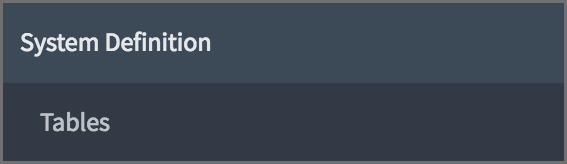
  2. From the left pane, navigate to System Definitions > Tables.

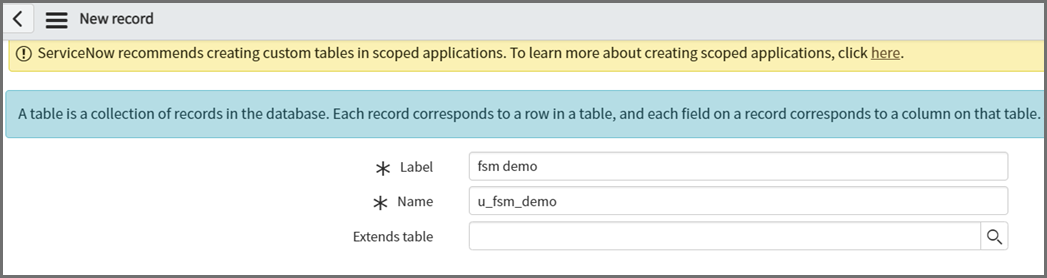
  3. Next to the heading Tables, click New to create a table.
    1. In the Label field, enter a label. Here, we can use "fsm demo". The Name field will be automatically populated. Keep this name recorded, as it will be needed later.
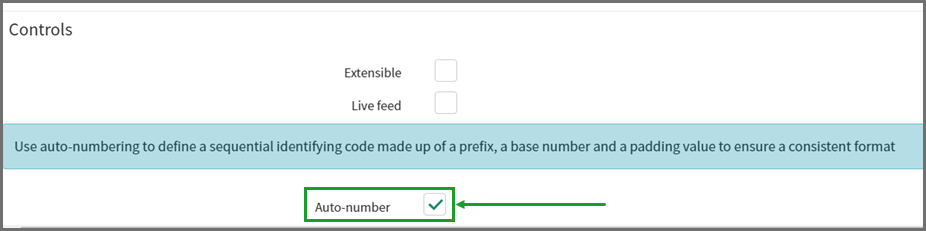
    2. Under Controls, check the Auto-number checkbox. This is required to map the External Ticket Id.

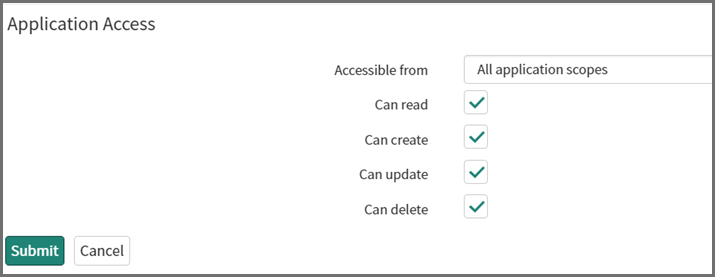
    3. Under Application Access, check the following checkboxes.
      • Can read
      • Can create
      • Can update
      • Can delete

    4. Click Submit.
      A ServiceNow table has now been created.
  4. Next to the heading Table Columns, click New to create a table column.
    1. Create your column/mappings and ensure that Type is set correctly (See FortiSIEM Incident Schema for the correct Types). For this example, we use the following:
      Type: String
      Column label: ticketnumber
      Note: For External Ticket ID
      Max length: 256
    2. Type: String
      Column label: externalcleartime
      Note: For External Cleared Time
      Max length: 256
    3. Type: String
      Column label: incident_status
      Note: For Ticket Status
      Max length: 256
    4. Configure any additional mappings necessary for your ServiceNow table.
      To create a drop-down list, navigate to Choice List Specification, and from the Choice drop-down list, make a selection. To configure what will appear in your drop-down list, click the Advanced view link, and under Choices, click New to add items to appear in your drop-down list.
  5. When done, click Submit.

Step 2. From FortiSIEM, take the following steps to create Incident Outbound Integration Policy.

  1. Login to FortiSIEM.
  2. Navigate to ADMIN > Settings > General > External Integration.
  3. Click New to create an Integration Policy, and take the following steps.
    1. From the Type drop-down list, select Incident.
    2. From the Direction drop-down list, select Outbound.
    3. From the Vendor drop-down list, select ServiceNow.
    4. In the Host/URL field, enter the ServiceNow URL being used.
    5. In the User Name field, enter the ServiceNow username credential.
    6. In the Password and Confirm Password field, enter the password associated with the ServiceNow User Name account.
    7. In the ServiceNow Table Name field, enter the name of the ServiceNow table that was set up during the ServiceNow table creation.
    8. In the Content Mapping row, click the Edit icon.
    9. In the Integration Policy > Incident Outbound Content Mapping window, take the following steps.

      1. From the FortiSIEM Incident Field drop-down list, select External Ticket Id.
      2. From the ServiceNow Field drop-down list, select the "ticketnumber" mapping.
      3. From the FortiSIEM Incident Field drop-down list, select External Ticket State.
      4. From the ServiceNow Field drop-down list, select the "externalcleartime" mapping.
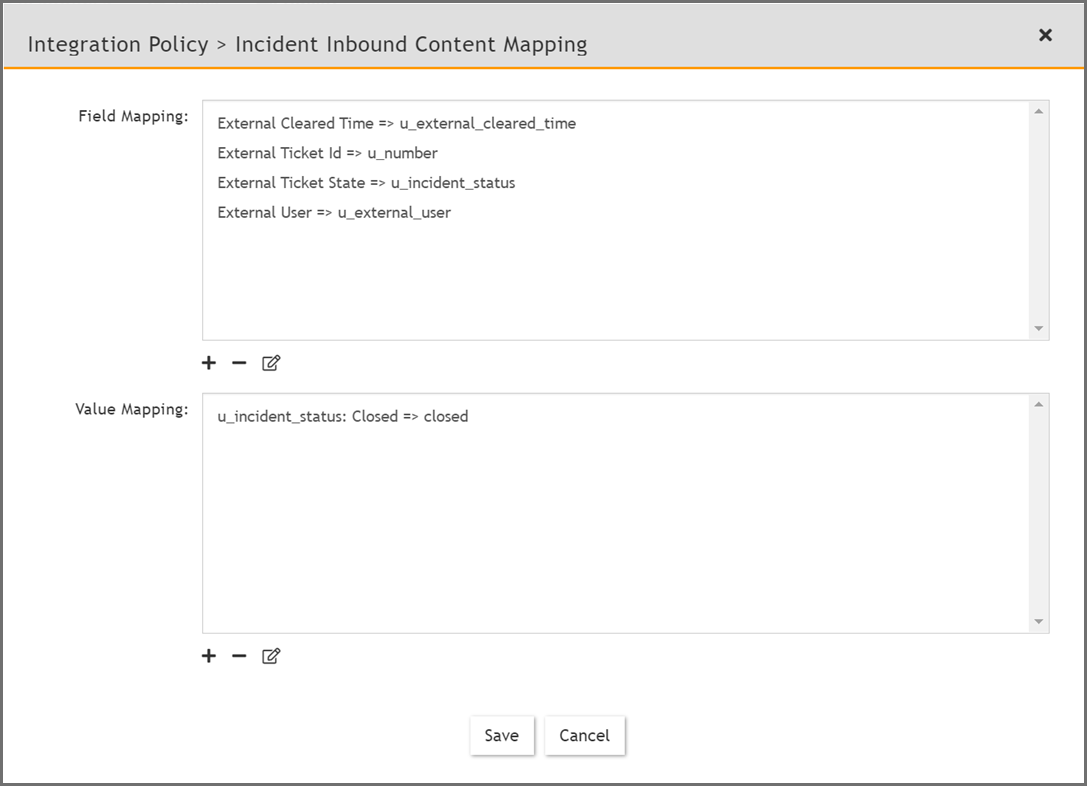
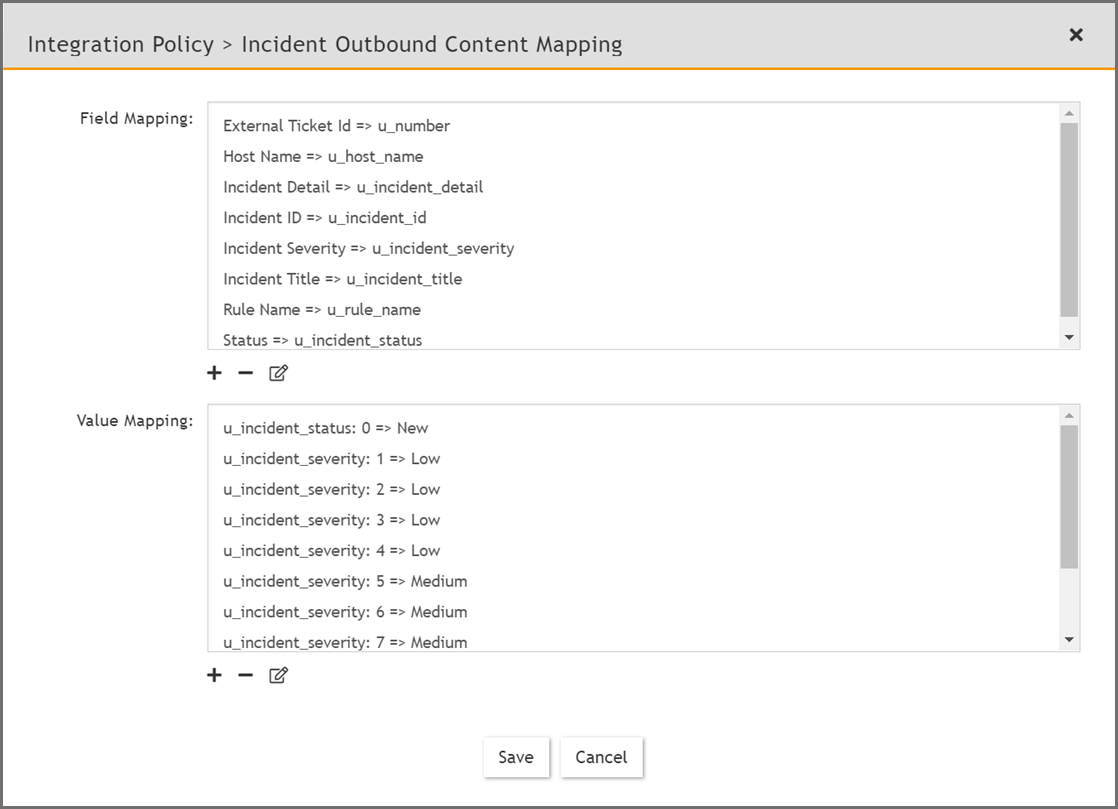
        A more complicated custom mapping is provided in the following screenshot.

      5. Click Save.
    10. Click Save.
      Your Outbound Integration Policy has been created.

Step 3. From FortiSIEM, take the following steps to create Incident Inbound Integration Policy.

  1. Click New to create an Integration Policy, and take the following steps.
    1. From the Type drop-down list, select Incident.
    2. From the Direction drop-down list, select Inbound.
    3. From the Vendor drop-down list, select ServiceNow.
    4. In the Host/URL field, enter the ServiceNow URL being used.
    5. In the User Name field, enter the ServiceNow username credential.
    6. In the Password and Confirm Password field, enter the password associated with the ServiceNow User Name account.
    7. In the ServiceNow Table Name field, enter the name of the ServiceNow table that was set up during the ServiceNow table creation.
    8. In the Content Mapping row, click the Edit icon.
    9. In the Integration Policy > Incident Outbound Content Mapping window, take the following steps.
      1. From the FortiSIEM Incident Field drop-down list, select from External Cleared Time, External Ticket Id, External Ticket State, External User, or Incident Resolution.
        Note: External Ticket ID and External Ticket State are required.
      2. From the ServiceNow Field drop-down list, select the corresponding column.
      3. Click Save.
      4. Repeat i.-iii. for any additional mappings. Proceed to v. when done with incident mapping.
      5. In Value Mapping, click + .
      6. In the Field drop-down list, select the ServiceNow "external ticket state".
      7. In the From field, enter "Closed".
        The value mapping should appear similar to the following example: u_incident_status: Closed => closed

      8. Click Save.
    10. Click Save.
      Your Inbound Integration Policy has been created. Now, if you close an incident/ticket in ServiceNow, and run the inbound integration in FortiSIEM, the incident/ticket will also be closed.

Step 4. Run Outbound Integration

  1. Confirm you are on the External Integration page. (ADMIN > Settings > General > External Integration)
  2. Select the Outbound Integration you created.
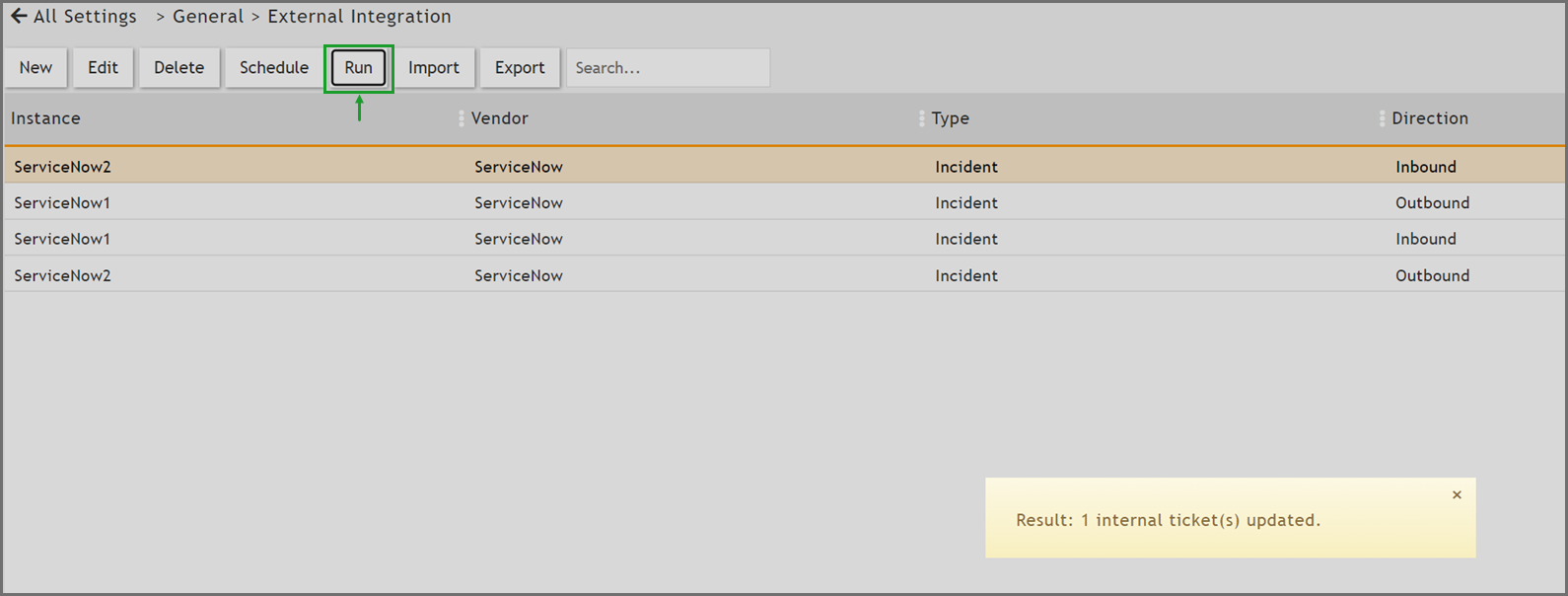
  3. Click Run.
    Note: The maximum number of incidents can be configured by changing the value of the Max Incidents field in your Outbound Integration Automation policy .
  4. Click Yes to confirm.

Step 5. Run Inbound Integration

  1. Confirm you are on the External Integration page. (ADMIN > Settings > General > External Integration)
  2. Select the Inbound Integration you created.
  3. Click Run.
    Note: You can verify the closing of an incident/ticket by checking the External Ticket State column.

ServiceNow Integration

ServiceNow Integration

Configuring ServiceNow for FortiSIEM Integration

  1. Log in to ServiceNow.
  2. For Service Provider Configurations, create Companies by creating Company Name.
  3. For the integrations to work, FortiSIEM needs to modify certain ServiceNow database tables.
    • if you are using custom integration, then make sure that the FortiSIEM user account has the read/write permissions on the specific ServiceNow tables and columns.

Incident Outbound Integration (Default)

In this integration, you can create tickets in ServiceNow when an Incident triggers in FortiSIEM. In the Default integration, FortiSIEM Incidents are written to the ServiceNow incident table. FortiSIEM incident attributes are mapped to ServiceNow incident table columns as follows.

FortiSIEM Incident Attribute

ServiceNow Incident Table Column

Incident Status

work_notes

Incident Name

short_description

Incident Comments (generated string containing few Incident attributes – see Step 1.4.k.)

comments

Organization Name

company

Incident Severity

impact

Incident Severity

urgency

Step 1: Create an Integration

  1. Log into your Supervisor node with administrator credentials.
  2. Navigate to ADMIN > Settings > General > External Integration.
  3. Click New.
  4. From the Integration Policy window, take the following steps.
    1. From the Type drop-down list, select Incident.
    2. From the Direction drop-down list, select Outbound.
    3. From the Vendor drop-down list, select ServiceNow. When you select a vendor, an instance is created, with a unique name for the policy. For example, if you had two ServiceNow installations, each would have different instance names.
    4. Set the Instance - This is the name of the integration. If you want matching inbound and outbound Incident integration for a specific vendor, then the instance name for the inbound and outbound integration must be the same. For example, ServiceNow Outbound and ServiceNow Inbound should have the same instance name, for example, ServiceNow1.
    5. For Plugin Name, a default Plugin Name is populated. Leave it as is. This is the Java code that implements the integration, including connecting to the external help desk systems and synching the CMDB elements.
    6. In the Host/URL field, enter the login URL, for example, https://vendor123.service-now.com.
    7. In the User Name field, enter the ServiceNow username login credential.
    8. In the Password field, enter the ServiceNow password login credential.
    9. Leave the ServiceNow Table Name attribute alone.
    10. In the Description field, enter a description as to what the integration does. This is for display purposes only.
    11. For Incident Comment, you can keep the default format shown in Step 1.k.i, or create your own, shown in Step 1.k.ii.
      1. Default format : [FortiSIEM]Incident Id:<val>;First seen time:<val>;Target IP:<val>;Incident Details:<val>;Mitre TechniqueId:<val>;Mitre Tactics:<val>; Description:<Rule Name>
      2. To create your own, click the Edit icon, and form a string by combining your own text and incident attributes by choosing from the Insert Content drop-down list. When done, click Save.
    12. For Organization Mapping, click the Edit icon to create mappings between the Organizations in your FortiSIEM deployment and Company names in ServiceNow (created in Configuring ServiceNow for FortiSIEM Integration, Step 2).
    13. For Run For, click the Edit icon, and choose the organizations for whom tickets will be created.
    14. In the Max Incidents field, enter the maximum number of incidents you want to record.
    15. Click Save.

Step 2: Link Integration to an Automation Policy

You need to link the integration to an automation policy, so that the integration runs when the automation policy triggers.

Take the following steps.

  1. Go to ADMIN > Settings > General > Automation Policy.
  2. Click New to create a new policy or Edit to edit an existing policy.
  3. In the Automation Settings dialog box, select Action > Invoke an Integration Policy, then select the edit icon.
  4. Choose a specific integration from the drop-down list.
  5. Click Save.

Incident Outbound Integration (Custom)

In this integration, you can create tickets in ServiceNow when an Incident triggers in FortiSIEM. You can choose your own ServiceNow table to map FortiSIEM Incidents to. Take the following steps to create a custom outbound integration.

Step 1: Create an Integration

  1. Log into your Supervisor node with administrator credentials.
  2. Navigate to ADMIN > Settings > General > External Integration.
  3. Click New.
  4. From the Integration Policy window, take the following steps.
    1. From the Type drop-down list, select Incident.
    2. From the Direction drop-down list, select Outbound.
    3. From the Vendor drop-down list, select ServiceNow. When you select a vendor, an instance is created, with a unique name for the policy. For example, if you had two ServiceNow installations, each would have different instance names.
    4. For Plugin Name, a default Plugin Name is populated. Leave it as is. This is the Java code that implements the integration, including connecting to the external help desk systems and synching the CMDB elements. For other vendors, you must create your own plugin and enter the plugin name here.
    5. In the Host/URL field, enter the login URL, for example, https://vendor123.service-now.com.
    6. In the User Name field, enter the ServiceNow username login credential.
    7. In the Password field, enter the ServiceNow password login credential.
    8. In the ServiceNow Table Name field, enter the custom ServiceNow table
    9. In the Description field, enter a description as to what the integration does. This is for display purposes only.
    10. For Incident Comment, you can keep the default format shown in Step 1.j.i, or create your own, shown in Step 1.j.ii.
      1. Default format : [FortiSIEM]Incident Id:<val>;First seen time:<val>;Target IP:<val>;Incident Details:<val>;Mitre TechniqueId:<val>;Mitre Tactics:<val>; Description:<Rule Name>
      2. To create your own, click the Edit icon, and form a string by combining your own text and incident attributes by choosing from the Insert Content drop-down list. When done, click Save.
    11. For Organization Mapping, click the Edit icon to create mappings between the Organizations in your FortiSIEM deployment and Company names in ServiceNow (created in Configuring ServiceNow for FortiSIEM Integration, Step 2).
    12. For Run For, click the Edit icon, and choose the organizations for whom tickets will be created.
    13. For Content Mapping, click the Edit icon to define mappings between FortiSIEM Incident fields and ServiceNow custom table columns.
      1. Select the Field Mappings dialog box and click +.
        Note: To delete a Field Mapping, select the entry and click -. To edit a Field Mapping, click the Edit icon.
      2. From the FortiSIEM Incident Field drop-down list, select a FortiSIEM Incident field.
      3. From the ServiceNow Field drop-down list, select a mapped ServiceNow field. Note that the menu is populated from the table in step 4.i.
      4. Select the Value Mappings dialog box and click + to enter Value Mappings if you want the values for a specific field to be transformed. A standard example is Severity, where FortiSIEM Incident Severity 1-> 4 may be mapped to Low, 5-8 as Medium and 9-10 as High.
      5. From Field, select the ServiceNow Field whose values need to be transformed.
      6. In the From field, select the value that FortiSIEM generates.
      7. In the To field, select the value that you want ServiceNow to store.
      8. When done, click Save.
    14. In the Max Incidents field, enter the maximum number of incidents you want to record.
    15. Click Save.

Step 2: Link Integration to an Automation Policy

You need to link the integration to an automation policy, so that the integration runs when the automation policy triggers.

Note: In the default Outbound integration, Incident updates are recorded in the comments field. However, in the custom integration, Incident updates are not reflected in ServiceNow.

Take the following steps.

  1. Go to ADMIN > Settings > General > Automation Policy.
  2. Click New to create a new policy or Edit to edit an existing policy.
  3. In the Automation Policy dialog box, select Action > Invoke an Integration Policy, then select the edit icon.
  4. Choose a specific integration from the drop-down list.
  5. Click Save.

Incident Inbound Integration (Default)

Using this integration, a FortiSIEM Incident can be programmatically cleared when a user closes the corresponding ticket in ServiceNow. In the default integration, the following fields from ServiceNow incident table are mapped to FortiSIEM incident fields.

ServiceNow Incident Table Column

FortiSIEM Incident Field

incident_state

Incident Status

Closed_code

Incident Resolution

Closed_by

External User

number

External Ticket Id

incident_state

External Ticket Status

Step 1: Create an Incident Inbound Integration

  1. Log into your Supervisor node with administrator credentials.
  2. Navigate to ADMIN > Settings > General > External Integration.
  3. Click New.
  4. From the Integration Policy window, take the following steps.
    1. From the Type drop-down list, select Incident.
    2. From the Direction drop-down list, select Inbound.
    3. From the Vendor drop-down list, select ServiceNow. When you select a vendor, an instance is created, with a unique name for the policy. For example, if you had two ServiceNow installations, each would have different instance names.
    4. Set the Instance - This is the name of the integration. If you want matching inbound and outbound Incident integration for a specific vendor, then the instance name for the inbound and outbound integration must be the same. For example, ServiceNow Outbound and ServiceNow Inbound should have the same instance name, for example, ServiceNow1.
    5. For Plugin Name, a default Plugin Name is populated. Leave it as is. This is the Java code that implements the integration, including connecting to the external help desk systems and synching the CMDB elements.
    6. In the Host/URL field, enter the login URL, for example, https://vendor123.service-now.com.
    7. In the User Name field, enter the ServiceNow username login credential.
    8. In the Password field, enter the ServiceNow password login credential.
    9. Leave the ServiceNow Table Name attribute alone.
    10. In the Description field, enter a description as to what the integration does. This is for display purposes only.
    11. For Content Mapping, do not make any edits. Keep the system defined one.
    12. In the Time Window field, enter/select the number of hours for which incident states will be synched from ServiceNow. For example, if time window is set to 10 hours, then the states of incidents that occurred in the last 10 hours will be synched.
    13. When done, click Save.

Step 2: Create an Incident Inbound Integration Schedule

This determines the schedule on which the inbound integration policy defined in Step 1: Create an Incident Inbound Integration will be run.

  1. Log into your Supervisor node with administrator credentials.
  2. Navigate to ADMIN > Settings > General > External Integration.
  3. Click Schedule.
  4. Click + to open the Integration Policy Schedules window.
    1. From the Integration Policy column, select your integration policy and move it to the Selected column.
    2. Under Time Range, configure your schedule by taking the following steps.
      1. In the Start Time field, enter the start time of your schedule.
      2. From the Local/UTC Timeand Region drop-down lists, configure the start time of the schedule.
    3. Under Recurrence Pattern, configure the frequency.
      1. Select Once, Minutely, Hourly, Daily, Weekly, or Monthly for the schedule's recurrence pattern. Depending on what is selected, configure the related date/time schedule attributes.
      2. In the Start From field, enter the date which the schedule starts.
    4. When done, click Save.

Incident Inbound Integration (Custom)

In this integration, you can clear tickets in FortiSIEM when a user closes the corresponding ServiceNow ticket. You can choose your own ServiceNow table to update the following FortiSIEM Incident fields:

  • External Ticket Id
  • Incident Status
  • Incident Resolution
  • External User
  • External Ticket State

Step 1: Create an Incident Inbound Integration

  1. Log into your Supervisor node with administrator credentials.
  2. Navigate to ADMIN > Settings > General > External Integration.
  3. Click New.
  4. From the Integration Policy window, take the following steps.
    1. From the Type drop-down list, select Incident.
    2. From the Direction drop-down list, select Inbound.
    3. From the Vendor drop-down list, select ServiceNow. When you select a vendor, an instance is created, with a unique name for the policy. For example, if you had two ServiceNow installations, each would have different instance names.
    4. For Plugin Name, a default Plugin Name is populated. Leave it as is. This is the Java code that implements the integration, including connecting to the external help desk systems and synching the CMDB elements.
    5. In the Host/URL field, enter the login URL, for example, https://vendor123.service-now.com.
    6. In the User Name field, enter the ServiceNow username login credential.
    7. In the Password field, enter the ServiceNow password login credential.
    8. For the ServiceNow Table Name, choose your custom ServiceNow table.
    9. In the Description field, enter a description as to what the integration does. This is for display purposes only.
    10. For Content Mapping, click the Edit icon to define mappings between FortiSIEM Incident fields and ServiceNow custom table columns.
      1. Select the Field Mappings dialog box and click +.
        Note: To delete a Field Mapping, select the entry and click -. To edit a Field Mapping, click the Edit icon.
      2. From the FortiSIEM Incident Field drop-down list, select a FortiSIEM Incident field.
      3. From the ServiceNow Field drop-down list, select a mapped ServiceNow field. Note that the menu is populated from the table in step 4.i.
      4. Select the Value Mappings dialog box and click + to enter Value Mappings if you want the values for a specific field to be transformed. For the Incident Inbound Integration to function, we need a mapping to the "Closed" value of FortiSIEM Incident Status field. This allows FortiSIEM to close an Incident.
      5. From Field, select the ServiceNow Field whose values need to be transformed.
      6. In the From field, select the value that FortiSIEM generates.
      7. In the To field, select the value that you want ServiceNow to store.
      8. When done, click Save.
    11. In the Time Window field, enter/select the number of hours for which incident states will be synched from ServiceNow. For example, if time window is set to 10 hours, then the states of incidents that occurred in the last 10 hours will be synched.
    12. When done, click Save.

CMDB Outbound Integration (Default)

CMDB Outbound Integration populates an external CMDB from FortiSIEM’s own CMDB. Built in integrations are available for ServiceNow.

Step 1: Create a CMDB Outbound Integration

  1. Log into your Supervisor node with administrator credentials.
  2. Go to ADMIN > Settings > General > External Integration.
  3. Click New.
  4. For Type, select Device.
  5. For Direction, select Outbound.
  6. For Vendor, select the vendor of the system you want to connect to. ServiceNow is supported out of the box.
    When you select the Vendor:
    1. An Instance is created - this is the unique name for this policy. For example if you had 2 ServiceNow installations, each would have different Instance names.
    2. A default Plugin Name is populated - this is the Java code that implements the integration including connecting to the external help desk systems and synching the CMDB elements. The plugin is automatically populated for ServiceNow. For other vendors, you have to create your own plugin and type in the plugin name here.
  7. For Host/URL, enter the host name or URL of the external system. For ServiceNow, select the login URL
  8. For User Name and Password, enter a user name and password that the system can use to authenticate with the external system. For ServiceNow, select the login credentials.
  9. In Attribute Mapping, specify the mapping of attributes to resources.
  10. For Organization Mapping, click Edit to create mappings between the organizations in your FortiSIEM deployment and the names of the organization in the external system. For ServiceNow, select the Company names as in Configuring ServiceNow for FortiSIEM Integration, Step 2.
  11. For Run For, choose the organizations for whom tickets will be created.
  12. For Groups, select the FortiSIEM CMDB Groups whose member devices would be synched to external CMDB.
  13. Select Run after Discovery if you want this export to take place after you have run discovery in your system. This is the only way to push automatic changes from FortiSIEM to the external system.
  14. Enter the Maximum number of devices to send to the external system.
  15. Click Save.

Step 2: Create a CMDB Outbound Integration Schedule

Updating external CMDB automatically after FortiSIEM discovery:

  1. Create an integration policy.
  2. Make sure Run after Discovery is checked.
  3. Click Save.

Updating external CMDB on a schedule:

  1. Log into your FortiSIEM Supervisor with administrator credentials.
  2. Go to ADMIN > Settings > General > External Integration.
  3. Click Schedule and then click +.
    1. Select the integration policies.
    2. Select a schedule.

Updating external CMDB on-demand (one-time):

  1. Log into your FortiSIEM Supervisor with administrator credentials.
  2. Go to ADMIN > Settings > General > External Integration.
  3. Select a specific integration policy and click Run.

Appendix

FortiSIEM Incident Schema

The following FortiSIEM Incident fields are available for integration.

FortiSIEM Incident Field

Type

Description

Required for Custom Integration

Incident ID

64bit Integer

Incident Id in FortiSIEM database.

Optional for outbound

Incident Title

String

Incident Title is a formatted string to capture Incident details and actors .

Optional for outbound

Rule Name

String

The name of the rule that triggered the Incident.

Optional for outbound

Rule Description

String

The description of the rule that triggered the Incident.

Optional for outbound

First Seen Time

64bit Integer

The first time an incident triggered in FortiSIEM. Format: Unix epoch timestamp (number of seconds that have elapsed since 00:00:00 UTC on 1 January 1970)

Optional for outbound

Last Seen Time

64bit Integer

The last time an incident triggered in FortiSIEM. Format: Unix epoch timestamp (number of seconds that have elapsed since 00:00:00 UTC on 1 January 1970)

Optional for outbound

Incident Severity

32bit integer – values 1-10

Severity of the Incident. Severities are increasing meaning 1 is lowest and 10 is highest.

Optional for outbound

Incident Severity Category

String – takes 3 values: LOW, MEDIUM, HIGH

Incident severity categorized into 3 levels: LOW, MEDIUM, HIGH

Optional for outbound

Incident Source

String

Incident source attributes in comma separated attribute:Value format. Following attributes are included: srcIpAddr

Optional for outbound

Incident Target

String

Incident destination in comma separated attribute:Value format. Following attributes are included: destIpAddr, destName, hostIpAddr, hostname, user, targetUser

Optional for outbound

Incident Detail

String

Incident details in comma separated attribute:Value format. All attributes not included in Incident Source and Incident target are included in this attribute.

Optional for outbound

Triggering Attributes

String

List of attributes present in the incident.

Optional for outbound

Incident Count

32bit integer

Number of times the incident triggered.

Optional for outbound

Host Name

String

Host Name in incident. This is also present in Incident Target.

Optional for outbound

Incident Comment

String

Comments added by user or by a notification script.

Optional for outbound

Status

32bit integer

Incident Status: 0 means Active, 1 means System Cleared, 2 means User Cleared.

Optional for outbound

Incident Resolution

String

Four values: Open, InProgress, TruePostive and FalsePositive

Optional for outbound

Rule Remediation Note

String

Optional for outbound

External Ticket Id

String

ServiceNow Ticket Id

Required for both Inbound and Outbound

External Ticket State

String

ServiceNow Ticket State

Required for Inbound and must have a value mapping for “Closed”

External User

String

User who closed the Ticket in ServiceNow.

Optional for outbound

External Cleared Time

String

Time at which Incident cleared in ServiceNow.

Required for Inbound

There are two main requirements for a successful custom integration.

  1. Outbound and Inbound – must have a mapping for External Ticket Id.
  2. Inbound - External Ticket State must have value “Closed”.
  3. Inbound - must have a mapping for External Cleared Time.
Required Permissions for ServiceNow SOAP Integration
General Requirements

FortiSIEM uses ServiceNow Direct Web Service for integration. FortiSIEM communicates on SOAP port 80.

The following SOA APIs are used:

  • Insert
  • Update
  • getKeys
  • get
  • getRecords

The following role types are required:

  • soap_create
  • soap_query
  • soap_query_update
  • soap_update

The following Table and Field permissions are provided.

Required Table and Field Permissions for CMDB Outbound Integration

Main Table Permissions

ServiceNow Table

FortiSIEM Actions

Required Permissions

configuration item

[cmdb_ci]

  • Query
  • Insert
  • Update
  • Read
  • Write
  • Create
Running Process

[cmdb_running_process]

  • Query
  • Insert / Create
  • Update
  • Read
  • Write
  • Create
Software Instance

[cmdb_software_instance]

  • Query
  • Insert / Create
  • Update
  • Read
  • Write
  • Create

Extended Table Permissions

ServiceNow Table

FortiSIEM Actions

Required Permissions

cmdb_ci_linux_server
  • Query
  • Insert / Create
  • Update
  • Read
  • Write
  • Create
cmdb_ci_win_server
  • Query
  • Insert / Create
  • Update
  • Read
  • Write
  • Create
cmdb_ci_hpux_server
  • Query
  • Insert / Create
  • Update
  • Read
  • Write
  • Create
cmdb_ci_unix_server
  • Query
  • Insert / Create
  • Update
  • Read
  • Write
  • Create
cmdb_ci_aix_server
  • Query
  • Insert / Create
  • Update
  • Read
  • Write
  • Create
cmdb_ci_solaris_server
  • Query
  • Insert / Create
  • Update
  • Read
  • Write
  • Create
cmdb_ci_esx_server
  • Query
  • Insert / Create
  • Update
  • Read
  • Write
  • Create
cmdb_ci_web_server
  • Query
  • Insert / Create
  • Update
  • Read
  • Write
  • Create

cmdb_ci_app_server_java

  • Query
  • Insert / Create
  • Update
  • Read
  • Write
  • Create

cmdb_ci_app_server_tomcat

  • Query
  • Insert / Create
  • Update
  • Read
  • Write
  • Create

cmdb_ci_app_server_weblogic

  • Query
  • Insert / Create
  • Update
  • Read
  • Write
  • Create

cmdb_ci_app_server_websphere

  • Query
  • Insert / Create
  • Update
  • Read
  • Write
  • Create

cmdb_ci_app_server_jboss

  • Query
  • Insert / Create
  • Update
  • Read
  • Write
  • Create

cmdb_ci_netware_server

  • Query
  • Insert / Create
  • Update
  • Read
  • Write
  • Create

cmdb_ci_database

  • Query
  • Insert / Create
  • Update
  • Read
  • Write
  • Create

cmdb_ci_vpn

  • Query
  • Insert / Create
  • Update
  • Read
  • Write
  • Create

cmdb_ci_ip_router

  • Query
  • Insert / Create
  • Update
  • Read
  • Write
  • Create

cmdb_ci_netgear

  • Query
  • Insert / Create
  • Update
  • Read
  • Write
  • Create

cmdb_ci_ups

  • Query
  • Insert / Create
  • Update
  • Read
  • Write
  • Create

cmdb_ci_printer

  • Query
  • Insert / Create
  • Update
  • Read
  • Write
  • Create

cmdb_ci_network_adapter

  • Query
  • Insert / Create
  • Update
  • Read
  • Write
  • Create

cmdb_ci_storage_disk

  • Query
  • Insert / Create
  • Update
  • Read
  • Write
  • Create

Reference Table Permissions

ServiceNow Table

FortiSIEM Actions

Required Permissions

Company

[core_company]

  • Query
  • Read

Reference Field Permissions

Field ServiceNow Table Required Permissions Need write_role
company core_company
  • Read

  • Write

Yes. The default role in ServiceNow is : admin

Regular Field Permissions

Need Read/Write and write_role is not required.

Required Table and Field Permissions for Incident Outbound Integration

Main Table Permissions

ServiceNow Table

FortiSIEM Actions

Required Permissions

Incident

[incident]

  • Query
  • Insert / Create
  • Update
  • Read
  • Write
  • Create

Reference Table Permissions

ServiceNow Table

FortiSIEM Actions

Required Permissions

Company

[core_company]

  • Query
  • Read

Reference Field Permissions

Field

ServiceNow Table

Required Permissions

Need write_role

assigned_to sys_user
  • Read

Yes. The default role in ServiceNow is : itil
company core_company
  • Read

  • Write

Yes. The default role in ServiceNow is: admin

Regular Field Permissions

Field

Required Permissions

Need write_role

state
  • Read

Yes. The default role in ServiceNow is : itil

comments

  • Read
  • Write

Yes. The default role in ServiceNow is : itil

closed_by

  • Read

Yes. The default role in ServiceNow is : itil

short_description

  • Read
  • Write

Yes. The default role in ServiceNow is : itil

impact

  • Read
  • Write

Yes. The default role in ServiceNow is : itil

urgency

  • Read
  • Write

Yes. The default role in ServiceNow is : itil

closed_at

  • Read

Yes. The default role in ServiceNow is : admin

work_notes

  • Read
  • Write

Yes. The default role in ServiceNow is : itil

Active

  • Read
  • Write

No

Example Custom Integration

This section provides a sample integration.

There are a few main requirements for a successful custom integration

  1. Outbound and Inbound – must have a mapping for External Ticket Id
  2. Inbound - External Ticket State must have value “Closed”
  3. Inbound - must have a mapping for External Cleared Time

Follow these steps:

Step 1. From ServiceNow, take the following steps to create a ServiceNow Table.

  1. Login to ServiceNow.
  2. From the left pane, navigate to System Definitions > Tables.


  3. Next to the heading Tables, click New to create a table.
    1. In the Label field, enter a label. Here, we can use "fsm demo". The Name field will be automatically populated. Keep this name recorded, as it will be needed later.

    2. Under Controls, check the Auto-number checkbox. This is required to map the External Ticket Id.


    3. Under Application Access, check the following checkboxes.
      • Can read
      • Can create
      • Can update
      • Can delete

    4. Click Submit.
      A ServiceNow table has now been created.
  4. Next to the heading Table Columns, click New to create a table column.
    1. Create your column/mappings and ensure that Type is set correctly (See FortiSIEM Incident Schema for the correct Types). For this example, we use the following:
      Type: String
      Column label: ticketnumber
      Note: For External Ticket ID
      Max length: 256
    2. Type: String
      Column label: externalcleartime
      Note: For External Cleared Time
      Max length: 256
    3. Type: String
      Column label: incident_status
      Note: For Ticket Status
      Max length: 256
    4. Configure any additional mappings necessary for your ServiceNow table.
      To create a drop-down list, navigate to Choice List Specification, and from the Choice drop-down list, make a selection. To configure what will appear in your drop-down list, click the Advanced view link, and under Choices, click New to add items to appear in your drop-down list.
  5. When done, click Submit.

Step 2. From FortiSIEM, take the following steps to create Incident Outbound Integration Policy.

  1. Login to FortiSIEM.
  2. Navigate to ADMIN > Settings > General > External Integration.
  3. Click New to create an Integration Policy, and take the following steps.
    1. From the Type drop-down list, select Incident.
    2. From the Direction drop-down list, select Outbound.
    3. From the Vendor drop-down list, select ServiceNow.
    4. In the Host/URL field, enter the ServiceNow URL being used.
    5. In the User Name field, enter the ServiceNow username credential.
    6. In the Password and Confirm Password field, enter the password associated with the ServiceNow User Name account.
    7. In the ServiceNow Table Name field, enter the name of the ServiceNow table that was set up during the ServiceNow table creation.
    8. In the Content Mapping row, click the Edit icon.
    9. In the Integration Policy > Incident Outbound Content Mapping window, take the following steps.

      1. From the FortiSIEM Incident Field drop-down list, select External Ticket Id.
      2. From the ServiceNow Field drop-down list, select the "ticketnumber" mapping.
      3. From the FortiSIEM Incident Field drop-down list, select External Ticket State.
      4. From the ServiceNow Field drop-down list, select the "externalcleartime" mapping.
        A more complicated custom mapping is provided in the following screenshot.


      5. Click Save.
    10. Click Save.
      Your Outbound Integration Policy has been created.

Step 3. From FortiSIEM, take the following steps to create Incident Inbound Integration Policy.

  1. Click New to create an Integration Policy, and take the following steps.
    1. From the Type drop-down list, select Incident.
    2. From the Direction drop-down list, select Inbound.
    3. From the Vendor drop-down list, select ServiceNow.
    4. In the Host/URL field, enter the ServiceNow URL being used.
    5. In the User Name field, enter the ServiceNow username credential.
    6. In the Password and Confirm Password field, enter the password associated with the ServiceNow User Name account.
    7. In the ServiceNow Table Name field, enter the name of the ServiceNow table that was set up during the ServiceNow table creation.
    8. In the Content Mapping row, click the Edit icon.
    9. In the Integration Policy > Incident Outbound Content Mapping window, take the following steps.
      1. From the FortiSIEM Incident Field drop-down list, select from External Cleared Time, External Ticket Id, External Ticket State, External User, or Incident Resolution.
        Note: External Ticket ID and External Ticket State are required.
      2. From the ServiceNow Field drop-down list, select the corresponding column.
      3. Click Save.
      4. Repeat i.-iii. for any additional mappings. Proceed to v. when done with incident mapping.
      5. In Value Mapping, click + .
      6. In the Field drop-down list, select the ServiceNow "external ticket state".
      7. In the From field, enter "Closed".
        The value mapping should appear similar to the following example: u_incident_status: Closed => closed

      8. Click Save.
    10. Click Save.
      Your Inbound Integration Policy has been created. Now, if you close an incident/ticket in ServiceNow, and run the inbound integration in FortiSIEM, the incident/ticket will also be closed.

Step 4. Run Outbound Integration

  1. Confirm you are on the External Integration page. (ADMIN > Settings > General > External Integration)
  2. Select the Outbound Integration you created.
  3. Click Run.
    Note: The maximum number of incidents can be configured by changing the value of the Max Incidents field in your Outbound Integration Automation policy .

  4. Click Yes to confirm.

Step 5. Run Inbound Integration

  1. Confirm you are on the External Integration page. (ADMIN > Settings > General > External Integration)
  2. Select the Inbound Integration you created.
  3. Click Run.
    Note: You can verify the closing of an incident/ticket by checking the External Ticket State column.