
Fortinet white logo
Fortinet white logo

New Features

Secure explicit proxy with client certificate blocklist enforcement

Secure explicit proxy with client certificate blocklist enforcement

This information is also available in the FortiOS 8.0 Administration Guide:

Client certificate blocklist enforcement is now supported. FortiGate ensures that secure explicit proxy connections are protected against known malicious client certificates listed in the Malicious Certificate Database (MCDB), improving security posture and compliance.

Overview

Secure explicit proxy with client certificates allows FortiGate to authenticate proxy clients using X.509 certificates. When client certificate blocklist, enforcement is enabled, FortiGate checks the presented client certificate against the MCDB during the TLS handshake.

If the client certificate is listed in the MCDB:

  • The TLS handshake is aborted

  • The proxy connection is denied

  • A log entry is generated

This prevents malicious certificates from accessing web resources through the proxy.

The config web-proxy explicit command includes a new option:

config web-proxy explicit
    set client-certificate-blocklist {enable | disable}
end

Option

Description

client-certificate-blocklist {enable | disable}

Enable/disable blocking client malicious certificates list by FortiGuard during TLS (default = enabled).

  • enable: Enable client certificate blocklist during TLS handshake.

  • disable: Disable client certificate blocklist during TLS handshake.

Example

The following example demonstrates client certificate blocklist enforcement using a secure explicit proxy.
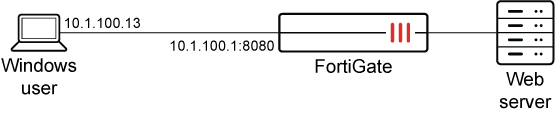
Prerequisite:

An active FortiGuard subscription is required to use the Malicious Certificate Database (MCDB). The MCDB is used by FortiGate’s SSL/TLS inspection and certificate reputation checks to detect and block SSL/TLS sessions that present malicious certificates.

To configure client certificate and blocklist enforcement with explicit proxies:
  1. Prepare the certificate:

    1. Use a CA to sign the client certificate.

    2. Import the root CA certificate that signed the client certificate to FortiGate. In this scenario, the certificate is root_ca.

    3. Install the client certificate on an endpoint.

  2. Configure the explicit web-proxy policy to request the client certificate from the endpoint.

    config web-proxy explicit
        set status enable
        set secure-web-proxy secure
        set http-incoming-port 8080
        set secure-web-proxy-cert "proxyserver"
        set client-cert enable
        set client-certificate-blocklist enable
    end
    
  3. Configure verification of the client certificate with the root CA.

    config authentication setting
        set user-cert-ca "root_ca"
    end
    
  4. Configure explicit proxy policy.

    config firewall proxy-policy
        edit 1
            set proxy explicit-web
            set srcaddr "all"
            set dstaddr "all"
            set service "web"
            set action accept
            set schedule "always"
            set logtraffic all
            set utm-status enable
            set ssl-ssh-profile "deep-custom"
        next
    end
    
Verification

On Client PC, initiate a connection with blocklisted client certificate:

# curl -v -k --proxy-insecure --proxy-cert /root/CA/client_blocklist.p12:123456 --proxy-cert-type P12 -x https://10.1.100.1:8080 http://172.16.200.99

TLS handshake fails, connection is denied, and following log is generated on the FortiGate:

1: date=2026-04-02 time=17:33:31 eventtime=1775176410797092890 tz="-0700" logid="0000000013" type="traffic" subtype="forward" level="notice" vd="vdom1" srcip=10.1.100.13 srcport=53684 srcintf="port2" srcintfrole="undefined" dstip=10.1.100.1 dstport=8080 dstintf="unknown-0" dstintfrole="undefined" srccountry="Reserved" dstcountry="Reserved" sessionid=268435461 proto=6 action="deny" policyid=0 policytype="policy" service="tcp/8080" trandisp="noop" appcat="unscanned" duration=0 sentbyte=1965 rcvdbyte=0 sentpkt=0 rcvdpkt=0 crscore=30 craction=131072 crlevel="high" msg="Traffic denied because of client certificate blocklisted"

Secure explicit proxy with client certificate blocklist enforcement

Secure explicit proxy with client certificate blocklist enforcement

This information is also available in the FortiOS 8.0 Administration Guide:

Client certificate blocklist enforcement is now supported. FortiGate ensures that secure explicit proxy connections are protected against known malicious client certificates listed in the Malicious Certificate Database (MCDB), improving security posture and compliance.

Overview

Secure explicit proxy with client certificates allows FortiGate to authenticate proxy clients using X.509 certificates. When client certificate blocklist, enforcement is enabled, FortiGate checks the presented client certificate against the MCDB during the TLS handshake.

If the client certificate is listed in the MCDB:

  • The TLS handshake is aborted

  • The proxy connection is denied

  • A log entry is generated

This prevents malicious certificates from accessing web resources through the proxy.

The config web-proxy explicit command includes a new option:

config web-proxy explicit
    set client-certificate-blocklist {enable | disable}
end

Option

Description

client-certificate-blocklist {enable | disable}

Enable/disable blocking client malicious certificates list by FortiGuard during TLS (default = enabled).

  • enable: Enable client certificate blocklist during TLS handshake.

  • disable: Disable client certificate blocklist during TLS handshake.

Example

The following example demonstrates client certificate blocklist enforcement using a secure explicit proxy.

Prerequisite:

An active FortiGuard subscription is required to use the Malicious Certificate Database (MCDB). The MCDB is used by FortiGate’s SSL/TLS inspection and certificate reputation checks to detect and block SSL/TLS sessions that present malicious certificates.

To configure client certificate and blocklist enforcement with explicit proxies:
  1. Prepare the certificate:

    1. Use a CA to sign the client certificate.

    2. Import the root CA certificate that signed the client certificate to FortiGate. In this scenario, the certificate is root_ca.

    3. Install the client certificate on an endpoint.

  2. Configure the explicit web-proxy policy to request the client certificate from the endpoint.

    config web-proxy explicit
        set status enable
        set secure-web-proxy secure
        set http-incoming-port 8080
        set secure-web-proxy-cert "proxyserver"
        set client-cert enable
        set client-certificate-blocklist enable
    end
    
  3. Configure verification of the client certificate with the root CA.

    config authentication setting
        set user-cert-ca "root_ca"
    end
    
  4. Configure explicit proxy policy.

    config firewall proxy-policy
        edit 1
            set proxy explicit-web
            set srcaddr "all"
            set dstaddr "all"
            set service "web"
            set action accept
            set schedule "always"
            set logtraffic all
            set utm-status enable
            set ssl-ssh-profile "deep-custom"
        next
    end
    
Verification

On Client PC, initiate a connection with blocklisted client certificate:

# curl -v -k --proxy-insecure --proxy-cert /root/CA/client_blocklist.p12:123456 --proxy-cert-type P12 -x https://10.1.100.1:8080 http://172.16.200.99

TLS handshake fails, connection is denied, and following log is generated on the FortiGate:

1: date=2026-04-02 time=17:33:31 eventtime=1775176410797092890 tz="-0700" logid="0000000013" type="traffic" subtype="forward" level="notice" vd="vdom1" srcip=10.1.100.13 srcport=53684 srcintf="port2" srcintfrole="undefined" dstip=10.1.100.1 dstport=8080 dstintf="unknown-0" dstintfrole="undefined" srccountry="Reserved" dstcountry="Reserved" sessionid=268435461 proto=6 action="deny" policyid=0 policytype="policy" service="tcp/8080" trandisp="noop" appcat="unscanned" duration=0 sentbyte=1965 rcvdbyte=0 sentpkt=0 rcvdpkt=0 crscore=30 craction=131072 crlevel="high" msg="Traffic denied because of client certificate blocklisted"