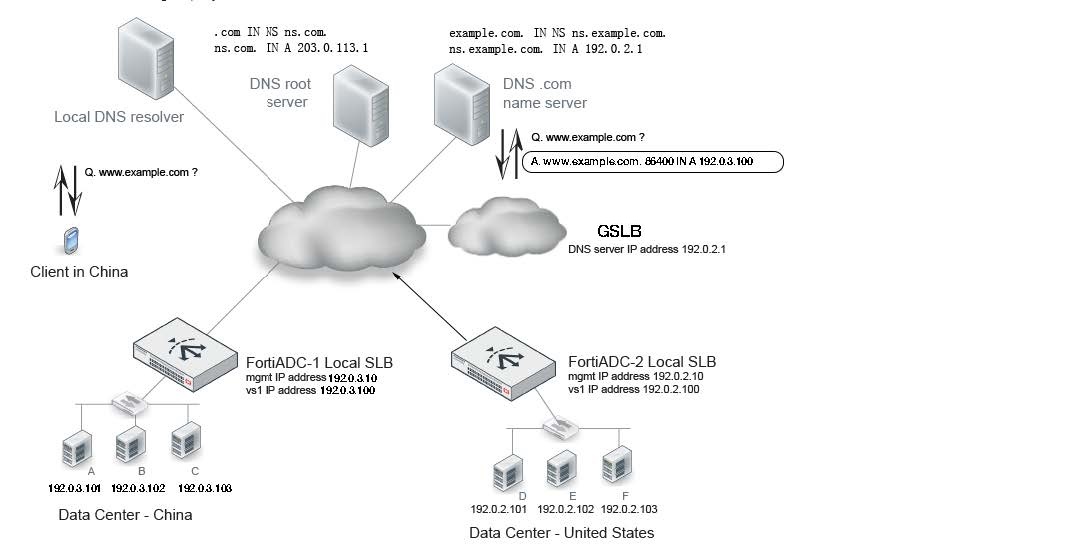
GSLB
Global Server Load Balancing (GSLB) is a DNS-based traffic management solution that ensures high availability and performance by distributing user requests across multiple servers or data centers globally. It provides redundancy and resilience by automatically directing traffic to the most optimal or available resources when a local deployment experiences unexpected downtime, spikes, or other disruptions.
GSLB supports EDNS Client Subnet (ECS) by default to improve geolocation accuracy during DNS resolution. When ECS data is available, the authoritative DNS server uses the client’s subnet to make more precise routing decisions—especially for users behind public DNS resolvers. If ECS is absent, the query’s source IP is used instead. No configuration is required.
GSLB objects are organized based on both physical and logical components on the network.
Physical Components:
-
Data Center: Represents a physical site where servers are hosted.
-
Server: Refers to physical machines located in a data center.
-
Location: A grouping of geographic areas that may include multiple data centers or servers.
Logical components:
-
Virtual Server Pool: Represents a collection of virtual servers that distribute and manage traffic logically.
-
FQDN Connector: Maps a fully-qualified domain name (FQDN) to a set of virtual servers for handling requests.
Mappings:
-
The object data center corresponds to the physical data center.
-
The object fabric connector relates to physical devices like FortiADC.
-
The object location organizes geographical regions.
-
The object pool represents a set of virtual servers.
-
The object FQDN links a fully-qualified domain name to the virtual server pool for routing traffic.