

Caching
Caching is an application delivery optimization technique in which previously retrieved content is temporarily stored so that subsequent requests for the same content can be served without contacting the backend server.
In FortiADC, caching stores eligible HTTP response content in memory and reuses it to reduce backend load, network traffic, and response time.
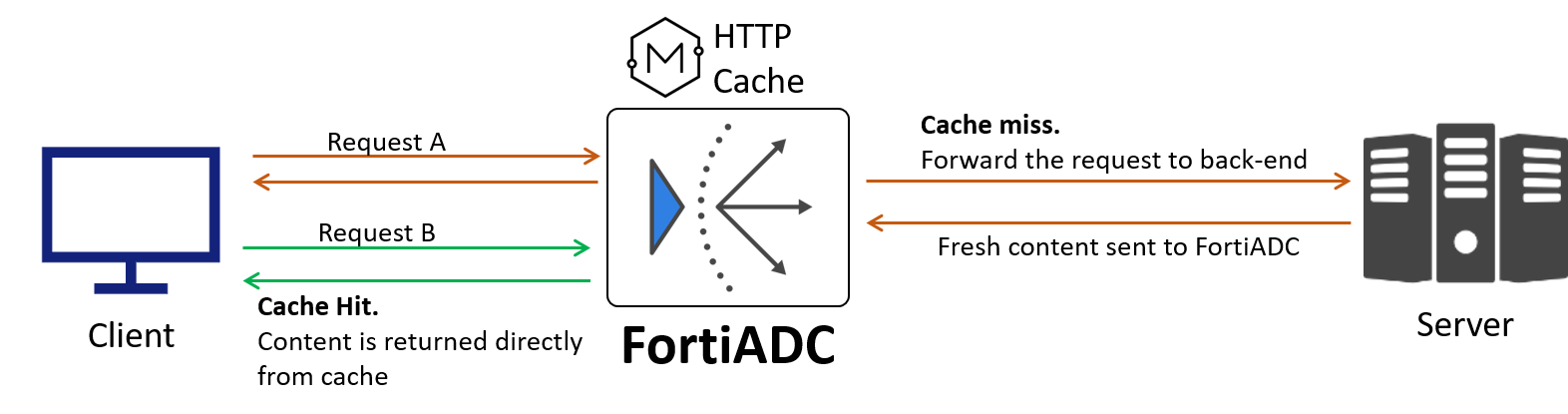
How Caching works
- A client sends an HTTP GET request to the FortiADC virtual server.
- FortiADC checks the system RAM cache to determine whether a cached copy of the requested content already exists.
- Cache Miss
If the content is not found in the cache:
- FortiADC forwards the request to the backend server.
- The backend server generates and returns the HTTP response.
- FortiADC evaluates the response against caching rules:
HTTP method
Status code
Cache-related headers
- Cache policy and size limits
- If the response is cacheable:
- FortiADC stores the content in the RAM cache.
- FortiADC forwards the response to the client.
- Cache Hit
If the content is found in the cache:
FortiADC immediately serves the cached response to the client.
The backend server is not contacted.
For more information, see Configuring caching rules in FortiADC Administration Guide.