
Fortinet white logo
Fortinet white logo

Administration Guide

Predefined basic event handlers

Predefined basic event handlers

FortiAnalyzer includes many predefined event handlers that you can use to generate events. You can easily create a custom event handler by cloning a predefined event handler and customizing its settings. See Cloning event handlers.

If you wish to recieve notifications from a pedefined event handler, configure a notification profile and assign it to the event handler. See Creating notification profiles.

Note

In 6.2.0 and up, predefined event handlers have been consolidated and have multiple rules that can be enabled or disabled individually.

To view predefined event handlers in the FortiAnalyzer GUI, go to Incidents & Events > Event Handlers > Event Handlers. From the More dropdown, select Show Predefined. The predefined event handlers display with Origin = Built-in. An icon in the Name column indicates if the event handler is a basic event handler or a correlation event handler. For more information about correlation event handlers, see Predefined correlation event handlers.
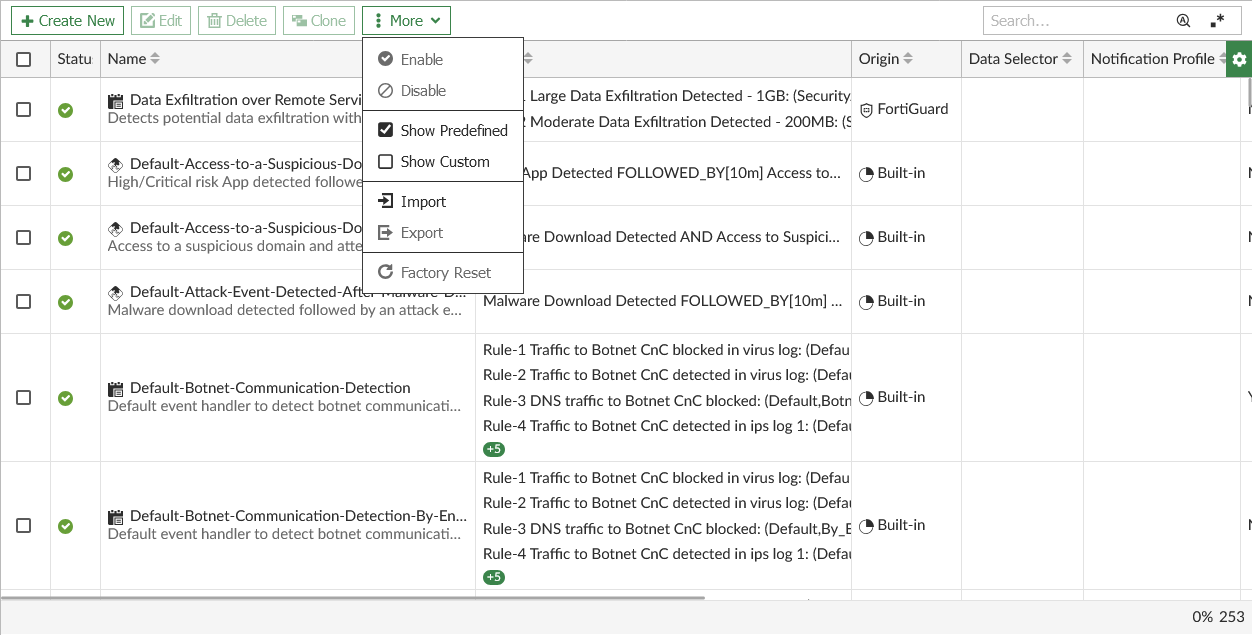
The following are a small sample of FortiAnalyzer predefined basic event handlers.

Event Handler

Description

Default-Compromised-Host-Detection-IOC-By-Threat

Default event handler to detect compromised hosts by FortiAnalyzer IOC feature grouped by threat.

Enabled by default

MITRE Tech IDs:

  • T1071.001 Web Protocols

  • T1071.004 DNS

  • T1041 Exfiltration Over C2 Channel

Rule 1: Traffic to CnC detected

  • Event Severity: Critical

  • Log Device Type: FortiGate

  • Log Type: Traffic Log > Any

  • Log Field: Destination IP, Endpoint

  • Log messages that match all of the following filters:

    • tdtype~infected

  • Event Status: Unhandled

  • Tags: IP, C&C, Ioc_Rescan

  • Custom Message: Traffic to C&C:${dstip}, Traffic path: PolicyID ${policyid}\${dstintf}\${dstip}:${dstport}

Rule 2: Web traffic to CnC detected

  • Event Severity: Critical

  • Log Device Type: FortiGate

  • Log Type: Web Filter

  • Log Field: Hostname URL, Source Endpoint

  • Log messages that match all of the following filters:

    • tdtype~infected

  • Event Status: Unhandled

  • Tags: C&C, URL, Ioc_Rescan

  • Custom Message: Traffic to C&C:${hostname}, Traffic path: PolicyID ${policyid}\${dstintf}\${dstip}:${dstport}

Rule 3: DNS traffic to CnC detected

  • Event Severity: Critical

  • Log Device Type: FortiGate

  • Log Type: DNS Log

  • Log Field: QNAME, Source Endpoint

  • Log messages that match all of the following filters:

    • tdtype~infected

  • Event Status: Unhandled

  • Tags: C&C, Domain, Ioc_Rescan

  • Custom Message: Traffic to C&C:${qname}, Traffic path: PolicyID ${policyid}\${dstintf}\${dstip}:${dstport}

Rule 4: Traffic to CnC event detected by FortiGate

  • Event Severity: Critical

  • Log Device Type: FortiGate

  • Log Type: Event Log > System

  • Log Field: Source IP

  • Log messages that match all of the following filters:

    • logid==0100020214

  • Event Status: Unhandled

  • Tags: C&C

  • Custom Message: FGT detected traffic to IOC location, from the source ip:${srcip}

Default-Data-Leak-Detection-By-Threat

Default data leak detection handler grouped by threat.

Disabled by default

MITRE Tech ID:

  • T1005 Data from Local System

Rule 1: Data leak detected

  • Event Severity: Medium

  • Log Device Type: FortiGate

  • Log Type: DLP

  • Log Field: Filter Category, Source Endpoint

  • Log messages that match all of the following filters:

    • action==log-only or action==allow

  • Event Status: Unhandled

  • Tags: Signature, Leak

  • Custom Message: File:${filename} (Type:${filetype}, Size:${filesize}), Traffic path: PolicyID ${policyid}\${dstip}:${dstport}

Rule 2: Data leak blocked

  • Event Severity: Low

  • Log Device Type: FortiGate

  • Log Type: DLP

  • Log Field: Filter Category, Source Endpoint

  • Log messages that match all of the following filters:

    • action!=log-only and action!=allow

  • Event Status: Mitigated

  • Tags: Signature, Leak

  • Custom Message: File:${filename} (Type:${filetype}, Size:${filesize}), Traffic path: PolicyID ${policyid}\${dstip}:${dstport}

Default-Sandbox-Detections-By-Endpoint

Default handler to track file submission and malware detection by FortiSandbox grouped by endpoint.

Disabled by default

MITRE Tech IDs:

  • T1041 Exfiltration Over C2 Channel

Rule 1: Malware detected

  • Event Severity: Critical

  • Log Device Type: FortiGate

  • Log Type: AntiVirus

  • Log Field: Source Endpoint, Virus Name

  • Log messages that match all of the following filters:

    • logid==0211009235 or logid==0211009237

  • Event Status: Unhandled

  • Tags: Sandbox, Signature, Malware

  • Custom Message: Malware:${virus} with severity:${crlevel} found in file:${filename} from ${dstip}:${dstport}, Reference: ${ref}

Rule 2: Malware blocked

  • Event Severity: Critical

  • Log Device Type: FortiGate

  • Log Type: AntiVirus

  • Log Field: Source Endpoint, Virus Name

  • Log messages that match all of the following filters:

    • logid==0211009234 or logid==0211009236

  • Event Status: Mitigated

  • Tags: Sandbox, Signature, Malware

  • Custom Message: Malware:${virus} with severity:${crlevel} found in file:${filename} from ${dstip}:${dstport}, Reference: ${ref}

Rule 3: Sandbox detected Malware

  • Event Severity: Critical

  • Log Device Type: FortiGate

  • Log Type: AntiVirus

  • Log Field: Source Endpoint

  • Log messages that match any one of the following filters:

    • logid==0201009238 and fsaverdict==malicious

  • Event Status: Unhandled

  • Tags: Sandbox, Malware

  • Custom Message: File:${filename}, Traffic path: ${dstintf}(Policy:${policyid})\${dstip}:${dstport}, Checksum:${analyticscksum}

Default-Shadow-IT-Events

Default event handler to detect unsanctioned user, application and file exfiltration for cloud access.

This event handler requires a FortiCASB connector configured on FortiAnalyzer. See Configuring security fabric connectors. This automatically creates the Get Cloud Service Data (FortiCasb Connector) playbook, which must be enabled for this event handler to generate events. See Playbooks.

Disabled by default

MITRE Tech ID:

  • T1011 Exfiltration Over Other Network Medium

Rule 1: Unsanctioned Applications detected

  • Event Severity: High

  • Log Device Type: FortiGate

  • Log Type: Application Control

  • Log Field: Source IP, Application Name

  • Log messages that match all of the following filters:

    • (siflags & 1) == 0 && siappid >=0

  • Event Status: Unhandled

  • Tags: Unsanctioned_App

  • Custom Message: Unsanctioned application ${app} with app risk: ${apprisk} detected on: ${devname} with message: ${msg}

Rule 2: File Exfiltration Attempts detected

  • Event Severity: High

  • Log Device Type: FortiGate

  • Log Type: Application Control

  • Log Field: Source IP, Application Name

  • Log messages that match all of the following filters:

    • (siflags & 4) == 4

  • Event Status: Unhandled

  • Tags: File_Exfiltration

  • Custom Message: File exfiltration detected on: ${devname} with message: ${msg}

Rule 3: Unsanctioned Users detected

  • Event Severity: High

  • Log Device Type: FortiGate

  • Log Type: Application Control

  • Log Field: Source IP, Application Name

  • Log messages that match all of the following filters:

    • (siflags & 1) == 1 && (siflags & 2) == 0

  • Event Status: Unhandled

  • Tags: Unsanctioned_User

  • Custom Message: Unsanctioned user: ${unauthuser} with app risk: ${apprisk} detected on: ${devname} with message: ${msg}

Local Device Event

Default local device event handler. Available only in the Root ADOM.

Enabled by default

Data Selector: Default Local Device Selector

Rule 1: Critical or important events

  • Event Severity: Medium

  • Log Device Type: Local Device

  • Log Type: Event

  • Log Field: Log Description

  • Log messages that match the following filters:

    • Level Greater Than or Equal To Warning

  • Tags: System, Local

Default-NOC-Interface-Events

Event handler for FortiGate device type logs to generate events for vlan/interface status up or down, and DNS service on interface status.

Disabled by default

MITRE Tech ID:

  • T1489 Service Stop

Rule 1: Interface status changed to up

  • Event Severity: Medium

  • Log Device Type: FortiGate

  • Log Type: Event > System

  • Log Field: Device Name, Log Description

  • Log messages that match any one of the following filters:

    • action="interface-stat-change" and status="UP"

  • Tags: NOC, Interface

  • Custom message: Device ${devname}, status changed to ${status} with message ${msg}.

Rule 2: Interface status changed to down

  • Event Severity: Medium

  • Log Device Type: FortiGate

  • Log Type: Event > System

  • Log Field: Device Name, Log Description

  • Log messages that match any one of the following filters:

    • action="interface-stat-change" and status="DOWN"

  • Tags: NOC, Interface

  • Custom message: Device ${devname}, status changed to ${status} with message ${msg}.

Rule 3: DNS server config added

  • Event Severity: Medium

  • Log Device Type: FortiGate

  • Log Type: Event > System

  • Log Field: Device Name, Log Description

  • Log messages that match any one of the following filters:

    • cfgpath="system.dns-server" and action="Add"

  • Tags: NOC, Interface, DNS

  • Custom Message: Device ${devname}, DNS server status changed with message ${msg}.

Rule 4: DNS server config deleted

  • Event Severity: Medium

  • Log Device Type: FortiGate

  • Log Type: Event > System

  • Log Field: Device Name, Log Description

  • Log messages that match all of the following filters:

    • cfgpath="system.dns-server" and action="Delete"

  • Tags: NOC, Interface, DNS

  • Custom Message: Device ${devname}, DNS server status changed with message ${msg}.

Default-NOC-FortiExtender-Events

Event handler for FortiGate device type logs to generate events for FortiExtender alerts, authorization and controller activity events.

Disabled by default

MITRE Tech ID:

  • T1499.001 OS Exhaustion Flood

Rule 1: FortiExtender Authorized

  • Event Severity: Medium

  • Log Device Type: FortiGate

  • Log Type: Event > FortiExtender

  • Log Field: SN, Log Description

  • Log messages that match any one of the following filters:

    • action="FortiExtender Authorized"

  • Tags: NOC, FortiExtender

  • Custom message: Device: ${ip} ${action} with message: ${msg}

Rule 2: Warning event detected

  • Event Severity: High

  • Log Device Type: FortiGate

  • Log Type: Event > FortiExtender

  • Log Field: SN, Log Description

  • Log messages that match any one of the following filters:

    • level="warning"

  • Tags: NOC, FortiExtender

  • Custom message: ${action} on ${ip} with message: ${msg}

Rule 3: Alert event detected

  • Event Severity: High

  • Log Device Type: FortiGate

  • Log Type: Event > FortiExtender

  • Log Field: SN, Log Description

  • Log messages that match any one of the following filters:

    • level="alert"

  • Tags: NOC, FortiExtender

  • Custom message: ${action} on ${ip} with message: ${msg}

Rule 4: Critical event detected

  • Event Severity: Critical

  • Log Device Type: FortiGate

  • Log Type: Event > FortiExtender

  • Log Field: SN, Log Description

  • Log messages that match any one of the following filters:

    • level="critical"

  • Tags: NOC, FortiExtender

  • Custom message: ${action} on ${ip} with message: ${msg}

Rule 5: Error event detected

  • Event Severity: Medium

  • Log Device Type: FortiGate

  • Log Type: Event > FortiExtender

  • Log Field: SN, Log Description

  • Log messages that match any one of the following filters:

    • level="error"

  • Tags: NOC, FortiExtender

  • Custom message: ${action} on ${ip} with message: ${msg}

Rule 6: Emergency event detected

  • Event Severity: Critical

  • Log Device Type: FortiGate

  • Log Type: Event > FortiExtender

  • Log Field: SN, Log Description

  • Log messages that match any one of the following filters:

    • level="emergency"

  • Tags: NOC, FortiExtender

  • Custom message: ${action} on ${ip} with message: ${msg}

Rule 7: FortiExtender controller activity detected

  • Event Severity: Medium

  • Log Device Type: FortiGate

  • Log Type: Event > FortiExtender

  • Log Field: SN, Log Description

  • Log messages that match any one of the following filters:

    • logid="0111046401" and logdesc="FortiExtender controller activity"

  • Tags: NOC, FortiExtender

  • Custom message: ${action} on ${ip} with message: ${msg}

Rule 8: FortiExtender controller activity error detected

  • Event Severity: Medium

  • Log Device Type: FortiGate

  • Log Type: Event > FortiExtender

  • Log Field: SN, Log Description

  • Log messages that match any one of the following filters:

    • logid="0111046402" and logdesc="FortiExtender controller activity error"

  • Tags: NOC, FortiExtender

  • Custom message: ${action} on ${ip} with message: ${msg}

Default-NOC-Routing-Events

Event handler for FortiGate device type logs to generate events for changes in routing information including BGP Neighbor Status, Routing information change, OSFP Neighbor Status, Neighbor Table Changed and VRRP State Changed.

Disabled by default

Rule 1: Routing information changed

  • Event Severity: Medium

  • Log Device Type: FortiGate

  • Log Type: Event > Any

  • Log Field: Device Name, Log Description

  • Log messages that match any one of the following filters:

    • logdesc="Routing information changed"

  • Tags: NOC, Routing

  • Custom message: ${logdesc} on ${devname} with message ${msg}

Rule 2: BGP neighbor status changed

  • Event Severity: Medium

  • Log Device Type: FortiGate

  • Log Type: Event > Router

  • Log Field: Device Name, Log Description

  • Log messages that match any one of the following filters:

    • logdesc="BGP neighbor status changed"

  • Tags: NOC, Routing

  • Custom message: ${devname}. BGP neighbor status changed with message ${msg}

Rule 3: OSPF or OSPF6 neighbor status changed

  • Event Severity: Medium

  • Log Device Type: FortiGate

  • Log Type: Event > Router

  • Log Field: Device Name, Log Description

  • Log messages that match any one of the following filters:

    • logdesc=="OSPF neighbor status changed" OR logdesc=="OSPF6 neighbor status changed"

  • Tags: NOC, Routing

  • Custom message: ${logdesc} on ${devname} with message ${msg}

Rule 4: Neighbor table changed

  • Event Severity: Medium

  • Log Device Type: FortiGate

  • Log Type: Event > Router

  • Log Field: Device Name, Log Description

  • Log messages that match any one of the following filters:

    • logdesc=="neighbor table change"

  • Tags: NOC, Routing

  • Custom message: ${logdesc} on ${devname} with message ${msg}

Rule 5: VRRP state changed

  • Event Severity: Medium

  • Log Device Type: FortiGate

  • Log Type: Event > Router

  • Log Field: Device Name, Log Description

  • Log messages that match any one of the following filters:

    • logdesc=="VRRP state changed"

  • Tags: NOC, Routing

  • Custom message: ${logdesc} on ${devname} with message ${msg}

Default-NOC-Network-Events

Event handler for FortiGate device type logs to generate network events including SNMP queries, routing information changes, DHCP server and status changes.

Disabled by default

Rule 1: Device SNMP query failed

  • Event Severity: High

  • Log Device Type: FortiGate

  • Log Type: Event > System

  • Log Field: Device Name, Log Description

  • Log messages that match all of the following filters:

    • logid="0100029021" AND logdesc="SNMP query failed"

  • Tags: NOC, Network

  • Custom message: Device: ${devname} ${logdesc} with message: ${msg}

Rule 2: Device routing information changed

  • Event Severity: High

  • Log Device Type: FortiGate

  • Log Type: Event > System

  • Log Field: Device Name, Log Description

  • Log messages that match any one of the following filters:

    • logdesc=="Routing information changed"

  • Tags: NOC, Network

  • Custom message: Device: ${devname} ${logdesc} with message: ${msg}

Rule 3: DHCP client lease granted or usage high

  • Event Severity: High

  • Log Device Type: FortiGate

  • Log Type: Event > System

  • Log Field: Device Name, Log Description

  • Log messages that match any one of the following filters:

    • logdesc=="DHCP client lease granted" OR logdesc=="DHCP lease usage high" OR logdesc=="DHCP lease usage full"

  • Tags: NOC, Network

  • Custom message: DHCP status on Device ${devname} is ${logdesc} with message: ${msg}

Rule 4: SNMP enabled

  • Event Severity: Medium

  • Log Device Type: FortiGate

  • Log Type: Event > System

  • Log Field: Device Name, Log Description

  • Log messages that match any one of the following filters:

    • cfgpath="system.snmp.sysinfo" and logdesc="Attribute configured" and cfgattr=status[disable->enable]

  • Tags: NOC, Network

  • Custom message: Device ${devname} ${logdesc} ${cfgattr} with message ${msg}.

Rule 5: SNMP disabled

  • Event Severity: Medium

  • Log Device Type: FortiGate

  • Log Type: Event > System

  • Log Field: Device Name, Log Description

  • Log messages that match any one of the following filters:

    • cfgpath="system.snmp.sysinfo" and logdesc="Attribute configured" and cfgattr=status[enable->disable]

  • Tags: NOC, Network

  • Custom message: Device ${devname} ${logdesc} ${cfgattr} with message ${msg}.

Rule 6: DHCP server status changed

  • Event Severity: Medium

  • Log Device Type: FortiGate

  • Log Type: Event > System

  • Log Field: Device Name, Log Description

  • Log messages that match all of the following filters:

    • cfgpath="system.dhcp.server" and logdesc="Object attribute configured"

  • Tags: NOC, Network

  • Custom message: DHCP server status change ${cfgattr} with message ${msg}.

Rule 7: DHCP lease renewed

  • Event Severity: Medium

  • Log Device Type: FortiGate

  • Log Type: Event > System

  • Log Field: Device Name, Log Description

  • Log messages that match any one of the following filters:

    • dhcp_msg="Ack" and logdesc="DHCP Ack log"

  • Tags: NOC, Network

  • Custom message: Host ${hostname} with message ${msg}.

Rule 8: DHCP lease released

  • Event Severity: Medium

  • Log Device Type: FortiGate

  • Log Type: Event > System

  • Log Field: Device Name, Log Description

  • Log messages that match all of the following filters:

    • dhcp_msg="Release" and logdesc="DHCP Release log"

  • Tags: NOC, Network

  • Custom message: Host ${hostname} with message ${msg}.

Default-NOC-Switch-Events

Event handler for FortiGate device type logs to generate events for Switch-Controller added/deleted or authorized/deauthorized, Switch-Controller Status, Interface flapping, LAG/MCLAG and split-brain status, Cable test/diagnosis and physical port up/down.

Disabled by default

MITRE Tech ID:

  • T1489 Service Stop

Rule 1: Switch-Controller activity detected

  • Event Severity: Medium

  • Log Device Type: FortiGate

  • Log Type: Event > Any

  • Log Field: Device Name, Message

  • Log messages that match all of the following filters:

    • (subtype="switch-controller") and (logdesc=="Switch-Controller discovered" OR logdesc=="Switch-Controller authorized" OR logdesc=="Switch-Controller deauthorized" OR logdesc=="Switch-Controller deleted" OR logdesc=="Switch-Controller warning")

  • Tags: NOC, Switch, Controller

  • Custom message: ${logdesc}

Rule 2: Vlan interface change has occurred

  • Event Severity: Medium

  • Log Device Type: FortiGate

  • Log Type: Event > Any

  • Log Field: Device Name, Log Description

  • Log messages that match any one of the following filters:

    • logdesc='FortiSwitch system' and msg~"interface vlan"

  • Tags: NOC, Switch, Controller

  • Custom message: Device ${devname} interface vlan change with message: ${msg}

Rule 3: Port switch detected

  • Event Severity: Medium

  • Log Device Type: FortiGate

  • Log Type: Event > Any

  • Log Field: Device Name, Message

  • Log messages that match any one of the following filters:

    • logdesc="FortiSwitch link" AND msg~"switch port"

  • Tags: NOC, Switch, Controller

  • Custom message: ${logdesc} on Device: ${devname} with message: ${msg}

Rule 4: Device flap detected

  • Event Severity: Medium

  • Log Device Type: FortiGate

  • Log Type: Event > Any

  • Log Field: Device Name, Message

  • Log messages that match any one of the following filters:

    • msg~"flap"

  • Tags: NOC, Switch, Controller

  • Default message

Rule 5: Device LAG-MCLAG status change

  • Event Severity: Medium

  • Log Device Type: FortiGate

  • Log Type: Event > Any

  • Log Field: Device Name, Log Description

  • Log messages that match any one of the following filters:

    • msg~"lag" OR msg~"mclag"

  • Tags: NOC, Switch, Controller

  • Custom message: Device: ${devname} LAG-MCLAG status update with message: ${msg}

Rule 6: Device MCLAG split-brain detected

  • Event Severity: Medium

  • Log Device Type: FortiGate

  • Log Type: Event > Any

  • Log Field: Device Name, Log Description

  • Log messages that match any one of the following filters:

    • log_id=0115032695 and msg~"MCLAG split-brain"

  • Tags: NOC, Switch, Controller

  • Custom message: Device ${devname} ${msg}.

Rule 7: Device cable diagnose detected

  • Event Severity: Medium

  • Log Device Type: FortiGate

  • Log Type: Event > Any

  • Log Field: Device Name, Log Description

  • Log messages that match any one of the following filters:

    • log_id=0115032699 and msg~"CABLE DIAGNOSE"

  • Tags: NOC, Switch, Controller

  • Custom message: Device ${devname} ${msg}.

Rule 8: Device come up detected

  • Event Severity: Medium

  • Log Device Type: FortiGate

  • Log Type: Event > Any

  • Log Field: Device Name, Log Description

  • Log messages that match any one of the following filters:

    • log_id=="0115032695" and msg~"come up"

  • Tags: NOC, Switch, Controller

  • Custom message: Device ${devname} ${msg}.

Rule 9: Device gone down detected

  • Event Severity: Medium

  • Log Device Type: FortiGate

  • Log Type: Event > Any

  • Log Field: Device Name, Log Description

  • Log messages that match any one of the following filters:

    • log_id=="0115032695" and msg~"gone down"

  • Tags: NOC, Switch, Controller

  • Custom message: Device ${devname} ${msg}.

Default-NOC-HA-Events

Event handler for FortiGate device type logs to generate events for HA cluster updates and alerts including HA Device interface failure, Cluster Priority Changed, cluster member state moved, device interface down, HA device syncronization status, connection to FortiAnalyzer status, FortiManager tunnel connection status and connection with CSF member status.

Disabled by default

MITRE Tech ID:

  • T1489 Service Stop

Rule 1: HA device interface failed

  • Event Severity: High

  • Log Device Type: FortiGate

  • Log Type: Event > HA

  • Log Field: Device Name, Message

  • Log messages that match any one of the following filters:

    • logdesc=="HA device interface failed" and logid=="0108037898"

  • Tags: NOC, HA, Cluster

  • Default message

Rule 2: Device set as HA primary

  • Event Severity: High

  • Log Device Type: FortiGate

  • Log Type: Event > HA

  • Log Field: Device Name, Log Description

  • Log messages that match any one of the following filters:

    • logdesc=="Device set as HA primary"

  • Tags: NOC, HA, Cluster

  • Custom message: Device: ${devname} has been set to HA Primary with msg: ${msg}

Rule 3: Cluster state moved or Heartbeat device interface down

  • Event Severity: High

  • Log Device Type: FortiGate

  • Log Type: Event > HA

  • Log Field: Device Name, Log Description

  • Log messages that match any one of the following filters:

    • logdesc=="Virtual cluster member state moved" OR logdesc=="Heartbeat device interface down"

  • Tags: NOC, HA, Cluster

  • Custom message: Device: ${devname} ${logdesc} with HA role: ${ha_role}

Rule 4: Synchronization activity detected

  • Event Severity: High

  • Log Device Type: FortiGate

  • Log Type: Event > HA

  • Log Field: Device Name, Log Description

  • Log messages that match any one of the following filters:

    • logdesc=="HA secondary synchronization failed" OR logdesc=="Secondary sync failed" OR logdesc="Synchronization status with master"

  • Tags: NOC, HA, Cluster

  • Custom message: Device: HA synchronization status for Device: ${devname} ${logdesc}. Message: ${msg}. Status is: ${sync_status}

Rule 5: FortiAnalyzer connection up

  • Event Severity: Medium

  • Log Device Type: FortiGate

  • Log Type: Event > System

  • Log Field: Device Name, Log Description

  • Log messages that match any one of the following filters:

    • action="connect" and status="success" and logdesc="FortiAnalyzer connection up"

  • Tags: NOC, HA, Cluster

  • Custom message: Device ${devname} ${msg}.

Rule 6: FortiAnalyzer connection failed

  • Event Severity: High

  • Log Device Type: FortiGate

  • Log Type: Event > System

  • Log Field: Device Name, Log Description

  • Log messages that any one all of the following filters:

    • action="connect" and status="failure" and logdesc="FortiAnalyzer connection failed"

  • Tags: NOC, HA, Cluster

  • Custom message: Device ${devname} ${msg}.

Rule 7: Upstream connection with CSF member established and authorized

  • Event Severity: Medium

  • Log Device Type: FortiGate

  • Log Type: Event > System

  • Log Field: Device Name, Log Description

  • Log messages that match any one of the following filters:

  • direction="upstream" and logdesc="Connection with CSF member established and authorized"

  • Tags: NOC, HA, Cluster

  • Custom message: Device ${devname} ${msg}.

Rule 8: Upstream connection with authorized CSF member terminated

  • Event Severity: High

  • Log Device Type: FortiGate

  • Log Type: Event > System

  • Log Field: Device Name, Log Description

  • Log messages that match any one of the following filters:

    • direction="upstream" and logdesc="Connection with authorized CSF member terminated"

  • Tags: NOC, HA, Cluster

  • Custom message: Device ${devname} ${msg}.

Rule 9: FortiManager tunnel connection up

  • Event Severity: Medium

  • Log Device Type: FortiGate

  • Log Type: Event > System

  • Log Field: Device Name, Log Description

  • Log messages that match any one of the following filters:

    • action="connect" and status="success" and logdesc="FortiManager tunnel connection up"

  • Tags: NOC, HA, Cluster

  • Custom message: Device ${devname} ${logdesc} with message - ${msg}.

Rule 10: FortiManager tunnel connection down

  • Event Severity: High

  • Log Device Type: FortiGate

  • Log Type: Event > System

  • Log Field: Device Name, Log Description

  • Log messages that match any one of the following filters:

    • action="connect" and status="failure" and logdesc="FortiManager tunnel connection down"

  • Tags: NOC, HA, Cluster

  • Custom message: Device ${devname} ${logdesc} with message - ${msg}.

Default-NOC-Wireless-Events

Event handler for FortiGate device type logs to generate events for wireless wifi, AP updates and alerts including AP Status Change and Fake/Rogue AP detection, wireless client status change added/removed/allowed or denied status, signal to noise ratio (SNR) poor/fair/good, SSID status up/down.

Disabled by default

Rule 1: Fake AP detected

  • Event Severity: Medium

  • Log Device Type: FortiGate

  • Log Type: Event > Wireless

  • Log Field: Device Name, SSID

  • Log messages that match any one of the following filters:

    • logid="0104043567" AND logdesc=="Fake AP detected"

  • Tags: NOC, Wireless, Wifi, AP

  • Custom message: ${logdesc}. SN: ${sndetected}

Rule 2: Rogue AP detected

  • Event Severity: Medium

  • Log Device Type: FortiGate

  • Log Type: Event > Wireless

  • Log Field: Device Name, SSID

  • Log messages that match any one of the following filters:

    • logid=="0104043563" AND logdesc=="Rogue AP detected"

  • Tags: NOC, Wireless, Wifi, AP

  • Custom message: ${logdesc}. SN: ${sndetected} with message: ${msg}

Rule 3: Wireless event log id matched

  • Event Severity: Medium

  • Log Device Type: FortiGate

  • Log Type: Event > Wireless

  • Log Field: Device Name, Message

  • Log messages that match any one of the following filters:

    • subtype="wireless" AND (logid=="0104043551" OR logid=="0104043552" OR logid=="0104043553")

  • Tags: NOC, Wireless, Wifi, AP

  • Custom message: ${logdesc}. of AP: ${ap}

Rule 4: Wireless client activity detected

  • Event Severity: Medium

  • Log Device Type: FortiGate

  • Log Type: Event > Wireless

  • Log Field: Device Name, Log Description

  • Log messages that match any one of the following filters:

    • (logdesc=="Wireless client associated" OR logdesc=="Wireless client authenticated" OR logdesc=="Wireless client disassociated" OR logdesc=="Wireless client deauthenticated" OR logdesc=="Wireless client idle" OR logdesc=="Wireless client denied" OR logdesc=="Wireless client kicked" OR logdesc="Wireless client IP assigned" OR logdesc=="Wireless client left WTP" OR logdesc=="Wireless client WTP disconnected")

  • Tags: NOC, Wireless, Wifi, AP

  • Custom message: ${logdesc} for ${ssid} with message: ${msg}

Rule 5: Signal-to-noise ratio is poor

  • Event Severity: Medium

  • Log Device Type: FortiGate

  • Log Type: Event > Wireless

  • Log Field: Device Name

  • Log messages that match any one of the following filters:

    • snr<="24"

  • Tags: NOC, Wireless, Wifi, AP

  • Custom message: SSID ${ssid}. has a poor quality SNR at ${snr} dB.

Rule 6: Signal-to-noise ratio is fair

  • Event Severity: Medium

  • Log Device Type: FortiGate

  • Log Type: Event > Wireless

  • Log Field: Device Name

  • Log messages that match any one of the following filters:

    • snr>="25" and snr<="40"

  • Tags: NOC, Wireless, Wifi, AP

  • Custom message: SSID ${ssid}. has fair quality SNR at ${snr} dB.

Rule 7: Signal-to-noise ratio on is excellent

  • Event Severity: Medium

  • Log Device Type: FortiGate

  • Log Type: Event > Wireless

  • Log Field: Device Name

  • Log messages that match any one of the following filters:

    • snr>="41"

  • Tags: NOC, Wireless, Wifi, AP

  • Custom message: SSID ${ssid}. has excellent quality SNR at ${snr} dB.

Rule 8: Physical AP radio ssid up

  • Event Severity: Medium

  • Log Device Type: FortiGate

  • Log Type: Event > Wireless

  • Log Field: SSID, Log Description

  • Log messages that match any one of the following filters:

    • logdesc="Physical AP radio ssid up" and action="ssid-up"

  • Tags: NOC, Wireless, Wifi, AP

  • Custom message: Device ${sn} SSID status change with message ${msg}.

Rule 9: Physical AP radio ssid down

  • Event Severity: Medium

  • Log Device Type: FortiGate

  • Log Type: Event > Wireless

  • Log Field: SSID, Log Description

  • Log messages that match any one of the following filters:

    • logdesc="Physical AP radio ssid down" and action="ssid-down"

  • Tags: NOC, Wireless, Wifi, AP

  • Custom message: Device ${sn} SSID status change with message ${msg}.

Default-NOC-Security-Events

Event handler for FortiGate device type logs to generate events for security events including Admin Logins failed or disabled, Admin or Admin Monitor Disconnected, Admin password expired and UTM Profile changes.

Disabled by default

Rule 1: Admin login failed or desabled

  • Event Severity: High

  • Log Device Type: FortiGate

  • Log Type: Event > System

  • Log Field: Device Name, Log Description

  • Log messages that match any one of the following filters:

    • logdesc=="Admin login failed" OR logdesc=="Admin login disabled" OR logdesc=="SSL VPN login fail"

  • Tags: NOC, Security, Login, Password

  • Custom message: ${logdesc} for ${user} on device: ${devname} due to: ${reason} with message: ${msg}

Rule 2: Admin password expired

  • Event Severity: High

  • Log Device Type: FortiGate

  • Log Type: Event > System

  • Log Field: Device Name, Log Description

  • Log messages that match any one of the following filters:

    • logdesc=="Admin password expired"

  • Tags: NOC, Security, Login, Password

  • Custom message: Device: ${devname} ${logdesc} with message: ${msg}

Rule 3: Admin disconnected

  • Event Severity: High

  • Log Device Type: FortiGate

  • Log Type: Event > System

  • Log Field: Device Name, Log Description

  • Log messages that match any one of the following filters:

    • logdesc=="Admin disconnected" OR logdesc=="Admin monitor disconnected"

  • Tags: NOC, Security, Login, Password

  • Custom message: ${logdesc} on device: ${devname} with message: ${msg}

Rule 4: AV or IPS change detected

  • Event Severity: High

  • Log Device Type: FortiGate

  • Log Type: Event > System

  • Log Field: Device Name, Log Description

  • Log messages that match any one of the following filters:

    • logdesc=="AV updated by admin" OR logdesc=="IPS package - Admin update successful" OR logdesc=="AV package update by SCP failed" OR logdesc=="IPS package failed to update via SCP" OR logdesc=="IPS custom signatures backup failed"

  • Tags: NOC, Security, Login, Password

  • Custom message: Device: ${devname} ${logdesc} with message: ${msg}

Default-NOC-Fabric-Events

Event handler for FortiAnalyzer and FortiGate log device type to detect Fabric events, including device offline, CSF member connection status down or terminated, CSF member configuration changes, automation stitch triggered , licenses that are expiring or failed updates.

Disabled by default

MITRE Tech ID:

  • T1529 System Shutdown/Reboot

Rule 1: Device offline detected

  • Event Severity: High

  • Log Device Type: FortiAnalyzer

  • Log Type: Application Log

  • Log Field: Logging Device Name, Message

  • Log messages that match any one of the following filters:

    • desc="Device offline"

  • Tags: NOC, Fabric

  • Custom message: ${logdev_id} is offline

Rule 2: FortiAnalyzer connection down detected

  • Event Severity: High

  • Log Device Type: FortiGate

  • Log Type: Event > System

  • Log Field: Device Name, Message

  • Log messages that match any one of the following filters:

    • logdesc="FortiAnalyzer connection down"

  • Tags: NOC, Fabric

  • Default message

Rule 3: Connection with authorized CSF member terminated

  • Event Severity: High

  • Log Device Type: FortiGate

  • Log Type: Event > System

  • Log Field: Device Name, Message

  • Log messages that match all of the following filters:

    • logdesc="Connection with authorized CSF member terminated"

  • Tags: NOC, Fabric

  • Custom message: ${logdesc} on: ${devid} due to: ${reason}

Rule 4: Automation stitch triggered

  • Event Severity: Medium

  • Log Device Type: FortiGate

  • Log Type: Event > System

  • Log Field: Device Name, Log Description

  • Log messages that match any one of the following filters:

    • logdesc="Automation stitch triggered"

  • Tags: NOC, Fabric

  • Custom message: ${logdesc} on: ${devname} with message: ${msg} and stitch action: ${stitchaction}

Rule 5: Device license failed or expiring detected

  • Event Severity: Critical

  • Log Device Type: FortiGate

  • Log Type: Event > System

  • Log Field: Device Name, Message

  • Log messages that match any one of the following filters:

    • logdesc~"license failed" OR logdesc~"license expiring"

  • Tags: NOC, Fabric

  • Custom message: ${logdesc} on: ${devid}

Rule 6: System update or failure detected

  • Event Severity: Critical

  • Log Device Type: FortiGate

  • Log Type: Event > System

  • Log Field: Device Name, Message

  • Log messages that match all of the following filters:

    • logdesc~"update" AND logdesc~"failed"

  • Tags: NOC, Fabric

  • Custom message: ${logdesc} on: ${devname} with message: ${msg}

Rule 7: Security fabric settings change detected

  • Event Severity: Medium

  • Log Device Type: FortiGate

  • Log Type: Event > System

  • Log Field: Device Name, Log Description

  • Log messages that match any one of the following filters:

    • logdesc=="Settings modified by Security Fabric service" OR logdesc=="Looped configuration in Security Fabric service" OR logdesc=="Connection with CSF member established and authorized" OR logdesc=="Connection with authorized CSF member terminated" OR logdesc=="Serial number of upstream is changed"

  • Tags: NOC, Fabric

  • Custom message: Device: ${devname} change with message: ${msg}

Default-NOC-System-Events

Event handler for FortiGate device type logs to generate events for system events including Power failure and device shutdown, High Resource usage (CPU, Mem, Storage), log device full status warnings and disk rolled, and devices entering/exiting conserve mode.

Disabled by default

MITRE Tech IDs:

  • T1496 Resource Hijacking

  • T1529 System Shutdown/Reboot

Rule 1: Device shutdown detected

  • Event Severity: Critical

  • Log Device Type: FortiGate

  • Log Type: Event > System

  • Log Field: Device Name, Log Description

  • Log messages that match any one of the following filters:

    • logdesc="Device shutdown"

  • Tags: NOC, System, Power, CPU, Memory, Storage

  • Custom message: ${devname} experienced $logdesc with message: ${msg}

Rule 2: Device conserve mode detected

  • Event Severity: High

  • Log Device Type: FortiGate

  • Log Type: Event > System

  • Log Field: Device Name, Log Description

  • Log messages that match any one of the following filters:

    • logid=="0100022011" OR logid=="0100022802"

  • Tags: NOC, System, Power, CPU, Memory, Storage

  • Custom message: ${logdesc} on Device: ${devname} with message ${msg}

Rule 3: Disk or memory is full

  • Event Severity: High

  • Log Device Type: FortiGate

  • Log Type: Event > System

  • Log Field: Device Name, Log Description

  • Log messages that match any one of the following filters:

    • logdesc=="Disk log full over first warning" OR logdesc=="Memory log full over first warning level" OR logdesc=="Memory log full over second warning level" OR logdesc=="Memory log full over final warning level" OR logdesc=="Disk full" OR logdesc=="Disk log rolled" OR logdesc=="Log disk full"

  • Tags: NOC, System, Power, CPU, Memory, Storage

  • Custom message: Device: ${devname} ${logdesc} with message: ${msg}

Rule 4: Device high CPU consumption detected

  • Event Severity: High

  • Log Device Type: FortiGate

  • Log Type: Event > System

  • Log Field: Device Name, Log Description

  • Log messages that match any one of the following filters:

    • cpu>="80"

  • Tags: NOC, System, Power, CPU, Memory, Storage

  • Custom message: ${devid} performance cpu: ${cpu}

Rule 5: Device high memory consumption detected

  • Event Severity: Medium

  • Log Device Type: FortiGate

  • Log Type: Event > System

  • Log Field: Device Name, Log Description

  • Log messages that match any one of the following filters:

    • mem>="75"

  • Tags: NOC, System, Power, CPU, Memory, Storage

  • Custom message: ${devid} performance memory: ${memory}

Default-NOC-VPN-Events

Event handler for FortiGate device type logs to generate events for VPN status changes including IPsec Phase1 error or failure, and Phase2 Up/Down and errors, Ipsec Tunnel Up/Down, VPN SSL login failures, IPSec ESP Error, IPsec DPD failures.

Disabled by default

MITRE Tech IDs:

  • T1133 External Remote Services

  • T1572 Protocol Tunneling

Rule 1: User SSL VPN login failed

  • Event Severity: High

  • Log Device Type: FortiGate

  • Log Type: Event > VPN

  • Log Field: Device Name, Source End User

  • Log messages that match any one of the following filters:

    • logid=="0101039426" and action=="ssl-login-fail"

  • Tags: NOC, VPN

  • Custom message: ${logdesc} due to: ${reason}

Rule 2: IPsec phase 1 error or status fail detected

  • Event Severity: High

  • Log Device Type: FortiGate

  • Log Type: Event > VPN

  • Log Field: Device Name, Message

  • Log messages that match any one of the following filters:

    • (logid=="0101037124" OR logid=="0101037120") and (logdesc=="IPsec phase 1 error" OR status="fail")

  • Tags: NOC, VPN

  • Custom message: ${logdesc} due to: ${status} with reason: ${reason}

Rule 3: IPsec ESP error detected

  • Event Severity: High

  • Log Device Type: FortiGate

  • Log Type: Event > VPN

  • Log Field: Device Name, Message

  • Log messages that match any one of the following filters:

    • logid=="0101037131" and logdesc=="IPsec ESP"

  • Tags: NOC, VPN

  • Custom message: ${status} on: ${devname}, ${error_num}

Rule 4: IPsec DPD failed

  • Event Severity: High

  • Log Device Type: FortiGate

  • Log Type: Event > VPN

  • Log Field: Device Name, Message

  • Log messages that match any one of the following filters:

    • logid=="0101037136" and logdesc=="IPsec DPD failed"

  • Tags: NOC, VPN

  • Custom message: ${msg} on device: ${devname}

Rule 5: Device tunnel-up or tunnel-down detected

  • Event Severity: High

  • Log Device Type: FortiGate

  • Log Type: Event > VPN

  • Log Field: Device Name, Log Description

  • Log messages that match any one of the following filters:

    • logid="0101037138" and (action="tunnel-up" or action= "tunnel-down")

  • Tags: NOC, VPN

  • Custom message: ${msg} due to: ${action}

Rule 6: IPsec phase 2 error detected

  • Event Severity: High

  • Log Device Type: FortiGate

  • Log Type: Event > VPN

  • Log Field: Device Name, Message

  • Log messages that match any one of the following filters:

    • logid=="0101037125" and logdesc=="IPsec phase 2 error"

  • Tags: NOC, VPN

  • Custom message: ${logdesc} due to: ${reason}

Rule 7: Device phase2-up or phase2-down detected

  • Event Severity: Medium

  • Log Device Type: FortiGate

  • Log Type: Event > VPN

  • Log Field: Device Name, Message

  • Log messages that any one all of the following filters:

    • logid=="0101037139" and (action=="phase2-up" OR action=="phase2-down")

  • Tags: NOC, VPN

  • Custom message: ${logdesc} due to: ${action}

Default-NOC-SD-WAN-Events

Event handler for FortiGate device type logs to generate events for SD-WAN status, alerts, and health check events including SLA targets/SLA met or not met for jitter, latency, packetloss, Health-check server status (alive or dead), status (up or down), and member status change.

Disabled by default

MITRE Tech IDs:

  • T1499.002 Service Exhaustion Flood

  • T1529 System Shutdown/Reboot

Rule 1: SLA failed for jitter

  • Event Severity: High

  • Log Device Type: FortiGate

  • Log Type: Event > SD-WAN

  • Log Field: Device Name, Health Check

  • Log messages that match any one of the following filters:

    • subtype=="sdwan" AND metric=="jitter" AND msg~"SLA failed"

  • Tags: NOC, SD-WAN

  • Custom message: On ${devname} the SLA for the ${healthcheck} failed for ${metric} with the current value of ${jitter} which violates the target ID ${slatargetid}.

Rule 2: SLA failed for latency

  • Event Severity: High

  • Log Device Type: FortiGate

  • Log Type: Event > SD-WAN

  • Log Field: Device Name, Health Check

  • Log messages that match any one of the following filters:

    • subtype=="sdwan" AND metric=="latency" AND msg~"SLA failed"

  • Tags: NOC, SD-WAN

  • Custom message: On ${devname} the SLA for the ${healthcheck} failed for ${metric} with the current value of ${latency} which violates the target ID ${slatargetid}.

Rule 3: SLA failed for packetloss

  • Event Severity: High

  • Log Device Type: FortiGate

  • Log Type: Event > SD-WAN

  • Log Field: Device Name, Health Check

  • Log messages that match any one of the following filters:

    • subtype=="sdwan" AND metric=="packetloss" AND msg~"SLA failed"

  • Tags: NOC, SD-WAN

  • Custom message: On ${devname} the SLA for the ${healthcheck} failed for ${metric} with the current value of ${packetloss} which violates the target ID ${slatargetid}.

Rule 4: Device status changed to die

  • Event Severity: Medium

  • Log Device Type: FortiGate

  • Log Type: Event > SD-WAN

  • Log Field: Device Name, Log Description

  • Log messages that match any one of the following filters:

    • logid="0113022925" AND newvalue="die"

  • Tags: NOC, SD-WAN

  • Custom message: Device: ${devname} with status ${newvalue}. ${msg}.

Rule 5: Device status changed to alive.

  • Event Severity: Medium

  • Log Device Type: FortiGate

  • Log Type: Event > SD-WAN

  • Log Field: Device Name, Log Description

  • Log messages that match any one of the following filters:

    • logid="0113022925" AND newvalue="alive"

  • Tags: NOC, SD-WAN

  • Custom message: Device: ${devname} with status ${newvalue}. ${msg}.

Rule 6: Device status is up

  • Event Severity: Medium

  • Log Device Type: FortiGate

  • Log Type: Event > SD-WAN

  • Log Field: Device Name, Health Check

  • Log messages that match any one of the following filters:

    • logid="0113022925" AND status=="up"

  • Tags: NOC, SD-WAN

  • Custom message: Device: ${devname} ${msg} status is ${status}.

Rule 7: Device status is down

  • Event Severity: Medium

  • Log Device Type: FortiGate

  • Log Type: Event > SD-WAN

  • Log Field: Device Name, Health Check

  • Log messages that match any one of the following filters:

    • logid="0113022925" AND status=="down"

  • Tags: NOC, SD-WAN

  • Custom message: Device: ${devname} ${msg} status is ${status}.

Rule 8: Number of pass member changed

  • Event Severity: Medium

  • Log Device Type: FortiGate

  • Log Type: Event > SD-WAN

  • Log Field: Device Name, Log Description

  • Log messages that match any one of the following filters:

    • logid="0113022923" AND msg="Number of pass member changed."

  • Tags: NOC, SD-WAN

  • Custom message: ${msg} from ${oldvalue} to ${newvalue} for ${devname}

Rule 9: Member status changed

  • Event Severity: Medium

  • Log Device Type: FortiGate

  • Log Type: Event > SD-WAN

  • Log Field: Device Name, Log Description

  • Log messages that match any one of the following filters:

    • logid="0113022923" AND msg="Member status changed. Member out-of-sla."

  • Tags: NOC, SD-WAN

  • Custom message: ${msg}. Member is now ${member} on ${devname}.

Default-NOC-Docker-Events

Event handler for FortiGate device type logs to generate events for Docker including inlcuding container enabled/disabled, CPU value set/max reached and MEM value set/max reached.

Disabled by default

Rule 1: Memory report detected

  • Event Severity: Medium

  • Log Device Type: FortiManager

  • Log Type: Event

  • Log Field: Type, Subtype

  • Log messages that match any one of the following filters:

    • log_id=="0042010266" and msg~"MEM"

  • Tags: NOC, Docker

  • Custom message: Device ${devname} with message ${msg}.

Rule 2: CPU report detected

  • Event Severity: Medium

  • Log Device Type: FortiManager

  • Log Type: Event

  • Log Field: Type, Subtype

  • Log messages that match any one of the following filters:

    • log_id=="0042010266" and msg~"CPU"

  • Tags: NOC, Docker

  • Custom message: Device ${devname} with message ${msg}.

Rule 3: Status changed to disable

  • Event Severity: Medium

  • Log Device Type: FortiManager

  • Log Type: Event

  • Log Field: Type, Subtype

  • Log messages that match any one of the following filters:

    • log_id="0001010026" and changes~"status=disable"

  • Tags: NOC, Docker

  • Custom message: Device ${devname} with changes ${changes}.

Rule 4: Status changed to enable

  • Event Severity: Medium

  • Log Device Type: FortiManager

  • Log Type: Event

  • Log Field: Type, Subtype

  • Log messages that match any one of the following filters:

    • log_id="0001010026" and changes~"status=enable"

  • Tags: NOC, Docker

  • Custom message: Device ${devname} with changes ${changes}.

ZTNA Brute Force Login

Detects various brute force login attempts in ZTNA environments.

Enabled by default

Rule 1: High Volume of Failed Authentications from Multiple Non-Existing Users

Triggers an event when 100 or more non-existing users have failed authentications to a host name within 10 minutes.

  • Event Severity: Medium

  • Log Device Type: Fabric

  • Log Type: Normalized

  • Log Field: Host Name

  • Log messages that match all of the following filters:

    • Data Source Type = FortiAuthenticator

    • Event Sub Type = Authentication

    • Event ID = 20101

  • Event Message: High volume of failed authentications from multiple non-existing users to host: $groupby1

  • Tags: ZTNA, Login, AccountDiscovery, BruteForce, CredentialSurfing

Rule 2: Authentication Failed from Multiple Geo Locations

Triggers an event when an existing account fails to authenticate from three or more different geo locations within five minutes.

  • Event Severity: High

  • Log Device Type: Fabric

  • Log Type: Normalized

  • Log Field: User ID

  • Log messages that match all of the following filters:

    • Data Source Type = FortiAuthenticator

    • Event Sub Type = Authentication

    • Event Profile contains AUTH_FAIL

    • UEBA User ID > 1024

  • Event Message: Authentication failed from multiple geo locations for user: $groupby1

  • Tags: ZTNA, Login, Geo, BruteForce

Rule 3: Brute Force Login Attack

Triggers an event when and existing user has 10 or more failed authentications with an event profile containing AUTH_FAIL_LOCK within 10 minutes.

  • Event Severity: Medium

  • Log Device Type: Fabric

  • Log Type: Normalized

  • Log Fields: User ID, Event Profile

  • Log messages that match all of the following filters:

    • Data Source Type = FortiAuthenticator

    • Event Sub Type = Authentication

    • Event Profile contains AUTH_FAIL

    • UEBA User ID > 1024

  • Event Message: Brute force login attack for user: $groupby1

  • Tags: ZTNA, Login, BruteForce

Rule 4: High Volume of Failed Authentications to Same Non-Existing User

Triggers an event when a non-existing user has at least 100 or more failed authentications within 1440 minutes (one day).

  • Event Severity: Medium

  • Log Device Type: Fabric

  • Log Type: Normalized

  • Log Field: User ID

  • Log messages that match all of the following filters:

    • Data Source Type = FortiAuthenticator

    • Event Sub Type = Authentication

    • Event ID = 20101

  • Event Message: High volume of failed authentications for non-existing user: $groupby1

  • Tags: ZTNA, Login, BruteForce, DoS

ZTNA Login Anomaly Detection

Detects various suspicious login scenarios in ZTNA environments.

Enabled by default

Rule 1: Authentication to Multiple Services Failed

Triggers an event when a user has failed authentications to three or more services within 10 minutes.

  • Event Severity: Medium

  • Log Device Type: Fabric

  • Log Type: Normalized

  • Log Field: User ID

  • Log messages that match all of the following filters:

    • Data Source Type = FortiAuthenticator

    • Event Sub Type = Authentication

    • Event Profile contains AUTH_FAIL

    • UEBA User ID > 1024

  • Event Message: Authentication to multiple services failed for user: $groupby1

  • Tags: ZTNA, Login, PrivilegeEscalation

Rule 2: Successful Authentication from Multiple Geo Locations

Triggers an event when a user has successful authentication from three or more unique geo locations within 10 minutes.

  • Event Severity: Critical

  • Log Device Type: Fabric

  • Log Type: Normalized

  • Log Field: User ID

  • Log Filter by Text:

    • data_sourcetype = 'FortiAuthenticator' and euid > 1024 and ((event_subtype = 'User' and event_profile = 'SAML_IDP_PORTAL_LOGIN') or (event_subtype = 'Authentication' and event_profile ~ 'AUTH_OK'))

  • Event Message: Suspicious successful authentication from multiple geo locations for user: $groupby1

  • Tags: ZTNA, Login, Geo, ImpossibleTravel

Rule 3: Successful Authentication from Multiple Endpoints

Triggers an event when a user has successful authentication from five or more different host_IPs within 10 minutes.

  • Event Severity: High

  • Log Device Type: Fabric

  • Log Type: Normalized

  • Log Field: User ID, Host Name

  • Log Filter by Text:

    • data_sourcetype = 'FortiAuthenticator' and euid > 1024 and ((event_subtype = 'User' and event_profile = 'SAML_IDP_PORTAL_LOGIN') or (event_subtype = 'Authentication' and event_profile ~ 'AUTH_OK'))

  • Event Message: Suspicious successful authentication from multiple endpoints for user: $groupby1 to host $groupby2

  • Tags: ZTNA, Login, LateralMovement

Rule 4: Successful Authentication from Sanctioned Countries

Triggers an event when a user has at least one successful authentication from sanctioned countries within 10 minutes.

  • Event Severity: Medium

  • Log Device Type: Fabric

  • Log Type: Normalized

  • Log Field: User ID

  • Log Filter by Text:

    • data_sourcetype='FortiAuthenticator' and euid>1024 and ((event_subtype='User' and event_profile='SAML_IDP_PORTAL_LOGIN') or (event_subtype='Authentication' and event_profile~'AUTH_OK')) and (src_geo_country='Russian Federation' or src_geo_country='Belarus' or src_geo_country='Iraq' or src_geo_country='Sri Lanka' or src_geo_country='Central African Republic' or src_geo_country='Syrian Arab Republic' or src_geo_country='Libyan Arab Jamahiriya' or src_geo_country='Korea, Democratic People\'s Republic of' or src_geo_country='Nicaragua' or src_geo_country='China' or src_geo_country~'Iran' or src_geo_country='Venezuela' or src_geo_country='Yemen' or src_geo_country='Lebanon' or src_geo_country='Myanmar' or src_geo_country~'Sudan' or src_geo_country~'Moldova' or src_geo_country~'Congo' or src_geo_country='Guatemala' or src_geo_country='Ukraine' or src_geo_country='Haiti' or src_geo_country='Somalia' or src_geo_country='Zimbabwe')

  • Event Message: Successful authentication from sanctioned countries for user: $groupby1

  • Tags: ZTNA, Login, Geo, PolicyViolation, Compliance

Below are examples of raw logs that would trigger the associated default event handler.

Default Event Handler

Example Log

Local Device Event

id=6872390755323740160 itime=2020-09-14 10:06:03 euid=1 epid=1 dsteuid=1 dstepid=1 log_id=0034043006 subtype=logdb type=event level=warning time=10:06:03 date=2020-09-14 user=system action=delete msg=Requested to trim database tables older than 60 days to enforce the retention policy of Adom root. userfrom=system desc=Trim local db devid=FAZ-VMTM20001572 devname=FAZ-VMTM20001572 dtime=2020-09-14 10:06:03 itime_t=1600103163

Default-Compromised Host-Detection-by IOC-By-Threat

date=2020-09-20 time=07:41:20 id=6874471739997290516 itime=2020-09-20 00:41:20 euid=3 epid=1161 dsteuid=3 dstepid=101 type=utm subtype=ips level=warning sessionid=917509475 policyid=2 srcip=172.16.93.164 dstip=5.79.68.109 srcport=51392 dstport=80 proto=6 logid=0421016399 service=HTTP eventtime=1537181449 crscore=30 crlevel=high srcintfrole=lan dstintfrole=wan direction=outgoing url=/ hostname=survey-smiles.com profile=default eventtype=malicious-url srcintf=95-FortiCloud dstintf=OSPF msg=URL blocked by malicious-url-list devid=FG100D3G02000011 vd=root dtime=2020-09-20 07:41:20 itime_t=1600587680 devname=FG100D3G02000011
Default-Risky-App-Detection-By-Threat
date=2020-09-20 time=07:41:23 id=6874471752882192399 itime=2020-09-20 00:41:23 euid=3 epid=1201 dsteuid=3 dstepid=101 type=utm subtype=app-ctrl level=information action=pass sessionid=3003333495 policyid=79 srcip=172.16.80.218 dstip=122.195.166.40 srcport=38625 dstport=26881 proto=6 logid=1059028704 service=tcp/26881 eventtime=1537399002 incidentserialno=603516169 crscore=5 crlevel=low direction=outgoing apprisk=high appid=6 srcintfrole=lan dstintfrole=wan applist=scan appcat=P2P app=BitTorrent eventtype=app-ctrl-all srcintf=80-software-r dstintf=port7 msg=P2P: BitTorrent_HTTP.Track, devid=FG100D3G02000011 vd=root dtime=2020-09-20 07:41:23 itime_t=1600587683 devname=FG100D3G02000011

Default_NOC_Routing_Events

date=2021-02-08 time=10:36:09 eventtime=1612809370040652208 tz="-0800" logid="0103027001" type="event" subtype="router" level="information" vd="root" logdesc="VRRP state changed" interface="port1" msg="VRRP vrid 200 vrip 172.17.200.200 changes state from Master to Backup due to ADVERTISEMENT with higherer priority received"

FortiOS system events

FortiOS predefined system event handlers are consolidated into a single event handler with multiple rules called Default-FOS-System-Events.

Events are organized by device in the Incidents & Events dashboards, which can be expanded to view all related events.

Default-FOS-System-Events rules apply tags to each event, allowing you to identify which Default-FOS-System-Events rule triggered the event.

Tooltip

If you are upgrading from a version before FortiAnalyzer 6.2.0, the existing legacy predefined handlers which are enabled or have been modified will be available as custom handlers. In the Event Handler List, select the More dropdown and choose Show Custom.

Predefined basic event handlers

Predefined basic event handlers

FortiAnalyzer includes many predefined event handlers that you can use to generate events. You can easily create a custom event handler by cloning a predefined event handler and customizing its settings. See Cloning event handlers.

If you wish to recieve notifications from a pedefined event handler, configure a notification profile and assign it to the event handler. See Creating notification profiles.

Note

In 6.2.0 and up, predefined event handlers have been consolidated and have multiple rules that can be enabled or disabled individually.

To view predefined event handlers in the FortiAnalyzer GUI, go to Incidents & Events > Event Handlers > Event Handlers. From the More dropdown, select Show Predefined. The predefined event handlers display with Origin = Built-in. An icon in the Name column indicates if the event handler is a basic event handler or a correlation event handler. For more information about correlation event handlers, see Predefined correlation event handlers.

The following are a small sample of FortiAnalyzer predefined basic event handlers.

Event Handler

Description

Default-Compromised-Host-Detection-IOC-By-Threat

Default event handler to detect compromised hosts by FortiAnalyzer IOC feature grouped by threat.

Enabled by default

MITRE Tech IDs:

  • T1071.001 Web Protocols

  • T1071.004 DNS

  • T1041 Exfiltration Over C2 Channel

Rule 1: Traffic to CnC detected

  • Event Severity: Critical

  • Log Device Type: FortiGate

  • Log Type: Traffic Log > Any

  • Log Field: Destination IP, Endpoint

  • Log messages that match all of the following filters:

    • tdtype~infected

  • Event Status: Unhandled

  • Tags: IP, C&C, Ioc_Rescan

  • Custom Message: Traffic to C&C:${dstip}, Traffic path: PolicyID ${policyid}\${dstintf}\${dstip}:${dstport}

Rule 2: Web traffic to CnC detected

  • Event Severity: Critical

  • Log Device Type: FortiGate

  • Log Type: Web Filter

  • Log Field: Hostname URL, Source Endpoint

  • Log messages that match all of the following filters:

    • tdtype~infected

  • Event Status: Unhandled

  • Tags: C&C, URL, Ioc_Rescan

  • Custom Message: Traffic to C&C:${hostname}, Traffic path: PolicyID ${policyid}\${dstintf}\${dstip}:${dstport}

Rule 3: DNS traffic to CnC detected

  • Event Severity: Critical

  • Log Device Type: FortiGate

  • Log Type: DNS Log

  • Log Field: QNAME, Source Endpoint

  • Log messages that match all of the following filters:

    • tdtype~infected

  • Event Status: Unhandled

  • Tags: C&C, Domain, Ioc_Rescan

  • Custom Message: Traffic to C&C:${qname}, Traffic path: PolicyID ${policyid}\${dstintf}\${dstip}:${dstport}

Rule 4: Traffic to CnC event detected by FortiGate

  • Event Severity: Critical

  • Log Device Type: FortiGate

  • Log Type: Event Log > System

  • Log Field: Source IP

  • Log messages that match all of the following filters:

    • logid==0100020214

  • Event Status: Unhandled

  • Tags: C&C

  • Custom Message: FGT detected traffic to IOC location, from the source ip:${srcip}

Default-Data-Leak-Detection-By-Threat

Default data leak detection handler grouped by threat.

Disabled by default

MITRE Tech ID:

  • T1005 Data from Local System

Rule 1: Data leak detected

  • Event Severity: Medium

  • Log Device Type: FortiGate

  • Log Type: DLP

  • Log Field: Filter Category, Source Endpoint

  • Log messages that match all of the following filters:

    • action==log-only or action==allow

  • Event Status: Unhandled

  • Tags: Signature, Leak

  • Custom Message: File:${filename} (Type:${filetype}, Size:${filesize}), Traffic path: PolicyID ${policyid}\${dstip}:${dstport}

Rule 2: Data leak blocked

  • Event Severity: Low

  • Log Device Type: FortiGate

  • Log Type: DLP

  • Log Field: Filter Category, Source Endpoint

  • Log messages that match all of the following filters:

    • action!=log-only and action!=allow

  • Event Status: Mitigated

  • Tags: Signature, Leak

  • Custom Message: File:${filename} (Type:${filetype}, Size:${filesize}), Traffic path: PolicyID ${policyid}\${dstip}:${dstport}

Default-Sandbox-Detections-By-Endpoint

Default handler to track file submission and malware detection by FortiSandbox grouped by endpoint.

Disabled by default

MITRE Tech IDs:

  • T1041 Exfiltration Over C2 Channel

Rule 1: Malware detected

  • Event Severity: Critical

  • Log Device Type: FortiGate

  • Log Type: AntiVirus

  • Log Field: Source Endpoint, Virus Name

  • Log messages that match all of the following filters:

    • logid==0211009235 or logid==0211009237

  • Event Status: Unhandled

  • Tags: Sandbox, Signature, Malware

  • Custom Message: Malware:${virus} with severity:${crlevel} found in file:${filename} from ${dstip}:${dstport}, Reference: ${ref}

Rule 2: Malware blocked

  • Event Severity: Critical

  • Log Device Type: FortiGate

  • Log Type: AntiVirus

  • Log Field: Source Endpoint, Virus Name

  • Log messages that match all of the following filters:

    • logid==0211009234 or logid==0211009236

  • Event Status: Mitigated

  • Tags: Sandbox, Signature, Malware

  • Custom Message: Malware:${virus} with severity:${crlevel} found in file:${filename} from ${dstip}:${dstport}, Reference: ${ref}

Rule 3: Sandbox detected Malware

  • Event Severity: Critical

  • Log Device Type: FortiGate

  • Log Type: AntiVirus

  • Log Field: Source Endpoint

  • Log messages that match any one of the following filters:

    • logid==0201009238 and fsaverdict==malicious

  • Event Status: Unhandled

  • Tags: Sandbox, Malware

  • Custom Message: File:${filename}, Traffic path: ${dstintf}(Policy:${policyid})\${dstip}:${dstport}, Checksum:${analyticscksum}

Default-Shadow-IT-Events

Default event handler to detect unsanctioned user, application and file exfiltration for cloud access.

This event handler requires a FortiCASB connector configured on FortiAnalyzer. See Configuring security fabric connectors. This automatically creates the Get Cloud Service Data (FortiCasb Connector) playbook, which must be enabled for this event handler to generate events. See Playbooks.

Disabled by default

MITRE Tech ID:

  • T1011 Exfiltration Over Other Network Medium

Rule 1: Unsanctioned Applications detected

  • Event Severity: High

  • Log Device Type: FortiGate

  • Log Type: Application Control

  • Log Field: Source IP, Application Name

  • Log messages that match all of the following filters:

    • (siflags & 1) == 0 && siappid >=0

  • Event Status: Unhandled

  • Tags: Unsanctioned_App

  • Custom Message: Unsanctioned application ${app} with app risk: ${apprisk} detected on: ${devname} with message: ${msg}

Rule 2: File Exfiltration Attempts detected

  • Event Severity: High

  • Log Device Type: FortiGate

  • Log Type: Application Control

  • Log Field: Source IP, Application Name

  • Log messages that match all of the following filters:

    • (siflags & 4) == 4

  • Event Status: Unhandled

  • Tags: File_Exfiltration

  • Custom Message: File exfiltration detected on: ${devname} with message: ${msg}

Rule 3: Unsanctioned Users detected

  • Event Severity: High

  • Log Device Type: FortiGate

  • Log Type: Application Control

  • Log Field: Source IP, Application Name

  • Log messages that match all of the following filters:

    • (siflags & 1) == 1 && (siflags & 2) == 0

  • Event Status: Unhandled

  • Tags: Unsanctioned_User

  • Custom Message: Unsanctioned user: ${unauthuser} with app risk: ${apprisk} detected on: ${devname} with message: ${msg}

Local Device Event

Default local device event handler. Available only in the Root ADOM.

Enabled by default

Data Selector: Default Local Device Selector

Rule 1: Critical or important events

  • Event Severity: Medium

  • Log Device Type: Local Device

  • Log Type: Event

  • Log Field: Log Description

  • Log messages that match the following filters:

    • Level Greater Than or Equal To Warning

  • Tags: System, Local

Default-NOC-Interface-Events

Event handler for FortiGate device type logs to generate events for vlan/interface status up or down, and DNS service on interface status.

Disabled by default

MITRE Tech ID:

  • T1489 Service Stop

Rule 1: Interface status changed to up

  • Event Severity: Medium

  • Log Device Type: FortiGate

  • Log Type: Event > System

  • Log Field: Device Name, Log Description

  • Log messages that match any one of the following filters:

    • action="interface-stat-change" and status="UP"

  • Tags: NOC, Interface

  • Custom message: Device ${devname}, status changed to ${status} with message ${msg}.

Rule 2: Interface status changed to down

  • Event Severity: Medium

  • Log Device Type: FortiGate

  • Log Type: Event > System

  • Log Field: Device Name, Log Description

  • Log messages that match any one of the following filters:

    • action="interface-stat-change" and status="DOWN"

  • Tags: NOC, Interface

  • Custom message: Device ${devname}, status changed to ${status} with message ${msg}.

Rule 3: DNS server config added

  • Event Severity: Medium

  • Log Device Type: FortiGate

  • Log Type: Event > System

  • Log Field: Device Name, Log Description

  • Log messages that match any one of the following filters:

    • cfgpath="system.dns-server" and action="Add"

  • Tags: NOC, Interface, DNS

  • Custom Message: Device ${devname}, DNS server status changed with message ${msg}.

Rule 4: DNS server config deleted

  • Event Severity: Medium

  • Log Device Type: FortiGate

  • Log Type: Event > System

  • Log Field: Device Name, Log Description

  • Log messages that match all of the following filters:

    • cfgpath="system.dns-server" and action="Delete"

  • Tags: NOC, Interface, DNS

  • Custom Message: Device ${devname}, DNS server status changed with message ${msg}.

Default-NOC-FortiExtender-Events

Event handler for FortiGate device type logs to generate events for FortiExtender alerts, authorization and controller activity events.

Disabled by default

MITRE Tech ID:

  • T1499.001 OS Exhaustion Flood

Rule 1: FortiExtender Authorized

  • Event Severity: Medium

  • Log Device Type: FortiGate

  • Log Type: Event > FortiExtender

  • Log Field: SN, Log Description

  • Log messages that match any one of the following filters:

    • action="FortiExtender Authorized"

  • Tags: NOC, FortiExtender

  • Custom message: Device: ${ip} ${action} with message: ${msg}

Rule 2: Warning event detected

  • Event Severity: High

  • Log Device Type: FortiGate

  • Log Type: Event > FortiExtender

  • Log Field: SN, Log Description

  • Log messages that match any one of the following filters:

    • level="warning"

  • Tags: NOC, FortiExtender

  • Custom message: ${action} on ${ip} with message: ${msg}

Rule 3: Alert event detected

  • Event Severity: High

  • Log Device Type: FortiGate

  • Log Type: Event > FortiExtender

  • Log Field: SN, Log Description

  • Log messages that match any one of the following filters:

    • level="alert"

  • Tags: NOC, FortiExtender

  • Custom message: ${action} on ${ip} with message: ${msg}

Rule 4: Critical event detected

  • Event Severity: Critical

  • Log Device Type: FortiGate

  • Log Type: Event > FortiExtender

  • Log Field: SN, Log Description

  • Log messages that match any one of the following filters:

    • level="critical"

  • Tags: NOC, FortiExtender

  • Custom message: ${action} on ${ip} with message: ${msg}

Rule 5: Error event detected

  • Event Severity: Medium

  • Log Device Type: FortiGate

  • Log Type: Event > FortiExtender

  • Log Field: SN, Log Description

  • Log messages that match any one of the following filters:

    • level="error"

  • Tags: NOC, FortiExtender

  • Custom message: ${action} on ${ip} with message: ${msg}

Rule 6: Emergency event detected

  • Event Severity: Critical

  • Log Device Type: FortiGate

  • Log Type: Event > FortiExtender

  • Log Field: SN, Log Description

  • Log messages that match any one of the following filters:

    • level="emergency"

  • Tags: NOC, FortiExtender

  • Custom message: ${action} on ${ip} with message: ${msg}

Rule 7: FortiExtender controller activity detected

  • Event Severity: Medium

  • Log Device Type: FortiGate

  • Log Type: Event > FortiExtender

  • Log Field: SN, Log Description

  • Log messages that match any one of the following filters:

    • logid="0111046401" and logdesc="FortiExtender controller activity"

  • Tags: NOC, FortiExtender

  • Custom message: ${action} on ${ip} with message: ${msg}

Rule 8: FortiExtender controller activity error detected

  • Event Severity: Medium

  • Log Device Type: FortiGate

  • Log Type: Event > FortiExtender

  • Log Field: SN, Log Description

  • Log messages that match any one of the following filters:

    • logid="0111046402" and logdesc="FortiExtender controller activity error"

  • Tags: NOC, FortiExtender

  • Custom message: ${action} on ${ip} with message: ${msg}

Default-NOC-Routing-Events

Event handler for FortiGate device type logs to generate events for changes in routing information including BGP Neighbor Status, Routing information change, OSFP Neighbor Status, Neighbor Table Changed and VRRP State Changed.

Disabled by default

Rule 1: Routing information changed

  • Event Severity: Medium

  • Log Device Type: FortiGate

  • Log Type: Event > Any

  • Log Field: Device Name, Log Description

  • Log messages that match any one of the following filters:

    • logdesc="Routing information changed"

  • Tags: NOC, Routing

  • Custom message: ${logdesc} on ${devname} with message ${msg}

Rule 2: BGP neighbor status changed

  • Event Severity: Medium

  • Log Device Type: FortiGate

  • Log Type: Event > Router

  • Log Field: Device Name, Log Description

  • Log messages that match any one of the following filters:

    • logdesc="BGP neighbor status changed"

  • Tags: NOC, Routing

  • Custom message: ${devname}. BGP neighbor status changed with message ${msg}

Rule 3: OSPF or OSPF6 neighbor status changed

  • Event Severity: Medium

  • Log Device Type: FortiGate

  • Log Type: Event > Router

  • Log Field: Device Name, Log Description

  • Log messages that match any one of the following filters:

    • logdesc=="OSPF neighbor status changed" OR logdesc=="OSPF6 neighbor status changed"

  • Tags: NOC, Routing

  • Custom message: ${logdesc} on ${devname} with message ${msg}

Rule 4: Neighbor table changed

  • Event Severity: Medium

  • Log Device Type: FortiGate

  • Log Type: Event > Router

  • Log Field: Device Name, Log Description

  • Log messages that match any one of the following filters:

    • logdesc=="neighbor table change"

  • Tags: NOC, Routing

  • Custom message: ${logdesc} on ${devname} with message ${msg}

Rule 5: VRRP state changed

  • Event Severity: Medium

  • Log Device Type: FortiGate

  • Log Type: Event > Router

  • Log Field: Device Name, Log Description

  • Log messages that match any one of the following filters:

    • logdesc=="VRRP state changed"

  • Tags: NOC, Routing

  • Custom message: ${logdesc} on ${devname} with message ${msg}

Default-NOC-Network-Events

Event handler for FortiGate device type logs to generate network events including SNMP queries, routing information changes, DHCP server and status changes.

Disabled by default

Rule 1: Device SNMP query failed

  • Event Severity: High

  • Log Device Type: FortiGate

  • Log Type: Event > System

  • Log Field: Device Name, Log Description

  • Log messages that match all of the following filters:

    • logid="0100029021" AND logdesc="SNMP query failed"

  • Tags: NOC, Network

  • Custom message: Device: ${devname} ${logdesc} with message: ${msg}

Rule 2: Device routing information changed

  • Event Severity: High

  • Log Device Type: FortiGate

  • Log Type: Event > System

  • Log Field: Device Name, Log Description

  • Log messages that match any one of the following filters:

    • logdesc=="Routing information changed"

  • Tags: NOC, Network

  • Custom message: Device: ${devname} ${logdesc} with message: ${msg}

Rule 3: DHCP client lease granted or usage high

  • Event Severity: High

  • Log Device Type: FortiGate

  • Log Type: Event > System

  • Log Field: Device Name, Log Description

  • Log messages that match any one of the following filters:

    • logdesc=="DHCP client lease granted" OR logdesc=="DHCP lease usage high" OR logdesc=="DHCP lease usage full"

  • Tags: NOC, Network

  • Custom message: DHCP status on Device ${devname} is ${logdesc} with message: ${msg}

Rule 4: SNMP enabled

  • Event Severity: Medium

  • Log Device Type: FortiGate

  • Log Type: Event > System

  • Log Field: Device Name, Log Description

  • Log messages that match any one of the following filters:

    • cfgpath="system.snmp.sysinfo" and logdesc="Attribute configured" and cfgattr=status[disable->enable]

  • Tags: NOC, Network

  • Custom message: Device ${devname} ${logdesc} ${cfgattr} with message ${msg}.

Rule 5: SNMP disabled

  • Event Severity: Medium

  • Log Device Type: FortiGate

  • Log Type: Event > System

  • Log Field: Device Name, Log Description

  • Log messages that match any one of the following filters:

    • cfgpath="system.snmp.sysinfo" and logdesc="Attribute configured" and cfgattr=status[enable->disable]

  • Tags: NOC, Network

  • Custom message: Device ${devname} ${logdesc} ${cfgattr} with message ${msg}.

Rule 6: DHCP server status changed

  • Event Severity: Medium

  • Log Device Type: FortiGate

  • Log Type: Event > System

  • Log Field: Device Name, Log Description

  • Log messages that match all of the following filters:

    • cfgpath="system.dhcp.server" and logdesc="Object attribute configured"

  • Tags: NOC, Network

  • Custom message: DHCP server status change ${cfgattr} with message ${msg}.

Rule 7: DHCP lease renewed

  • Event Severity: Medium

  • Log Device Type: FortiGate

  • Log Type: Event > System

  • Log Field: Device Name, Log Description

  • Log messages that match any one of the following filters:

    • dhcp_msg="Ack" and logdesc="DHCP Ack log"

  • Tags: NOC, Network

  • Custom message: Host ${hostname} with message ${msg}.

Rule 8: DHCP lease released

  • Event Severity: Medium

  • Log Device Type: FortiGate

  • Log Type: Event > System

  • Log Field: Device Name, Log Description

  • Log messages that match all of the following filters:

    • dhcp_msg="Release" and logdesc="DHCP Release log"

  • Tags: NOC, Network

  • Custom message: Host ${hostname} with message ${msg}.

Default-NOC-Switch-Events

Event handler for FortiGate device type logs to generate events for Switch-Controller added/deleted or authorized/deauthorized, Switch-Controller Status, Interface flapping, LAG/MCLAG and split-brain status, Cable test/diagnosis and physical port up/down.

Disabled by default

MITRE Tech ID:

  • T1489 Service Stop

Rule 1: Switch-Controller activity detected

  • Event Severity: Medium

  • Log Device Type: FortiGate

  • Log Type: Event > Any

  • Log Field: Device Name, Message

  • Log messages that match all of the following filters:

    • (subtype="switch-controller") and (logdesc=="Switch-Controller discovered" OR logdesc=="Switch-Controller authorized" OR logdesc=="Switch-Controller deauthorized" OR logdesc=="Switch-Controller deleted" OR logdesc=="Switch-Controller warning")

  • Tags: NOC, Switch, Controller

  • Custom message: ${logdesc}

Rule 2: Vlan interface change has occurred

  • Event Severity: Medium

  • Log Device Type: FortiGate

  • Log Type: Event > Any

  • Log Field: Device Name, Log Description

  • Log messages that match any one of the following filters:

    • logdesc='FortiSwitch system' and msg~"interface vlan"

  • Tags: NOC, Switch, Controller

  • Custom message: Device ${devname} interface vlan change with message: ${msg}

Rule 3: Port switch detected

  • Event Severity: Medium

  • Log Device Type: FortiGate

  • Log Type: Event > Any

  • Log Field: Device Name, Message

  • Log messages that match any one of the following filters:

    • logdesc="FortiSwitch link" AND msg~"switch port"

  • Tags: NOC, Switch, Controller

  • Custom message: ${logdesc} on Device: ${devname} with message: ${msg}

Rule 4: Device flap detected

  • Event Severity: Medium

  • Log Device Type: FortiGate

  • Log Type: Event > Any

  • Log Field: Device Name, Message

  • Log messages that match any one of the following filters:

    • msg~"flap"

  • Tags: NOC, Switch, Controller

  • Default message

Rule 5: Device LAG-MCLAG status change

  • Event Severity: Medium

  • Log Device Type: FortiGate

  • Log Type: Event > Any

  • Log Field: Device Name, Log Description

  • Log messages that match any one of the following filters:

    • msg~"lag" OR msg~"mclag"

  • Tags: NOC, Switch, Controller

  • Custom message: Device: ${devname} LAG-MCLAG status update with message: ${msg}

Rule 6: Device MCLAG split-brain detected

  • Event Severity: Medium

  • Log Device Type: FortiGate

  • Log Type: Event > Any

  • Log Field: Device Name, Log Description

  • Log messages that match any one of the following filters:

    • log_id=0115032695 and msg~"MCLAG split-brain"

  • Tags: NOC, Switch, Controller

  • Custom message: Device ${devname} ${msg}.

Rule 7: Device cable diagnose detected

  • Event Severity: Medium

  • Log Device Type: FortiGate

  • Log Type: Event > Any

  • Log Field: Device Name, Log Description

  • Log messages that match any one of the following filters:

    • log_id=0115032699 and msg~"CABLE DIAGNOSE"

  • Tags: NOC, Switch, Controller

  • Custom message: Device ${devname} ${msg}.

Rule 8: Device come up detected

  • Event Severity: Medium

  • Log Device Type: FortiGate

  • Log Type: Event > Any

  • Log Field: Device Name, Log Description

  • Log messages that match any one of the following filters:

    • log_id=="0115032695" and msg~"come up"

  • Tags: NOC, Switch, Controller

  • Custom message: Device ${devname} ${msg}.

Rule 9: Device gone down detected

  • Event Severity: Medium

  • Log Device Type: FortiGate

  • Log Type: Event > Any

  • Log Field: Device Name, Log Description

  • Log messages that match any one of the following filters:

    • log_id=="0115032695" and msg~"gone down"

  • Tags: NOC, Switch, Controller

  • Custom message: Device ${devname} ${msg}.

Default-NOC-HA-Events

Event handler for FortiGate device type logs to generate events for HA cluster updates and alerts including HA Device interface failure, Cluster Priority Changed, cluster member state moved, device interface down, HA device syncronization status, connection to FortiAnalyzer status, FortiManager tunnel connection status and connection with CSF member status.

Disabled by default

MITRE Tech ID:

  • T1489 Service Stop

Rule 1: HA device interface failed

  • Event Severity: High

  • Log Device Type: FortiGate

  • Log Type: Event > HA

  • Log Field: Device Name, Message

  • Log messages that match any one of the following filters:

    • logdesc=="HA device interface failed" and logid=="0108037898"

  • Tags: NOC, HA, Cluster

  • Default message

Rule 2: Device set as HA primary

  • Event Severity: High

  • Log Device Type: FortiGate

  • Log Type: Event > HA

  • Log Field: Device Name, Log Description

  • Log messages that match any one of the following filters:

    • logdesc=="Device set as HA primary"

  • Tags: NOC, HA, Cluster

  • Custom message: Device: ${devname} has been set to HA Primary with msg: ${msg}

Rule 3: Cluster state moved or Heartbeat device interface down

  • Event Severity: High

  • Log Device Type: FortiGate

  • Log Type: Event > HA

  • Log Field: Device Name, Log Description

  • Log messages that match any one of the following filters:

    • logdesc=="Virtual cluster member state moved" OR logdesc=="Heartbeat device interface down"

  • Tags: NOC, HA, Cluster

  • Custom message: Device: ${devname} ${logdesc} with HA role: ${ha_role}

Rule 4: Synchronization activity detected

  • Event Severity: High

  • Log Device Type: FortiGate

  • Log Type: Event > HA

  • Log Field: Device Name, Log Description

  • Log messages that match any one of the following filters:

    • logdesc=="HA secondary synchronization failed" OR logdesc=="Secondary sync failed" OR logdesc="Synchronization status with master"

  • Tags: NOC, HA, Cluster

  • Custom message: Device: HA synchronization status for Device: ${devname} ${logdesc}. Message: ${msg}. Status is: ${sync_status}

Rule 5: FortiAnalyzer connection up

  • Event Severity: Medium

  • Log Device Type: FortiGate

  • Log Type: Event > System

  • Log Field: Device Name, Log Description

  • Log messages that match any one of the following filters:

    • action="connect" and status="success" and logdesc="FortiAnalyzer connection up"

  • Tags: NOC, HA, Cluster

  • Custom message: Device ${devname} ${msg}.

Rule 6: FortiAnalyzer connection failed

  • Event Severity: High

  • Log Device Type: FortiGate

  • Log Type: Event > System

  • Log Field: Device Name, Log Description

  • Log messages that any one all of the following filters:

    • action="connect" and status="failure" and logdesc="FortiAnalyzer connection failed"

  • Tags: NOC, HA, Cluster

  • Custom message: Device ${devname} ${msg}.

Rule 7: Upstream connection with CSF member established and authorized

  • Event Severity: Medium

  • Log Device Type: FortiGate

  • Log Type: Event > System

  • Log Field: Device Name, Log Description

  • Log messages that match any one of the following filters:

  • direction="upstream" and logdesc="Connection with CSF member established and authorized"

  • Tags: NOC, HA, Cluster

  • Custom message: Device ${devname} ${msg}.

Rule 8: Upstream connection with authorized CSF member terminated

  • Event Severity: High

  • Log Device Type: FortiGate

  • Log Type: Event > System

  • Log Field: Device Name, Log Description

  • Log messages that match any one of the following filters:

    • direction="upstream" and logdesc="Connection with authorized CSF member terminated"

  • Tags: NOC, HA, Cluster

  • Custom message: Device ${devname} ${msg}.

Rule 9: FortiManager tunnel connection up

  • Event Severity: Medium

  • Log Device Type: FortiGate

  • Log Type: Event > System

  • Log Field: Device Name, Log Description

  • Log messages that match any one of the following filters:

    • action="connect" and status="success" and logdesc="FortiManager tunnel connection up"

  • Tags: NOC, HA, Cluster

  • Custom message: Device ${devname} ${logdesc} with message - ${msg}.

Rule 10: FortiManager tunnel connection down

  • Event Severity: High

  • Log Device Type: FortiGate

  • Log Type: Event > System

  • Log Field: Device Name, Log Description

  • Log messages that match any one of the following filters:

    • action="connect" and status="failure" and logdesc="FortiManager tunnel connection down"

  • Tags: NOC, HA, Cluster

  • Custom message: Device ${devname} ${logdesc} with message - ${msg}.

Default-NOC-Wireless-Events

Event handler for FortiGate device type logs to generate events for wireless wifi, AP updates and alerts including AP Status Change and Fake/Rogue AP detection, wireless client status change added/removed/allowed or denied status, signal to noise ratio (SNR) poor/fair/good, SSID status up/down.

Disabled by default

Rule 1: Fake AP detected

  • Event Severity: Medium

  • Log Device Type: FortiGate

  • Log Type: Event > Wireless

  • Log Field: Device Name, SSID

  • Log messages that match any one of the following filters:

    • logid="0104043567" AND logdesc=="Fake AP detected"

  • Tags: NOC, Wireless, Wifi, AP

  • Custom message: ${logdesc}. SN: ${sndetected}

Rule 2: Rogue AP detected

  • Event Severity: Medium

  • Log Device Type: FortiGate

  • Log Type: Event > Wireless

  • Log Field: Device Name, SSID

  • Log messages that match any one of the following filters:

    • logid=="0104043563" AND logdesc=="Rogue AP detected"

  • Tags: NOC, Wireless, Wifi, AP

  • Custom message: ${logdesc}. SN: ${sndetected} with message: ${msg}

Rule 3: Wireless event log id matched

  • Event Severity: Medium

  • Log Device Type: FortiGate

  • Log Type: Event > Wireless

  • Log Field: Device Name, Message

  • Log messages that match any one of the following filters:

    • subtype="wireless" AND (logid=="0104043551" OR logid=="0104043552" OR logid=="0104043553")

  • Tags: NOC, Wireless, Wifi, AP

  • Custom message: ${logdesc}. of AP: ${ap}

Rule 4: Wireless client activity detected

  • Event Severity: Medium

  • Log Device Type: FortiGate

  • Log Type: Event > Wireless

  • Log Field: Device Name, Log Description

  • Log messages that match any one of the following filters:

    • (logdesc=="Wireless client associated" OR logdesc=="Wireless client authenticated" OR logdesc=="Wireless client disassociated" OR logdesc=="Wireless client deauthenticated" OR logdesc=="Wireless client idle" OR logdesc=="Wireless client denied" OR logdesc=="Wireless client kicked" OR logdesc="Wireless client IP assigned" OR logdesc=="Wireless client left WTP" OR logdesc=="Wireless client WTP disconnected")

  • Tags: NOC, Wireless, Wifi, AP

  • Custom message: ${logdesc} for ${ssid} with message: ${msg}

Rule 5: Signal-to-noise ratio is poor

  • Event Severity: Medium

  • Log Device Type: FortiGate

  • Log Type: Event > Wireless

  • Log Field: Device Name

  • Log messages that match any one of the following filters:

    • snr<="24"

  • Tags: NOC, Wireless, Wifi, AP

  • Custom message: SSID ${ssid}. has a poor quality SNR at ${snr} dB.

Rule 6: Signal-to-noise ratio is fair

  • Event Severity: Medium

  • Log Device Type: FortiGate

  • Log Type: Event > Wireless

  • Log Field: Device Name

  • Log messages that match any one of the following filters:

    • snr>="25" and snr<="40"

  • Tags: NOC, Wireless, Wifi, AP

  • Custom message: SSID ${ssid}. has fair quality SNR at ${snr} dB.

Rule 7: Signal-to-noise ratio on is excellent

  • Event Severity: Medium

  • Log Device Type: FortiGate

  • Log Type: Event > Wireless

  • Log Field: Device Name

  • Log messages that match any one of the following filters:

    • snr>="41"

  • Tags: NOC, Wireless, Wifi, AP

  • Custom message: SSID ${ssid}. has excellent quality SNR at ${snr} dB.

Rule 8: Physical AP radio ssid up

  • Event Severity: Medium

  • Log Device Type: FortiGate

  • Log Type: Event > Wireless

  • Log Field: SSID, Log Description

  • Log messages that match any one of the following filters:

    • logdesc="Physical AP radio ssid up" and action="ssid-up"

  • Tags: NOC, Wireless, Wifi, AP

  • Custom message: Device ${sn} SSID status change with message ${msg}.

Rule 9: Physical AP radio ssid down

  • Event Severity: Medium

  • Log Device Type: FortiGate

  • Log Type: Event > Wireless

  • Log Field: SSID, Log Description

  • Log messages that match any one of the following filters:

    • logdesc="Physical AP radio ssid down" and action="ssid-down"

  • Tags: NOC, Wireless, Wifi, AP

  • Custom message: Device ${sn} SSID status change with message ${msg}.

Default-NOC-Security-Events

Event handler for FortiGate device type logs to generate events for security events including Admin Logins failed or disabled, Admin or Admin Monitor Disconnected, Admin password expired and UTM Profile changes.

Disabled by default

Rule 1: Admin login failed or desabled

  • Event Severity: High

  • Log Device Type: FortiGate

  • Log Type: Event > System

  • Log Field: Device Name, Log Description

  • Log messages that match any one of the following filters:

    • logdesc=="Admin login failed" OR logdesc=="Admin login disabled" OR logdesc=="SSL VPN login fail"

  • Tags: NOC, Security, Login, Password

  • Custom message: ${logdesc} for ${user} on device: ${devname} due to: ${reason} with message: ${msg}

Rule 2: Admin password expired

  • Event Severity: High

  • Log Device Type: FortiGate

  • Log Type: Event > System

  • Log Field: Device Name, Log Description

  • Log messages that match any one of the following filters:

    • logdesc=="Admin password expired"

  • Tags: NOC, Security, Login, Password

  • Custom message: Device: ${devname} ${logdesc} with message: ${msg}

Rule 3: Admin disconnected

  • Event Severity: High

  • Log Device Type: FortiGate

  • Log Type: Event > System

  • Log Field: Device Name, Log Description

  • Log messages that match any one of the following filters:

    • logdesc=="Admin disconnected" OR logdesc=="Admin monitor disconnected"

  • Tags: NOC, Security, Login, Password

  • Custom message: ${logdesc} on device: ${devname} with message: ${msg}

Rule 4: AV or IPS change detected

  • Event Severity: High

  • Log Device Type: FortiGate

  • Log Type: Event > System

  • Log Field: Device Name, Log Description

  • Log messages that match any one of the following filters:

    • logdesc=="AV updated by admin" OR logdesc=="IPS package - Admin update successful" OR logdesc=="AV package update by SCP failed" OR logdesc=="IPS package failed to update via SCP" OR logdesc=="IPS custom signatures backup failed"

  • Tags: NOC, Security, Login, Password

  • Custom message: Device: ${devname} ${logdesc} with message: ${msg}

Default-NOC-Fabric-Events

Event handler for FortiAnalyzer and FortiGate log device type to detect Fabric events, including device offline, CSF member connection status down or terminated, CSF member configuration changes, automation stitch triggered , licenses that are expiring or failed updates.

Disabled by default

MITRE Tech ID:

  • T1529 System Shutdown/Reboot

Rule 1: Device offline detected

  • Event Severity: High

  • Log Device Type: FortiAnalyzer

  • Log Type: Application Log

  • Log Field: Logging Device Name, Message

  • Log messages that match any one of the following filters:

    • desc="Device offline"

  • Tags: NOC, Fabric

  • Custom message: ${logdev_id} is offline

Rule 2: FortiAnalyzer connection down detected

  • Event Severity: High

  • Log Device Type: FortiGate

  • Log Type: Event > System

  • Log Field: Device Name, Message

  • Log messages that match any one of the following filters:

    • logdesc="FortiAnalyzer connection down"

  • Tags: NOC, Fabric

  • Default message

Rule 3: Connection with authorized CSF member terminated

  • Event Severity: High

  • Log Device Type: FortiGate

  • Log Type: Event > System

  • Log Field: Device Name, Message

  • Log messages that match all of the following filters:

    • logdesc="Connection with authorized CSF member terminated"

  • Tags: NOC, Fabric

  • Custom message: ${logdesc} on: ${devid} due to: ${reason}

Rule 4: Automation stitch triggered

  • Event Severity: Medium

  • Log Device Type: FortiGate

  • Log Type: Event > System

  • Log Field: Device Name, Log Description

  • Log messages that match any one of the following filters:

    • logdesc="Automation stitch triggered"

  • Tags: NOC, Fabric

  • Custom message: ${logdesc} on: ${devname} with message: ${msg} and stitch action: ${stitchaction}

Rule 5: Device license failed or expiring detected

  • Event Severity: Critical

  • Log Device Type: FortiGate

  • Log Type: Event > System

  • Log Field: Device Name, Message

  • Log messages that match any one of the following filters:

    • logdesc~"license failed" OR logdesc~"license expiring"

  • Tags: NOC, Fabric

  • Custom message: ${logdesc} on: ${devid}

Rule 6: System update or failure detected

  • Event Severity: Critical

  • Log Device Type: FortiGate

  • Log Type: Event > System

  • Log Field: Device Name, Message

  • Log messages that match all of the following filters:

    • logdesc~"update" AND logdesc~"failed"

  • Tags: NOC, Fabric

  • Custom message: ${logdesc} on: ${devname} with message: ${msg}

Rule 7: Security fabric settings change detected

  • Event Severity: Medium

  • Log Device Type: FortiGate

  • Log Type: Event > System

  • Log Field: Device Name, Log Description

  • Log messages that match any one of the following filters:

    • logdesc=="Settings modified by Security Fabric service" OR logdesc=="Looped configuration in Security Fabric service" OR logdesc=="Connection with CSF member established and authorized" OR logdesc=="Connection with authorized CSF member terminated" OR logdesc=="Serial number of upstream is changed"

  • Tags: NOC, Fabric

  • Custom message: Device: ${devname} change with message: ${msg}

Default-NOC-System-Events

Event handler for FortiGate device type logs to generate events for system events including Power failure and device shutdown, High Resource usage (CPU, Mem, Storage), log device full status warnings and disk rolled, and devices entering/exiting conserve mode.

Disabled by default

MITRE Tech IDs:

  • T1496 Resource Hijacking

  • T1529 System Shutdown/Reboot

Rule 1: Device shutdown detected

  • Event Severity: Critical

  • Log Device Type: FortiGate

  • Log Type: Event > System

  • Log Field: Device Name, Log Description

  • Log messages that match any one of the following filters:

    • logdesc="Device shutdown"

  • Tags: NOC, System, Power, CPU, Memory, Storage

  • Custom message: ${devname} experienced $logdesc with message: ${msg}

Rule 2: Device conserve mode detected

  • Event Severity: High

  • Log Device Type: FortiGate

  • Log Type: Event > System

  • Log Field: Device Name, Log Description

  • Log messages that match any one of the following filters:

    • logid=="0100022011" OR logid=="0100022802"

  • Tags: NOC, System, Power, CPU, Memory, Storage

  • Custom message: ${logdesc} on Device: ${devname} with message ${msg}

Rule 3: Disk or memory is full

  • Event Severity: High

  • Log Device Type: FortiGate

  • Log Type: Event > System

  • Log Field: Device Name, Log Description

  • Log messages that match any one of the following filters:

    • logdesc=="Disk log full over first warning" OR logdesc=="Memory log full over first warning level" OR logdesc=="Memory log full over second warning level" OR logdesc=="Memory log full over final warning level" OR logdesc=="Disk full" OR logdesc=="Disk log rolled" OR logdesc=="Log disk full"

  • Tags: NOC, System, Power, CPU, Memory, Storage

  • Custom message: Device: ${devname} ${logdesc} with message: ${msg}

Rule 4: Device high CPU consumption detected

  • Event Severity: High

  • Log Device Type: FortiGate

  • Log Type: Event > System

  • Log Field: Device Name, Log Description

  • Log messages that match any one of the following filters:

    • cpu>="80"

  • Tags: NOC, System, Power, CPU, Memory, Storage

  • Custom message: ${devid} performance cpu: ${cpu}

Rule 5: Device high memory consumption detected

  • Event Severity: Medium

  • Log Device Type: FortiGate

  • Log Type: Event > System

  • Log Field: Device Name, Log Description

  • Log messages that match any one of the following filters:

    • mem>="75"

  • Tags: NOC, System, Power, CPU, Memory, Storage

  • Custom message: ${devid} performance memory: ${memory}

Default-NOC-VPN-Events

Event handler for FortiGate device type logs to generate events for VPN status changes including IPsec Phase1 error or failure, and Phase2 Up/Down and errors, Ipsec Tunnel Up/Down, VPN SSL login failures, IPSec ESP Error, IPsec DPD failures.

Disabled by default

MITRE Tech IDs:

  • T1133 External Remote Services

  • T1572 Protocol Tunneling

Rule 1: User SSL VPN login failed

  • Event Severity: High

  • Log Device Type: FortiGate

  • Log Type: Event > VPN

  • Log Field: Device Name, Source End User

  • Log messages that match any one of the following filters:

    • logid=="0101039426" and action=="ssl-login-fail"

  • Tags: NOC, VPN

  • Custom message: ${logdesc} due to: ${reason}

Rule 2: IPsec phase 1 error or status fail detected

  • Event Severity: High

  • Log Device Type: FortiGate

  • Log Type: Event > VPN

  • Log Field: Device Name, Message

  • Log messages that match any one of the following filters:

    • (logid=="0101037124" OR logid=="0101037120") and (logdesc=="IPsec phase 1 error" OR status="fail")

  • Tags: NOC, VPN

  • Custom message: ${logdesc} due to: ${status} with reason: ${reason}

Rule 3: IPsec ESP error detected

  • Event Severity: High

  • Log Device Type: FortiGate

  • Log Type: Event > VPN

  • Log Field: Device Name, Message

  • Log messages that match any one of the following filters:

    • logid=="0101037131" and logdesc=="IPsec ESP"

  • Tags: NOC, VPN

  • Custom message: ${status} on: ${devname}, ${error_num}

Rule 4: IPsec DPD failed

  • Event Severity: High

  • Log Device Type: FortiGate

  • Log Type: Event > VPN

  • Log Field: Device Name, Message

  • Log messages that match any one of the following filters:

    • logid=="0101037136" and logdesc=="IPsec DPD failed"

  • Tags: NOC, VPN

  • Custom message: ${msg} on device: ${devname}

Rule 5: Device tunnel-up or tunnel-down detected

  • Event Severity: High

  • Log Device Type: FortiGate

  • Log Type: Event > VPN

  • Log Field: Device Name, Log Description

  • Log messages that match any one of the following filters:

    • logid="0101037138" and (action="tunnel-up" or action= "tunnel-down")

  • Tags: NOC, VPN

  • Custom message: ${msg} due to: ${action}

Rule 6: IPsec phase 2 error detected

  • Event Severity: High

  • Log Device Type: FortiGate

  • Log Type: Event > VPN

  • Log Field: Device Name, Message

  • Log messages that match any one of the following filters:

    • logid=="0101037125" and logdesc=="IPsec phase 2 error"

  • Tags: NOC, VPN

  • Custom message: ${logdesc} due to: ${reason}

Rule 7: Device phase2-up or phase2-down detected

  • Event Severity: Medium

  • Log Device Type: FortiGate

  • Log Type: Event > VPN

  • Log Field: Device Name, Message

  • Log messages that any one all of the following filters:

    • logid=="0101037139" and (action=="phase2-up" OR action=="phase2-down")

  • Tags: NOC, VPN

  • Custom message: ${logdesc} due to: ${action}

Default-NOC-SD-WAN-Events

Event handler for FortiGate device type logs to generate events for SD-WAN status, alerts, and health check events including SLA targets/SLA met or not met for jitter, latency, packetloss, Health-check server status (alive or dead), status (up or down), and member status change.

Disabled by default

MITRE Tech IDs:

  • T1499.002 Service Exhaustion Flood

  • T1529 System Shutdown/Reboot

Rule 1: SLA failed for jitter

  • Event Severity: High

  • Log Device Type: FortiGate

  • Log Type: Event > SD-WAN

  • Log Field: Device Name, Health Check

  • Log messages that match any one of the following filters:

    • subtype=="sdwan" AND metric=="jitter" AND msg~"SLA failed"

  • Tags: NOC, SD-WAN

  • Custom message: On ${devname} the SLA for the ${healthcheck} failed for ${metric} with the current value of ${jitter} which violates the target ID ${slatargetid}.

Rule 2: SLA failed for latency

  • Event Severity: High

  • Log Device Type: FortiGate

  • Log Type: Event > SD-WAN

  • Log Field: Device Name, Health Check

  • Log messages that match any one of the following filters:

    • subtype=="sdwan" AND metric=="latency" AND msg~"SLA failed"

  • Tags: NOC, SD-WAN

  • Custom message: On ${devname} the SLA for the ${healthcheck} failed for ${metric} with the current value of ${latency} which violates the target ID ${slatargetid}.

Rule 3: SLA failed for packetloss

  • Event Severity: High

  • Log Device Type: FortiGate

  • Log Type: Event > SD-WAN

  • Log Field: Device Name, Health Check

  • Log messages that match any one of the following filters:

    • subtype=="sdwan" AND metric=="packetloss" AND msg~"SLA failed"

  • Tags: NOC, SD-WAN

  • Custom message: On ${devname} the SLA for the ${healthcheck} failed for ${metric} with the current value of ${packetloss} which violates the target ID ${slatargetid}.

Rule 4: Device status changed to die

  • Event Severity: Medium

  • Log Device Type: FortiGate

  • Log Type: Event > SD-WAN

  • Log Field: Device Name, Log Description

  • Log messages that match any one of the following filters:

    • logid="0113022925" AND newvalue="die"

  • Tags: NOC, SD-WAN

  • Custom message: Device: ${devname} with status ${newvalue}. ${msg}.

Rule 5: Device status changed to alive.

  • Event Severity: Medium

  • Log Device Type: FortiGate

  • Log Type: Event > SD-WAN

  • Log Field: Device Name, Log Description

  • Log messages that match any one of the following filters:

    • logid="0113022925" AND newvalue="alive"

  • Tags: NOC, SD-WAN

  • Custom message: Device: ${devname} with status ${newvalue}. ${msg}.

Rule 6: Device status is up

  • Event Severity: Medium

  • Log Device Type: FortiGate

  • Log Type: Event > SD-WAN

  • Log Field: Device Name, Health Check

  • Log messages that match any one of the following filters:

    • logid="0113022925" AND status=="up"

  • Tags: NOC, SD-WAN

  • Custom message: Device: ${devname} ${msg} status is ${status}.

Rule 7: Device status is down

  • Event Severity: Medium

  • Log Device Type: FortiGate

  • Log Type: Event > SD-WAN

  • Log Field: Device Name, Health Check

  • Log messages that match any one of the following filters:

    • logid="0113022925" AND status=="down"

  • Tags: NOC, SD-WAN

  • Custom message: Device: ${devname} ${msg} status is ${status}.

Rule 8: Number of pass member changed

  • Event Severity: Medium

  • Log Device Type: FortiGate

  • Log Type: Event > SD-WAN

  • Log Field: Device Name, Log Description

  • Log messages that match any one of the following filters:

    • logid="0113022923" AND msg="Number of pass member changed."

  • Tags: NOC, SD-WAN

  • Custom message: ${msg} from ${oldvalue} to ${newvalue} for ${devname}

Rule 9: Member status changed

  • Event Severity: Medium

  • Log Device Type: FortiGate

  • Log Type: Event > SD-WAN

  • Log Field: Device Name, Log Description

  • Log messages that match any one of the following filters:

    • logid="0113022923" AND msg="Member status changed. Member out-of-sla."

  • Tags: NOC, SD-WAN

  • Custom message: ${msg}. Member is now ${member} on ${devname}.

Default-NOC-Docker-Events

Event handler for FortiGate device type logs to generate events for Docker including inlcuding container enabled/disabled, CPU value set/max reached and MEM value set/max reached.

Disabled by default

Rule 1: Memory report detected

  • Event Severity: Medium

  • Log Device Type: FortiManager

  • Log Type: Event

  • Log Field: Type, Subtype

  • Log messages that match any one of the following filters:

    • log_id=="0042010266" and msg~"MEM"

  • Tags: NOC, Docker

  • Custom message: Device ${devname} with message ${msg}.

Rule 2: CPU report detected

  • Event Severity: Medium

  • Log Device Type: FortiManager

  • Log Type: Event

  • Log Field: Type, Subtype

  • Log messages that match any one of the following filters:

    • log_id=="0042010266" and msg~"CPU"

  • Tags: NOC, Docker

  • Custom message: Device ${devname} with message ${msg}.

Rule 3: Status changed to disable

  • Event Severity: Medium

  • Log Device Type: FortiManager

  • Log Type: Event

  • Log Field: Type, Subtype

  • Log messages that match any one of the following filters:

    • log_id="0001010026" and changes~"status=disable"

  • Tags: NOC, Docker

  • Custom message: Device ${devname} with changes ${changes}.

Rule 4: Status changed to enable

  • Event Severity: Medium

  • Log Device Type: FortiManager

  • Log Type: Event

  • Log Field: Type, Subtype

  • Log messages that match any one of the following filters:

    • log_id="0001010026" and changes~"status=enable"

  • Tags: NOC, Docker

  • Custom message: Device ${devname} with changes ${changes}.

ZTNA Brute Force Login

Detects various brute force login attempts in ZTNA environments.

Enabled by default

Rule 1: High Volume of Failed Authentications from Multiple Non-Existing Users

Triggers an event when 100 or more non-existing users have failed authentications to a host name within 10 minutes.

  • Event Severity: Medium

  • Log Device Type: Fabric

  • Log Type: Normalized

  • Log Field: Host Name

  • Log messages that match all of the following filters:

    • Data Source Type = FortiAuthenticator

    • Event Sub Type = Authentication

    • Event ID = 20101

  • Event Message: High volume of failed authentications from multiple non-existing users to host: $groupby1

  • Tags: ZTNA, Login, AccountDiscovery, BruteForce, CredentialSurfing

Rule 2: Authentication Failed from Multiple Geo Locations

Triggers an event when an existing account fails to authenticate from three or more different geo locations within five minutes.

  • Event Severity: High

  • Log Device Type: Fabric

  • Log Type: Normalized

  • Log Field: User ID

  • Log messages that match all of the following filters:

    • Data Source Type = FortiAuthenticator

    • Event Sub Type = Authentication

    • Event Profile contains AUTH_FAIL

    • UEBA User ID > 1024

  • Event Message: Authentication failed from multiple geo locations for user: $groupby1

  • Tags: ZTNA, Login, Geo, BruteForce

Rule 3: Brute Force Login Attack

Triggers an event when and existing user has 10 or more failed authentications with an event profile containing AUTH_FAIL_LOCK within 10 minutes.

  • Event Severity: Medium

  • Log Device Type: Fabric

  • Log Type: Normalized

  • Log Fields: User ID, Event Profile

  • Log messages that match all of the following filters:

    • Data Source Type = FortiAuthenticator

    • Event Sub Type = Authentication

    • Event Profile contains AUTH_FAIL

    • UEBA User ID > 1024

  • Event Message: Brute force login attack for user: $groupby1

  • Tags: ZTNA, Login, BruteForce

Rule 4: High Volume of Failed Authentications to Same Non-Existing User

Triggers an event when a non-existing user has at least 100 or more failed authentications within 1440 minutes (one day).

  • Event Severity: Medium

  • Log Device Type: Fabric

  • Log Type: Normalized

  • Log Field: User ID

  • Log messages that match all of the following filters:

    • Data Source Type = FortiAuthenticator

    • Event Sub Type = Authentication

    • Event ID = 20101

  • Event Message: High volume of failed authentications for non-existing user: $groupby1

  • Tags: ZTNA, Login, BruteForce, DoS

ZTNA Login Anomaly Detection

Detects various suspicious login scenarios in ZTNA environments.

Enabled by default

Rule 1: Authentication to Multiple Services Failed

Triggers an event when a user has failed authentications to three or more services within 10 minutes.

  • Event Severity: Medium

  • Log Device Type: Fabric

  • Log Type: Normalized

  • Log Field: User ID

  • Log messages that match all of the following filters:

    • Data Source Type = FortiAuthenticator

    • Event Sub Type = Authentication

    • Event Profile contains AUTH_FAIL

    • UEBA User ID > 1024

  • Event Message: Authentication to multiple services failed for user: $groupby1

  • Tags: ZTNA, Login, PrivilegeEscalation

Rule 2: Successful Authentication from Multiple Geo Locations

Triggers an event when a user has successful authentication from three or more unique geo locations within 10 minutes.

  • Event Severity: Critical

  • Log Device Type: Fabric

  • Log Type: Normalized

  • Log Field: User ID

  • Log Filter by Text:

    • data_sourcetype = 'FortiAuthenticator' and euid > 1024 and ((event_subtype = 'User' and event_profile = 'SAML_IDP_PORTAL_LOGIN') or (event_subtype = 'Authentication' and event_profile ~ 'AUTH_OK'))

  • Event Message: Suspicious successful authentication from multiple geo locations for user: $groupby1

  • Tags: ZTNA, Login, Geo, ImpossibleTravel

Rule 3: Successful Authentication from Multiple Endpoints

Triggers an event when a user has successful authentication from five or more different host_IPs within 10 minutes.

  • Event Severity: High

  • Log Device Type: Fabric

  • Log Type: Normalized

  • Log Field: User ID, Host Name

  • Log Filter by Text:

    • data_sourcetype = 'FortiAuthenticator' and euid > 1024 and ((event_subtype = 'User' and event_profile = 'SAML_IDP_PORTAL_LOGIN') or (event_subtype = 'Authentication' and event_profile ~ 'AUTH_OK'))

  • Event Message: Suspicious successful authentication from multiple endpoints for user: $groupby1 to host $groupby2

  • Tags: ZTNA, Login, LateralMovement

Rule 4: Successful Authentication from Sanctioned Countries

Triggers an event when a user has at least one successful authentication from sanctioned countries within 10 minutes.

  • Event Severity: Medium

  • Log Device Type: Fabric

  • Log Type: Normalized

  • Log Field: User ID

  • Log Filter by Text:

    • data_sourcetype='FortiAuthenticator' and euid>1024 and ((event_subtype='User' and event_profile='SAML_IDP_PORTAL_LOGIN') or (event_subtype='Authentication' and event_profile~'AUTH_OK')) and (src_geo_country='Russian Federation' or src_geo_country='Belarus' or src_geo_country='Iraq' or src_geo_country='Sri Lanka' or src_geo_country='Central African Republic' or src_geo_country='Syrian Arab Republic' or src_geo_country='Libyan Arab Jamahiriya' or src_geo_country='Korea, Democratic People\'s Republic of' or src_geo_country='Nicaragua' or src_geo_country='China' or src_geo_country~'Iran' or src_geo_country='Venezuela' or src_geo_country='Yemen' or src_geo_country='Lebanon' or src_geo_country='Myanmar' or src_geo_country~'Sudan' or src_geo_country~'Moldova' or src_geo_country~'Congo' or src_geo_country='Guatemala' or src_geo_country='Ukraine' or src_geo_country='Haiti' or src_geo_country='Somalia' or src_geo_country='Zimbabwe')

  • Event Message: Successful authentication from sanctioned countries for user: $groupby1

  • Tags: ZTNA, Login, Geo, PolicyViolation, Compliance

Below are examples of raw logs that would trigger the associated default event handler.

Default Event Handler

Example Log

Local Device Event

id=6872390755323740160 itime=2020-09-14 10:06:03 euid=1 epid=1 dsteuid=1 dstepid=1 log_id=0034043006 subtype=logdb type=event level=warning time=10:06:03 date=2020-09-14 user=system action=delete msg=Requested to trim database tables older than 60 days to enforce the retention policy of Adom root. userfrom=system desc=Trim local db devid=FAZ-VMTM20001572 devname=FAZ-VMTM20001572 dtime=2020-09-14 10:06:03 itime_t=1600103163

Default-Compromised Host-Detection-by IOC-By-Threat

date=2020-09-20 time=07:41:20 id=6874471739997290516 itime=2020-09-20 00:41:20 euid=3 epid=1161 dsteuid=3 dstepid=101 type=utm subtype=ips level=warning sessionid=917509475 policyid=2 srcip=172.16.93.164 dstip=5.79.68.109 srcport=51392 dstport=80 proto=6 logid=0421016399 service=HTTP eventtime=1537181449 crscore=30 crlevel=high srcintfrole=lan dstintfrole=wan direction=outgoing url=/ hostname=survey-smiles.com profile=default eventtype=malicious-url srcintf=95-FortiCloud dstintf=OSPF msg=URL blocked by malicious-url-list devid=FG100D3G02000011 vd=root dtime=2020-09-20 07:41:20 itime_t=1600587680 devname=FG100D3G02000011
Default-Risky-App-Detection-By-Threat
date=2020-09-20 time=07:41:23 id=6874471752882192399 itime=2020-09-20 00:41:23 euid=3 epid=1201 dsteuid=3 dstepid=101 type=utm subtype=app-ctrl level=information action=pass sessionid=3003333495 policyid=79 srcip=172.16.80.218 dstip=122.195.166.40 srcport=38625 dstport=26881 proto=6 logid=1059028704 service=tcp/26881 eventtime=1537399002 incidentserialno=603516169 crscore=5 crlevel=low direction=outgoing apprisk=high appid=6 srcintfrole=lan dstintfrole=wan applist=scan appcat=P2P app=BitTorrent eventtype=app-ctrl-all srcintf=80-software-r dstintf=port7 msg=P2P: BitTorrent_HTTP.Track, devid=FG100D3G02000011 vd=root dtime=2020-09-20 07:41:23 itime_t=1600587683 devname=FG100D3G02000011

Default_NOC_Routing_Events

date=2021-02-08 time=10:36:09 eventtime=1612809370040652208 tz="-0800" logid="0103027001" type="event" subtype="router" level="information" vd="root" logdesc="VRRP state changed" interface="port1" msg="VRRP vrid 200 vrip 172.17.200.200 changes state from Master to Backup due to ADVERTISEMENT with higherer priority received"

FortiOS system events

FortiOS predefined system event handlers are consolidated into a single event handler with multiple rules called Default-FOS-System-Events.

Events are organized by device in the Incidents & Events dashboards, which can be expanded to view all related events.

Default-FOS-System-Events rules apply tags to each event, allowing you to identify which Default-FOS-System-Events rule triggered the event.

Tooltip

If you are upgrading from a version before FortiAnalyzer 6.2.0, the existing legacy predefined handlers which are enabled or have been modified will be available as custom handlers. In the Event Handler List, select the More dropdown and choose Show Custom.