
Fortinet white logo
Fortinet white logo
8.0.3

DDoS Protection

DDoS Protection

FortiADC provides multi-layered protection against denial-of-service (DoS) attacks by detecting and mitigating abnormal traffic patterns across both application and network layers. These protections help ensure application availability and service continuity under high-load or attack conditions.
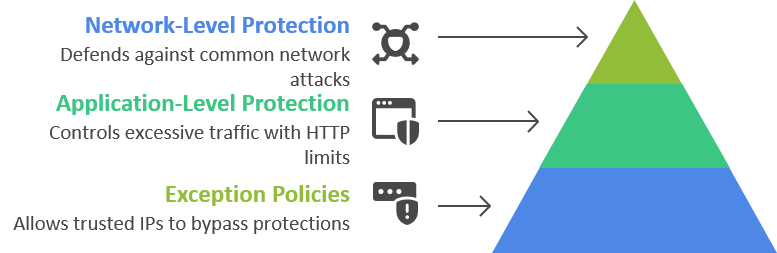
Network-Level Protection

Network-layer protections defend against lower-level attacks that aim to exhaust system or network resources.

  • TCP SYN Flood Protection

    Detects and mitigates SYN flood attacks that attempt to exhaust connection tables.

  • TCP Connection Flood Protection

    Limits excessive connection attempts that may degrade service availability.

  • TCP Slow Data (Slowloris) Protection

    Identifies slow, incomplete connections designed to hold server resources open.

  • IP Fragmentation Protection

    Protects against malformed or fragmented packets used to evade detection or overwhelm systems.

These mechanisms ensure stable network operation and prevent resource exhaustion at the transport layer.

  • Application-Level Protection

    Application-layer DoS protection focuses on HTTP/HTTPS and DNS traffic to prevent abuse targeting application resources.

    • HTTP Access Control

      Limits the number of requests or connections from clients to prevent excessive usage and resource exhaustion.

    • HTTP Connection Flood Protection

      Detects and mitigates large volumes of simultaneous connection attempts that can overwhelm application servers.

    • HTTP Request Flood Protection

      Identifies high-rate request bursts targeting application endpoints and applies rate limiting or blocking.

    • DNS Flood Protection

      Protects against:

      • DNS Query Floods – excessive DNS requests targeting the service

      • DNS Reverse Floods – abuse of reverse lookup mechanisms

    These controls ensure that application services remain responsive even under heavy or malicious traffic conditions.

  • Flexible Policy Control

    FortiADC enables granular and customizable DoS protection through policy-based configuration:

    • DoS Protection Profiles

      Define thresholds, detection methods, and actions (e.g., block, rate-limit, or monitor).

    • Exception Policies

      Allow trusted source IP addresses to bypass DoS protections, enabling fine-tuned control and reducing false positives.

    • Traffic Pattern Tuning

      Policies can be adjusted based on normal traffic behavior to balance security and performance.

For more information, see DoS Protection in FortiADC Administration Guide.

DDoS Protection

DDoS Protection

FortiADC provides multi-layered protection against denial-of-service (DoS) attacks by detecting and mitigating abnormal traffic patterns across both application and network layers. These protections help ensure application availability and service continuity under high-load or attack conditions.

Network-Level Protection

Network-layer protections defend against lower-level attacks that aim to exhaust system or network resources.

  • TCP SYN Flood Protection

    Detects and mitigates SYN flood attacks that attempt to exhaust connection tables.

  • TCP Connection Flood Protection

    Limits excessive connection attempts that may degrade service availability.

  • TCP Slow Data (Slowloris) Protection

    Identifies slow, incomplete connections designed to hold server resources open.

  • IP Fragmentation Protection

    Protects against malformed or fragmented packets used to evade detection or overwhelm systems.

These mechanisms ensure stable network operation and prevent resource exhaustion at the transport layer.

  • Application-Level Protection

    Application-layer DoS protection focuses on HTTP/HTTPS and DNS traffic to prevent abuse targeting application resources.

    • HTTP Access Control

      Limits the number of requests or connections from clients to prevent excessive usage and resource exhaustion.

    • HTTP Connection Flood Protection

      Detects and mitigates large volumes of simultaneous connection attempts that can overwhelm application servers.

    • HTTP Request Flood Protection

      Identifies high-rate request bursts targeting application endpoints and applies rate limiting or blocking.

    • DNS Flood Protection

      Protects against:

      • DNS Query Floods – excessive DNS requests targeting the service

      • DNS Reverse Floods – abuse of reverse lookup mechanisms

    These controls ensure that application services remain responsive even under heavy or malicious traffic conditions.

  • Flexible Policy Control

    FortiADC enables granular and customizable DoS protection through policy-based configuration:

    • DoS Protection Profiles

      Define thresholds, detection methods, and actions (e.g., block, rate-limit, or monitor).

    • Exception Policies

      Allow trusted source IP addresses to bypass DoS protections, enabling fine-tuned control and reducing false positives.

    • Traffic Pattern Tuning

      Policies can be adjusted based on normal traffic behavior to balance security and performance.

For more information, see DoS Protection in FortiADC Administration Guide.