

Server Load Balancing
Server load balancing is a core capability of FortiADC that provides intelligent, health-aware, and content-aware traffic steering, enabling applications to remain available, scalable, and performant under real-world conditions.
FortiADC distributes incoming client requests across multiple backend servers based on configurable load-balancing methods. These methods determine how traffic is intelligently allocated to achieve optimal performance, scalability, and availability.
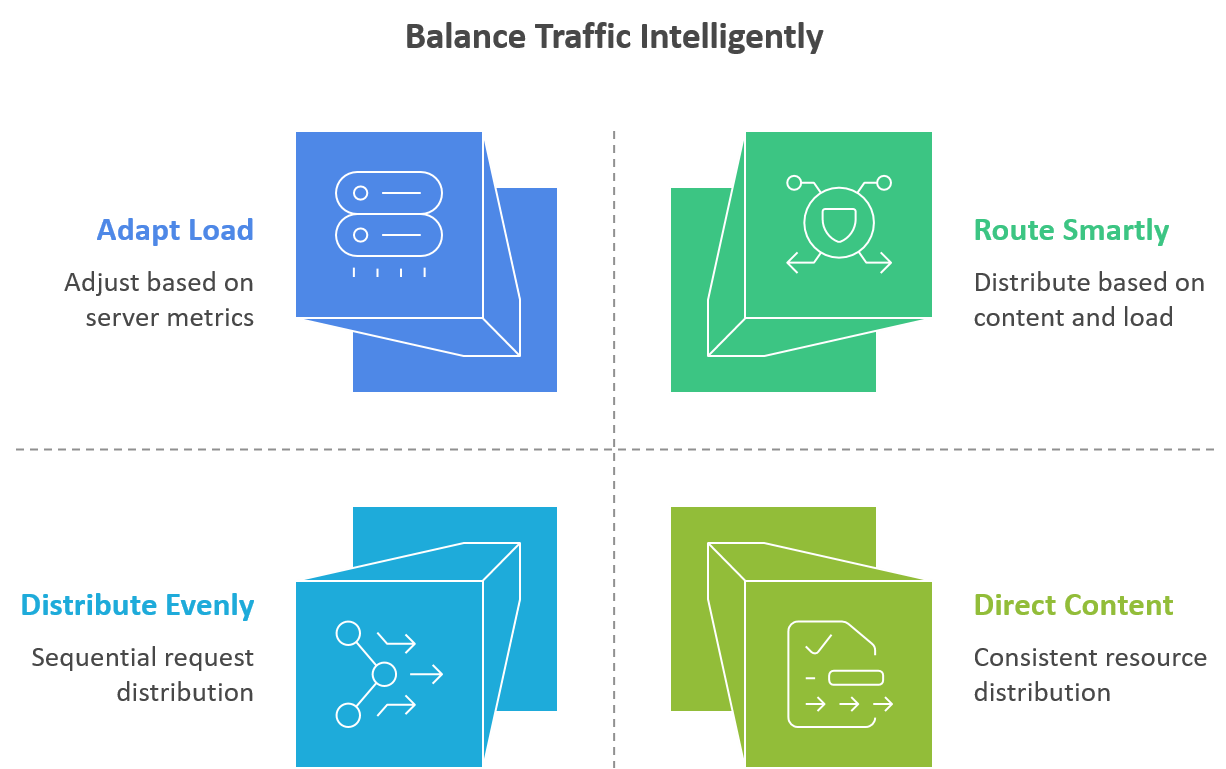
Supported Load-Balancing Methods
FortiADC supports both connection-based and content-aware load-balancing methods for Layer 7 traffic, including:
-
Round Robin – Distributes requests sequentially across servers for even load distribution.
-
Least Connection – Directs traffic to the server with the fewest active connections.
-
Fastest Response – Selects the server that responds fastest to health checks.
-
URI / Full URI Hash – Uses a hash of the requested URI (with or without hostname) to ensure consistent request distribution for the same resource.
-
Host / Host Domain Hash – Selects servers based on the hostname or domain in the HTTP Host header, enabling host-based request distribution.
-
Dynamic Load – Adjusts traffic distribution dynamically based on real-time server health metrics such as CPU, memory, and disk utilization, collected via SNMP health checks.
These methods allow FortiADC to intelligently distribute traffic based on connection load, application content, or real-time server capacity.
Health-Aware Traffic Distribution
Load-balancing decisions are tightly integrated with health checks. Servers that fail health checks or exceed defined thresholds are automatically removed from traffic distribution, ensuring that requests are sent only to healthy and responsive backend servers.
For more information, see the Server load balancing in FortiADC Administration Guide.